- Author
- Book reviewer
- Subjects
- Book reviews, History - post WWII
- Tags
-
- RAN Ships
- None noted.
- Publication
- December 2024 edition of the Naval Historical Review (all rights reserved)
Cyclone Warriors – the Armed Forces and Cyclone Tracy December 1974-June 1975. This paperback edition of 128 pages by Dr Tom Lewis is fully illustrated in colour. Published by Avonmore Books in October 2024 at a RRP of $39.95. Available via the website at avonmorebooks.com.au or (08) 8431 9780.
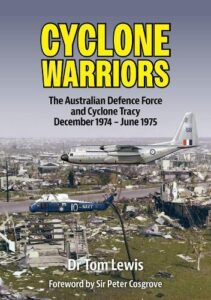 In his foreword to this timely book Sir Peter Cosgrove AK recalls as he flew into devastated Darwin as a junior Army officer, ‘seeing a goodly part of the Navy’s fleet in the harbour with ships’ boats shuttling backwards and forwards to bring hope and help to the enormously needy people overwhelmed by the wreckage.’
Beyond official reports, this story of the ADF’s role in saving Darwin has never been told as a well-researched narrative for the general public to read and appreciate. Now it has been. The author Tom Lewis lived in Darwin, while still serving in the Navy and remained as a resident for many years afterwards. He was elected as an Alderman of Palmerston and was appointed the Director of the Darwin Military Museum. His body of work on the bombing of Darwin in 1942 is now well complemented by this new book which reminds those who remember Cyclone Tracy, and reveals to those who do not, the scale of the destruction wrought on an unprepared town and its residents about to celebrate Christmas in 1974.
The three separate services, RAN, Army and RAAF, would not be badged as collectively the ADF until 1976 but they operated effectively as a joint command in the first days and weeks of this civil emergency. They were always subordinate to the newly formed and very small Federal National Disasters Organisation led by Major General Alan Stretton, DSO. He took over from the Administrator of the Northern Territory as it was the Federal Government’s resources which were required to match the scale of the disaster. None of this work was done under martial law but as military aid to the civil powers working with the Police Commissioner and his force.
Navy’s role in the relief effort was led by Captain Eric Johnston who was the resident Naval Officer Commanding North Australian Area. Operation ‘Navy Help Darwin’, which he coordinated was the urgently despatched Task Group led by the imperturbable Commodore Guy Griffiths DSC, DSO. Griffiths arrived in command of the aircraft carrier HMAS Melbourne with frigates and destroyers and Fleet Air Arm helicopters on 1 January. Many ships’ companies had been recalled from Christmas leave or responded to the call for volunteers from shore bases.
On arrival in Darwin, Wessex helicopters of 817 Squadron of the Fleet Air Arm started a six-week period of flying of an intensity unseen outside of wartime. They lifted and shifted tons of supplies every day and flew them and people to use them to where they were needed. They searched for and found the fate of missing trawlers and their crews. In 1974 the RAN’s Fleet Air Arm not only had helicopters but also had a squadron of passenger carrying HS748 aircraft in which they flew in a team of Navy Clearance Divers on 26 December. They cleared the harbour’s approaches and wharfs and raised the sunken HMAS Arrow. The same Navy aircraft joined the RAAF in flying the injured and vulnerable civilians south for treatment and care out of harm’s way, eventually evacuating all non-essential military families and those Darwin residents who chose to leave their shattered town.
In the city Guy Griffiths was photographed by the press, stripped to the waist and carrying a large baulk of timber as he joined his sailors in daily work clearing three ‘Navy’ suburbs. It made the front pages of Southern newspapers. One civilian on thanking a sailor for the endless hours of gruelling work, in body sapping heat, was met with a grin and the cheerful remark: ‘We are your Navy!’
The public of Australia expected and got exemplary service from its men and women in uniform. The book concentrates on the first intense period of rescue in January and February 1975 but also points out that Army stayed on doing infrastructure recovery until May, often using equipment, including a Bailey bridge, brought in by Melbourne. The Army’s engineers did a superb job of reconstruction to the point where they could hand the city back to civilian contractors to rebuild the much more resilient Darwin that exists today.
The book deals with all the controversies and conspiracies that occurred at the time, and have continued in the years since, particularly those that have alleged, without evidence, that there was a cover up of ‘hundreds of dead citizens’ buried secretly by bulldozers in mass graves in the desert for unknown reasons. It is worth dealing with these allegations head on so that they can be dismissed as groundless. The book confirms that 66 people died – 45 on land and 21 at sea.
Daj Hammarskjold, the second Secretary General of the United Nations, once remarked that, ‘Peace Keeping is no job for a soldier – but there is no one else who can do it.’ Post-pandemic and post bush fire, the question Australia is grappling with is whether it is the job of the ADF’s troops to meet the need when the disaster is great, and if not, who is to do it? Should troops be the first line of relief for civilians in a humanitarian disaster or only provide the back up for those who are trained and equipped for the roles in natural catastrophes? This book is a timely reminder that there are plausible disaster scenarios, far from the CBDs of cities, in which the ADF will provide the most realistic way to access and lift the public out of harm’s way by air and sea and to provide the boots on the ground to respond at scale to the need to save lives. The public expects to see uniforms hard at work in flood and fire amid shattered lives. That is not about to change partly because of the naval and military response to what happened when Tracy struck Darwin. It is held in the collective memory of the nation.
Thorough training, with the right equipment, needs to be coupled with mental preparation for those who, like Alan Stretton in 1974, will need to make quick and correct decisions from well-furnished minds. For that reason, Dr Lewis’s latest book should form part of the professional reading of those likely to lead men and women, both service and civilian, into scenes of disaster and sudden emergency.
This impeccably researched and beautifully illustrated book is strongly recommended for both those studying in military staff colleges and police academies and also for the general reader. It is a very good social history and a reminder that, on this island continent, in an age of climate change, we can expect severe and unpredictable natural events which will test the limits of all the State and Federal agencies, including the men and women of the ADF. They will no doubt be expected to emulate in skill, hardihood and endurance the efforts of those who responded when Tracy blew in, just in time for Christmas, half a century ago.
Reviewed by Lieutenant Commander Des Woods OAM RAN Rtd