- Author
- Editorial Staff
- Subjects
- None noted
- Tags
-
- RAN Ships
- HMAS Australia I, HMAS Sydney I
- Publication
- September 2025 edition of the Naval Historical Review (all rights reserved)
On Friday, 25 November 1932, Sydney newspapers reported that the Governor-General, Sir Isaac Isaacs, would unveil four memorials at Garden Island on 27 November. These were in remembrance of members of the Royal Australian Navy and the Royal Australian Naval Reserve, who fell in the Great War. The memorials, which comprised two mural mosaics and two stained windows, were erected in the Naval Chapel.
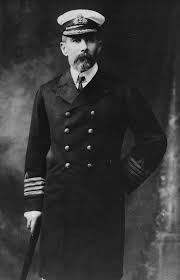
The completed memorials formed part of a scheme to commemorate the services of the crews of the 34-ships commissioned by the Royal Australian Navy for service in the Great War, with the Captain-Superintendent of Sydney Naval Establishments, Captain H. J. Feakes, overseeing the project. The mural mosaics were executed by a Melbourne firm, the only one in Australia able to manufacture them, whilst the windows were constructed in Sydney, with all four, being fine examples of their type. Naval personnel from the fleet in 1932 subscribed to the cost of one of the mosaics, whilst the other was purchased with funds raised by subscription amongst members of the Ex-Naval Men’s Association.
Remembering the Great War
Captain Feakes pointed out that, apart from the memorial to officers and ratings of HMAS Sydney, no public monument to the men of the Royal Australian Navy existed at the time. He had also suggested that a site be made available near Mrs. Macquarie’s Chair, overlooking Farm Cove in Sydney, the traditional mooring ground for the larger members of the Australian Fleet, for the erection of such a memorial.
All subscribers to the memorials were invited to attend the function on 27 November, but due to space in the chapel it was not possible to invite the general public. However, it was reported that the RAN was planning to throw the memorial open to public inspection during the Christmas holiday period.
The images on the following pages illustrate in great detail, these impressive windows and mosaics.
It highlights that the nation’s first losses in the Great War were RANR personnel at Kaba Kaul in New Britain on 11 September 1914. It also features the crest of the later, 1928-era, heavy cruiser HMAS Australia (II).
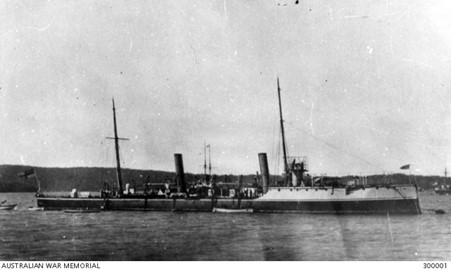
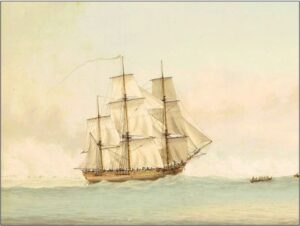
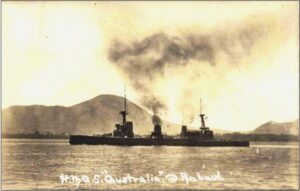
One mosaic depicts the first HMAS Australia, flagship of the Second Battle Cruiser Squadron in the North Sea from 1915 to 1919, with records of the names of those who fell in the naval engagements at Kaba Kaul, New Britain, in September, 1914, and of those who perished in the Australian submarine AE1, which was lost in St. George’s Channel, New Britain, in the same month.
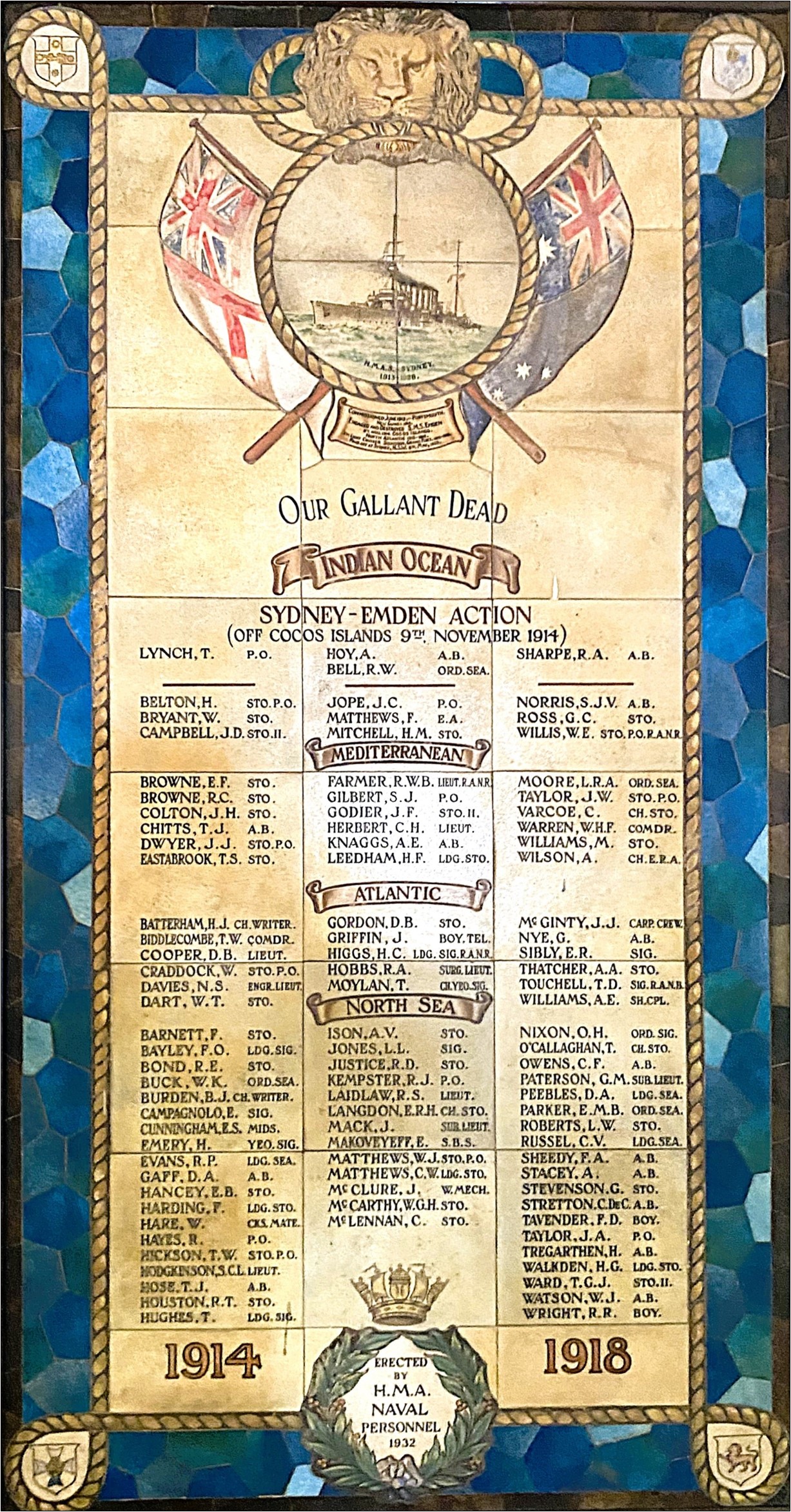
The other mosaic, below, built with subscriptions by Fleet personnel in 1932, was dedicated to the memory of “Our Gallant Dead,” and depicts the famous light cruiser HMAS Sydney. The names of those who fell in the Sydney-Emden engagement, as well as her service in the Mediterranean Sea, the Atlantic Ocean and the North Sea are shown.