By Desmond Woods OAM
During a period when a vital waterway is dominating the headlines, we may with profit recall that the entire amphibious campaign on the Gallipoli Peninsula was the unintended consequence of the inability of the British and French navies to get through the Dardanelles. It was closed with simple, but very effective, Ottoman sea mines and accurate artillery fire from shore batteries.
The Dangerous Dardanelles
The risk of attempting such an opposed operation in confined and defended waters in wartime had been foreseen ten years before by then First Sea Lord, and naval revolutionary, Admiral ‘Jackie’ Fisher. In 1904 he had concluded that attempting to run ships through the Dardanelles in wartime would be: ‘mighty hazardous.’ In 1911 Winston Churchill, as First Lord of the Admiralty, wrote: ‘it is no longer possible to force the Dardanelles, and nobody should expose a modern fleet to such peril.’ By early 1915, unfortunately as it turned out, he had changed his mind and believed that such an operation was not only possible but necessary to win the war.
Failing to keep the strategic aim in mind
Beyond the Bosphorus lay the Black Sea and the Russian ports of the Crimea. They appeared to Winston to offer a logistically difficult but possible opportunity to supply Tsar Nicholas’s vast but failing armies on the Eastern Front and keep them fighting Nicholas’s cousin, the Kaiser.
There were no easy ways of moving huge quantities of heavy military supplies from the Crimean Peninsula or Odessa to the Russian armies by road or rail. But with the Western Front deadlocked and static, it seemed to Winston and his supporters in the cabinet that opening a tenuous supply sea line from the Mediterranean through the Dardanelles was an opportunity worth seizing and within the means of the two powerful allied navies to achieve.
The risks and difficulties of the plan were minimised and the likely rewards and opportunities were exaggerated. Jackie Fisher, now out of retirement and back in the Admiralty in December 1914, as First Sea Lord at Winston’s request, hated his whole Dardanelles plan and opposed it from the outset, but to no avail. His realistic professional assessment as a seagoing officer who knew the dangers posed to ships from forts and mines were not wanted or heeded, as a wave of optimism swept the flawed endeavour forward to disaster.
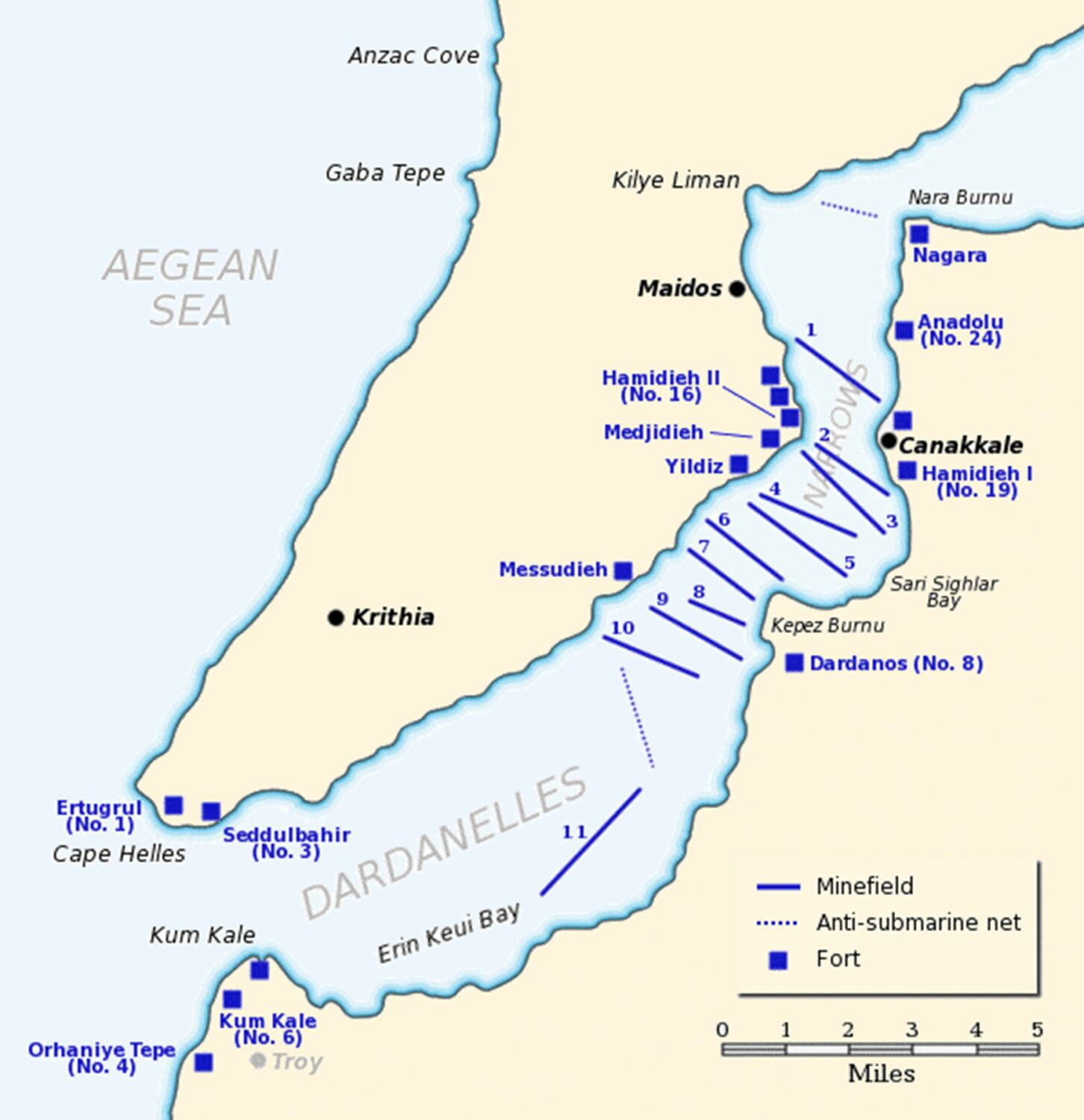
To combat the obvious problem Fisher foresaw of the narrow channel being a minefield and a maritime death trap, minesweepers were created. There were no such specialised vessels purpose built in any navies. So fishing trawlers, with their conscripted civilian British and French crews, were sent to join the combined fleet in the Aegean Sea. Their unenviable and hazardous task was to sweep mines by night and to clear the way for the warships, and later troop transports. The plan was that the combined fleet could then sail safely all the way through the Sea of Marmora up to the Golden Horn and place Constantinople under their guns and force an advantageous peace on the Ottomans. Regime change was the plan.
A Formidable Force on paper
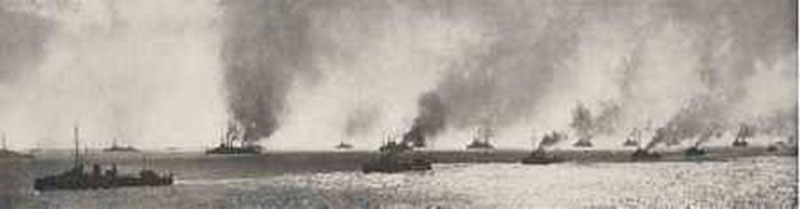
The hastily assembled combined British and French fleet was, on paper, a formidable one. It comprised the new super dreadnought HMS Queen Elizabeth, 16 pre-dreadnought battleships, one modern RN battle-cruiser HMS Inflexible, five cruisers, the seaplane carrier HMS Ark Royal, 15 destroyers, six submarines, and 35 minesweeping trawlers.
(https://www.history.navy.mil/)
Sweeping by night under searchlights
The mines that they were sent to sweep were German made and ‘state of the art’ for 1915. They were contact mines that just needed to be touched by a ship or a trawler to explode. They did so with great reliability.
In the last week of February 1915 British and French minesweepers were concentrating on clearing the main channel by night. They necessarily moved at slow speed and came under heavy artillery fire when probing searchlights detected them. One was sunk and others damaged. Morale and enthusiasm for the operation among the civilian crews dropped but, to their great credit, the nightly sweeping continued and many moored mines were detected and destroyed. Some were cut loose from their mooring wires and couldn’t be recovered or destroyed. They became drifters and remained hazardous to the fleet downstream.
Twenty Six Mines that defeated a Fleet
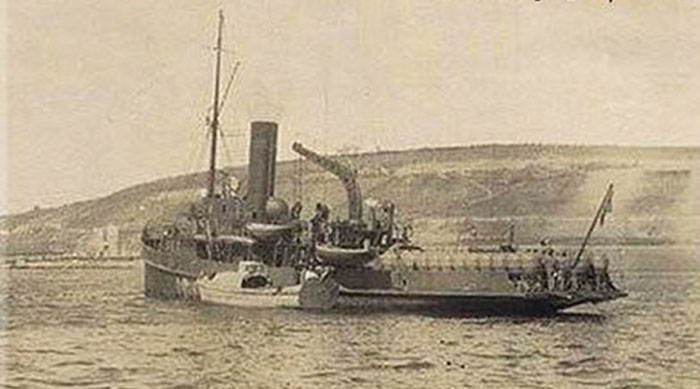
Meanwhile, the Turks had observed the normal pattern of the battleships as they turned to starboard in Erin Kevi Bay, after they had shelled Ottoman gun positions and forts, to resume their station. Consequently, the mines were placed where they were sure to be triggered by the turning battleships. On the night of 8th March, Captain Hakki Bey, in his small minelayer Nusret, laid the last 26 mines of the 350 that had been deployed since the Ottoman Empire had entered the war in October 2014. Bey moored them as ordered parallel to the shore in Erin Kevi Bay, just where the battleships turned, rather than across the main strait.
Three battleships sunk on 18th March 1915
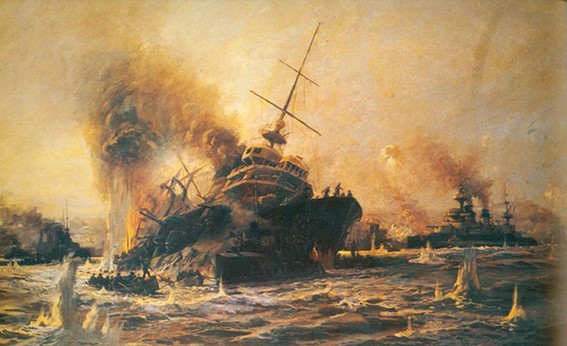
The Ottoman plan worked perfectly. Ten days later on 18th March, 1915, the French pre-dreadnought battleship Bouvet, which had stability problems and had been weakened by artillery fire, rolled over and sank within two minutes of striking one of the mines. The ship trapped and drowned 635 French sailors and officers. Only seventy survived.
Then HMS Irresistible detonated another of the mines and suffered extensive flooding which disabled her engines. Without power, the battleship began to drift into the range of Turkish guns, which laid down a withering fire on her. Attempts to tow her by HMS Ocean failed, so her surviving sailors were evacuated and the ship was abandoned and eventually sank. Around 150 crew were killed by the mine and the shelling. Ocean then struck another mine and suffered a similar fate to Irresistable. Fortunately, most of her crew were taken off the waterlogged ship by destroyers before she too sank.
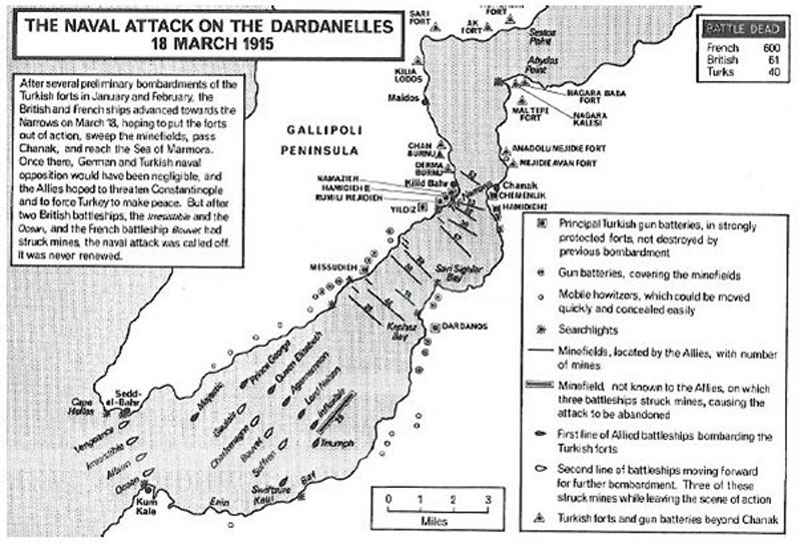
(https://www.history.navy.mil/)
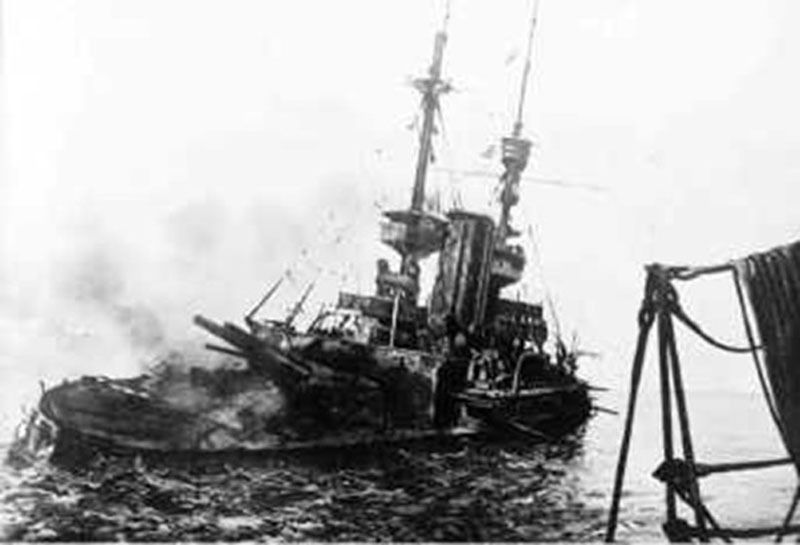
(https://www.history.navy.mil/)
HMS Inflexible – Battlecruiser crippled
These three pre-dreadnought battleships could not stand in the line of battle by 1914 and were of little practical value to their respective navies, except for shore bombardment. But the loss of over 800 sailors and officers lives in a day was serious for both Britain and France.
The striking of yet another of the Nusret’s mines the same day by the modern battlecruiser Inflexible was another matter. She was one of Fisher’s valuable new heavily armed ‘greyhounds’ for hunting enemy raiders, and with Invincible had just destroyed the two armoured cruisers of Graf Von Spee’s Asiatic Squadron, Scharnhorst and Gneisenau, in the Battle of the Falkland Islands on 8th December 1914. Her surviving the Dardanelles to fight another day mattered to the Battle Cruiser Squadron waiting at Rosyth in Scotland to take on the German High Seas Fleet in the North Sea. She had taken heavy fire during her attempt to silence mobile gun batteries. Worse was to follow.
Inflexible lost 39 sailors killed when the ship struck a fourth mine and was only saved from sinking by the swift construction of a coffer dam and beaching the ship. She was with great difficulty sailed to Malta for repairs. As predicted by Fisher the cost of the operation was becoming excessive and the risk to reward ratio was climbing steeply. Fisher resigned and returned to retirement having been unable to prevent the catastrophe he had long predicted and warned Winston not to attempt.
Firing the wrong ammunition
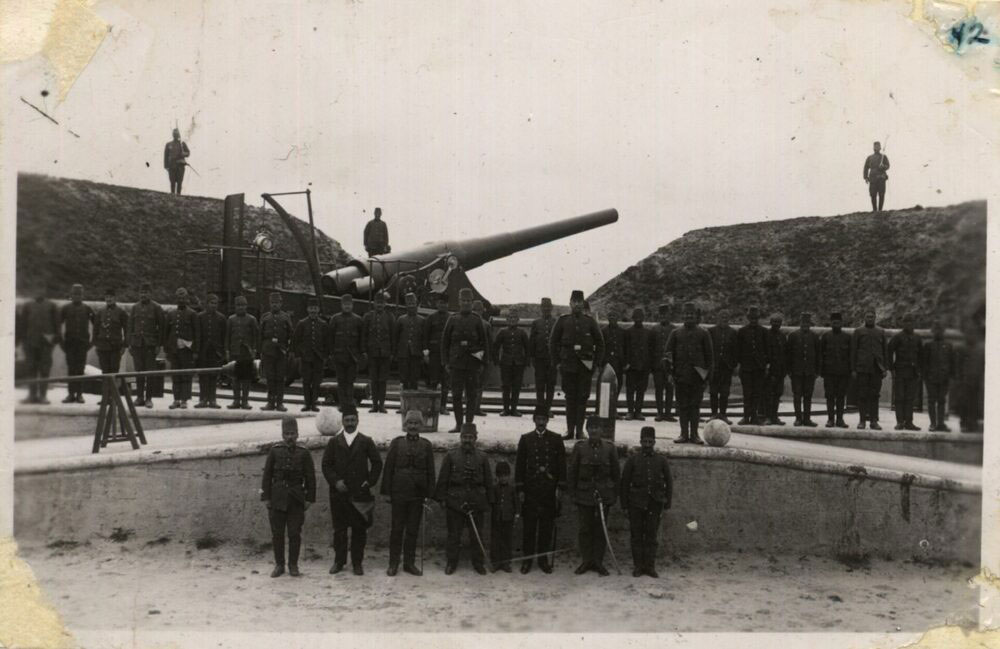
Part of the problem with the attack on the Ottoman artillery batteries was that the RN battleships and battlecruisers were firing AP (Armour Piercing) shells at the guns. These were intended for ship-on-ship action. They were designed with a delayed fuse allowing the shell to penetrate an enemy ship’s steel protecting armour plate before detonating. AP rounds did not always explode on soft ground and had to hit metal if they were to do any damage to guns or to kill their crews. Near misses by AP rounds were useless as the shells did not explode and fragment. The ships needed to be firing HE (High Explosive) rounds, but there had been too little time, or too little thought given to this problem. They were not loaded into the ship’s magazines in sufficient numbers. Someone had blundered.
‘A Ship is a Fool to fight a Fort’ – Nelson
Despite bombardment each night in support of the mine sweepers by escorting cruisers they still encountered direct fire aimed at them from well protected forts and mobile artillery. The cruiser HMS Amethyst, escorting the trawlers, lost 24 sailors killed by accurate shore battery fire.
More than a century earlier, when faced with the Danish fortress guns at Copenhagen, Nelson had commented: ‘A ship is a fool to fight a fort.’ The same dilemma faced the allied fleet in 1915.
Change of Plan
By the middle of March there was no longer any political appetite in London or Paris for trying to force the fleet all the way up to Constantinople given the near certainty of further losses to mines. Shore gun batteries could be temporarily silenced, with difficulty, but mines provided the Turks and their German assistants with, what we would call in the current parlance an Anti-Access Area Denial weapon. Plan Alpha had failed and could only be revived with the swift implementation of Plan Bravo.
Plan Bravo – The Gallipoli Landings
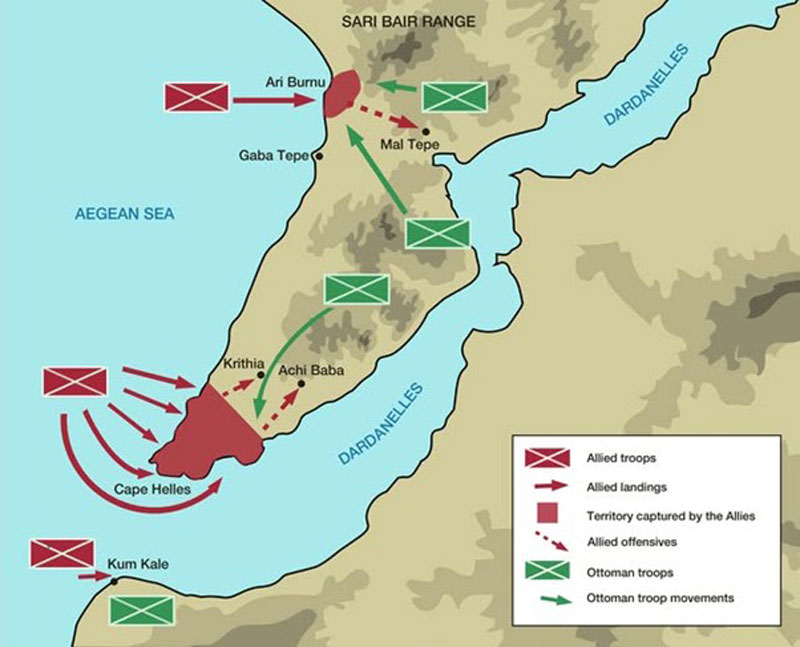
After the disasters in the middle of March it was decided by the British War Cabinet that the only way to ensure that the minefields could be cleared was to capture and neutralise the fixed and mobile gun batteries protecting them. This was to be done in a swift amphibious operation starting from Cape Helles in the south with British troops rolling up the peninsula and capturing and destroying the shore fortifications as they went. Then a decision was made to simultaneously land otherwise unemployed raw new Australian and New Zealand troops in Egypt on the Aegean coast.
Their task was to march over the high ground and take the forts and batteries facing the Narrows opposite their landing beach with infantry attacks. This was to be supported by Naval Gunnery Support from the Aegean. The French infantry was to achieve the same objective on the Asiatic side of the channel. That all sounded feasible and it was thought it would be much less dangerous than trying to sail a fleet of ‘targets’ through mine infested waters past accurate Ottoman gunners by day or by night. What could possibly go wrong with that tactical plan! It took nine months of mud, blood and trench warfare and evacuation to answer that question.
Lessons Learned from the Dardanelles
The Dardanelles Campaign was studied and taught as a case study in how not to conduct amphibious operations in staff colleges in the UK, Europe and the United States in the inter war years. The USN and the USMC made good use of it as they considered the possibility that they might be required to conduct amphibious operations in confined waters in the Pacific.
Commanders of all the great opposed landing operations 1942 – 45 considered the deadly effect that contact mines could have on their best laid plans. That was a legacy of the loss of men and their three battleships on 18th of March 1915.
The Straits of Hormuz April 2026
Most modern mines are much smarter than the contact ones which Captain Bey laid in 1915. They were in use right through the Second World War and for decades afterwards with deadly effect. The entrance to San Carlos waters in the Falkland Islands in 1982 were ‘swept’ by sailing RN frigates across it before the troop ships came in.
Many navies retain evolved versions of first generation mines. But advanced navies now have proximity mines which operate from the seabed and require no contact with the target. They work by exploding only when they acoustically detect a hull above them which their sophisticated electronics recognise as hostile. They detonate and lift a column of water up with such velocity that it breaks a ship’s back.
It is widely believed that China possesses large stocks of these acoustic seabed mines. Some may already be lying in the Taiwan Strait. They can, in theory, wait undetected for years and be activated immediately prior to operational requirement. The acoustic signature they are programmed to listen for can be a potent means of providing area denial for enemy ships while permitting Chinese ships to operate above them without triggering the mine waiting for its target.
Have the Chinese sold such smart proximity mines to the Iranians or are the Islamic Revolutionary Guard Corps relying on earlier types of mine? Both types work but the ones on the seabed are much harder to detect and to neutralise. We are told that Iranian minelaying vessels have all been destroyed by US air attack. We may be about to find out if that is true or an exaggeration.
Short Range Missile and Drone Attacks
Any attempt by the USN and other navies warships to pass convoys through Hormuz, while the Iranians have declared it closed, will expose vessels to a whole range of fast missiles and slower but cheaper and more numerous and cheaper to manufacture, drones.
The USN and several European navies have been successfully dealing with the Iranian supplied missiles and drones that the Houthis have been using in the Red Sea for the last two years. They were fired from far enough away in Yemen to allow them to be detected and destroyed. The Straits of Hormuz is much too narrow and the flight time from launch to impact is too short for guaranteed detection even for the best anti-air equipped warships.
Convoy Defence in confined waters
Defending a warship with a closed-up team of weapons specialists is a great deal simpler than taking responsibility for a convoy of high sided slow tankers which are being targeted at short range. At most six tankers could be escorted by one warship through the Straits.
The Iranian Revolutionary Guard Corps have trained for decades to use lightly armed disposable patrol boats, capable of 45 knots, to attack shipping. They used them during the ‘Tanker War’ during the Iran – Iraq War in the 1980s. We are also told that these attack boats have all been destroyed. Whether that is correct is also unknown.
The Risk Reward Ratio in the Straits of Hormuz
We need to add into this potent missile mix the possibility of fresh mines being laid at night in the very narrow doglegged Hormuz shipping channel, as fast as they are detected. Consequently, we have to assume that the US determination to open the Strait, and keep it open indefinitely, would not be without significant losses in hulls, cargos and crews. The losses would not necessarily be confined to merchant ships. If a USN ship was crippled, or sunk, with major loss of American lives then politically we would be in the realm of the unknowable as to what consequences would follow.
I suspect we are about to be reminded why there are some maritime choke points on the planet which geographically favour the defender so disproportionately that passing ships through their contested waters in wartime is the last and worst option open to a maritime power attempting to overthrow a regime. That is true whether it is the Ottoman Sultan in 1915 or the Iranian Ayatollahs in 2026. At some point this becomes obvious and another course of action has to be adopted as the risks outweigh the rewards.
Narrow waters can easily become Dire Straits
The history of war at sea does not ever repeat itself precisely. But similar circumstances can give rise to recognisable circumstances from which enduring lessons should be drawn and wise decisions taken.
Nelson’s observation remains true. In 2026 a ship is still ‘a fool to fight a fort’, or any modern combination of missiles, drones, smart mines and fast attack boats aiming to ‘burn, sink and destroy’ targets of opportunity in confined channels.
Underdog defenders have throughout history taught overconfident attackers that narrow waters can very quickly become places where ships and their crews find themselves in ‘dire straits’. Asymmetric weapons, like the mine, coastal artillery and more recently the short-range sea skimming missile and now the swarm of drones can, and have, inflicted heavy losses on well-equipped warships and experienced and capable merchant navy captains and their crew members since 1915.
There is no reason to suppose that familiar pattern of loss of life and ships is about to change in the Straits of Hormuz in 2026.