- Author
- Kingsley Perry
- Subjects
- Biographies and personal histories, WWII operations, History - WW1, History - WW2, Book reviews, WWI operations, Royal Navy, Biographies
- Tags
-
- RAN Ships
- None noted.
- Publication
- September 2026 edition of the Naval Historical Review (all rights reserved)
BOOK REVIEW
SALT IN HIS VEINS
The life of Vice Admiral Sir Albert Poland KBE CB DSO DSC
Author: Vice Admiral Peter Jones AO DSC RAN
Published by: Fonthill Media, £22, 248-pages, softback
Reviewed by: Kingsley Perry
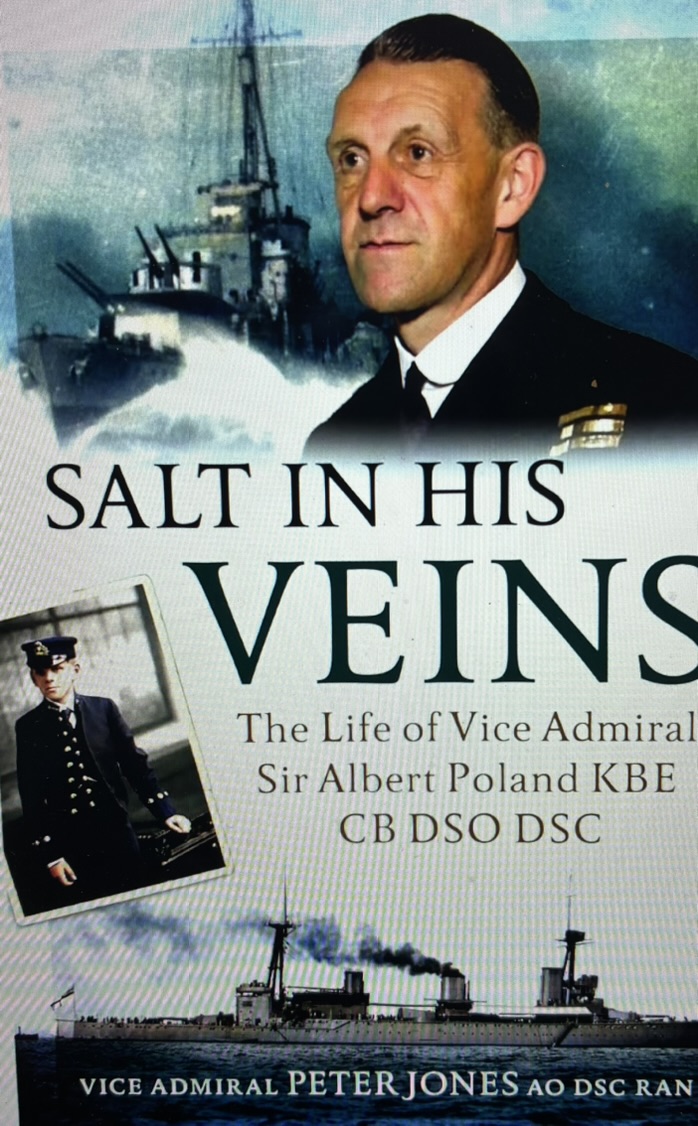 This is a lively story, combining biography, family, naval life (mostly in wartime), and history. It is said to be about the life of the subject, but it goes beyond that and moves well into the realm of his life and times.
Vice Admiral Sir Albert Poland (1885-1967) (known as ‘Patsy’ and as ‘Bertie’) had a varied and exciting naval career that spanned both world wars. As a young midshipman he took active part in the North Sea battles, including Jutland, and later in torpedo boats around the English Channel. And then just after WWI he was in the Black Sea during the Russian Civil War, and then to the China Station, the Mediterranean and to the Persian Gulf. In no time, WWII was upon him. Now well versed in command of destroyers, he took part in the ill-fated Norwegian campaign, the Tobruk campaign (which included the Scrap Iron Flotilla), back to the Mediterranean area (including the Battle of Sirte and the battles in the North Africa and Malta convoys), and then to service in the East Indies Fleet in the Indian Ocean leading up to the Japanese surrender.
His story is told with reference to his family, his naval college term-mates, the many officers with whom he served and, of course, his own involvement in wars. At the same time, detailed and interesting descriptions are given of the more significant operations or battles in which he was involved, and there are some handy maps. There is, of course a lot more action than this to his naval story – interesting but too much to fully itemise or describe here. It was said he had more bombs aimed at his various ships than any other naval officer. Throughout his service he was appropriately promoted, eventually to Vice Admiral, received a knighthood, and he was clearly well liked.
As for family, he had three sons who, like him and his forebears, had salt in their veins. During WWII there were ten of his relatives in naval service. In September 1956, his son Patrick became the 17th Poland to join the Navy. His second son, Peter, served as an officer in the RN as well as the RAN.
The book is well set out and, with all the narrative and background, is an interesting and easy read. It has been thoroughly and well researched, some evidence of which is disclosed in the long list of endnotes and the bibliography. The author acknowledges the assistance by the Poland family in providing what must have been extensive records such as journals, letters and photographs. Indeed, skipping through the many photographs before setting out to read the book might well create a handy picture, as it were, of what is to come. This is the definitive story of an interesting, committed and capable officer and family man.
The author is clearly well equipped to write a book like this. During a 40-year distinguished career he has developed a thorough grasp of the subject and its environment. Since his retirement he has been an Adjunct Professor in the Naval Studies Group at the University of NSW (Canberra) at the Australian Defence Force Academy.
Afterword
The mention of Bertie’s son Peter Poland might remind some readers that Peter was a long-term member of the Naval Historical Society, and a historian and author. There is a biographical note about him in the NHS Occasional Paper No. 206 (2026).