
This book was published by the Naval Historical Society Australia in 2026.
Price $70 includes packing and postage within Australia.
Available via the society website: www.navyhistory.au
Review by John Mortimer
Ross Gillett has been a prolific author on naval matters especially of an historical and current affairs nature. His major works include “Warships of Australia”, “Australian and New Zealand Warships 1914-1945”, “Australian and New Zealand Warships since 1946” and a very large format book commemorating “The Royal Australian Navy – The First Seventy-Five Years” with 26 paintings by the noted Naval Artist Phil Belbin. Ross has been a regular contributor to the Naval Historical Society and edited “The Navy” and “Australian Warship” magazines.
Structure of the book is divided into chapters on: Background 1948 to 1949, The Korean Years 1950 to 1954, The Highs and Lows 1955 to 1959, Confrontation 1960 to 1964, Vietnam 1965 to 1969, and An End to Conflict 1970 to 1972. The content is much broader than is inferred by the chapter headings and provides a very detailed overview of what the Navy was doing in its broadest context. The author provides an overview as an introduction to each chapter outlining the strength of the Navy, as well as other major considerations or challenges being addressed in the period. Most aspects of naval activity are covered, including operations, exercises, command, technical issues, logistics and personnel.
When reading the numerous stories on the Navy’s activities during the period 1948 to 1972, it is obvious that the author has identified many unusual events pertaining to the “Senior Service”. For this period the author has used two principal sources: the Navy’s official Australian Station Intelligence Summary, with 12 reports published annually throughout most of the 1950s, and the Navy League of Australia magazine “The Navy,” featuring a summary of activities and personnel movements. From these starting points the author has researched deeper into the RAN’s movements via “Navy News”, the National Library’s TROVE newspaper reports, liaison with former naval personnel and the services official Reports of Proceedings to generate the hundreds of stories that are featured in chronological order.
The text is complemented by a vast array of images including mostly photographs of ships, aircraft, people and events. Also included are newspaper cuttings, extracts from Reports of Proceedings, other official documents and media releases.
Coverage of this book takes the readers from the end of World War Two, as the nation transitioned to the post war period. It witnessed the reduction of personnel and the laying up of many ships or their modernisation to adopt new technologies and revised strategic circumstances. It covers the introduction of aircraft carriers and their organic aircraft, the purchase of guided missile destroyers and Oberon class submarines, as well as the growth in missile equipped ships fitted with Seacat, Ikara and, the early stages of what would evolve into the Standard family of air defence missiles. It takes the reader through to 1972 and the period when the Navy transitioned from having a Department and Minister to a time when their whole organisation was consumed within the broader Defence portfolio and a single Minister for Defence. This change witnessed the reduction of internal Navy skills as some of its former personnel were consumed by Defence, or functions were ceased in terms of efficiency measures, and as the Defence Department increasingly came to rely on consultants.
Later reorganisations extended these reductions especially through the Commercial Support Program and the Defence Reform Process. This eventuated in Navy’s loss of engineering and naval architecture skills with the demise of the Naval Technical Services organisation. Navy also faced more limited access to scientific support, such as that provided by the RAN Research Laboratory, RAN Trials and Assessing Unit and analytical studies, such as the Central Studies Establishment.
One cannot help but observe the ease with which new capabilities such as the DDGs and Oberon class entered service in such a short period compared to the more lengthy and complicated process we now see with the AUKUS submarine and Hunter frigate programs.
I thoroughly recommend this book, especially to those with an interest in naval activities, naval history and defence policy. This book is one of a small cohort which explains to others what a Navy does in both peace and time of conflict. I am sure this book will revive very fond memories of former naval personnel of the good times they enjoyed in naval service. Many will enjoy the book just for the extensive range of interesting photos.
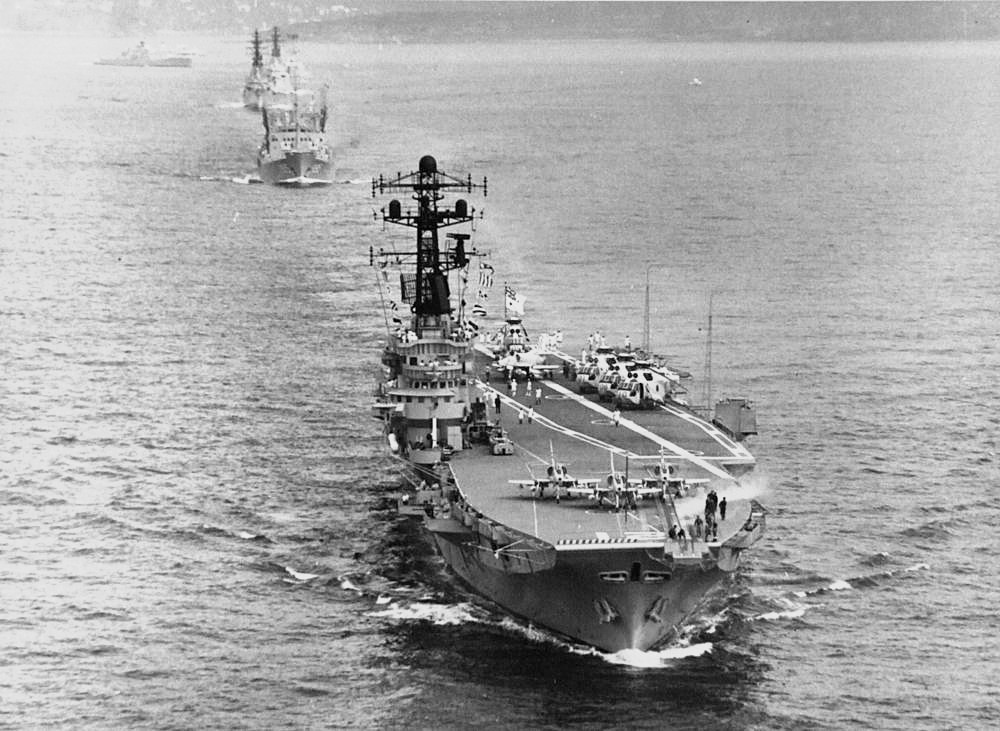 Formation of RAN ships in 1970s, In order, front to rear, HMAS Melbourne, HMAS Supply, HMAS Brisbane & HMAS Perth. Courtesy, City of Sydney Archives & History Resources