
• Skip to primary navigation
  • Skip to main content
  • Skip to primary sidebar

Naval Historical Society of Australia

Preserving Australia's Naval History

  • Events
  • Account
  • Members Area
  • Volunteer
  • Donate
  • Contact us
  • Show Search
  • 0 items
Hide Search
Menu
  • Home
  • Research
    • Where to start
      • Research – We can help!
      • Self help
      • Naval Service Records
      • Library
      • Related Maritime websites
    • Resources
      • Articles
      • Videos
      • On This Day
      • Podcasts
      • Australian Military Ship Losses
      • RAN events on a  Google Earth Map
      • RAN Vessels – Where are they now?
      • Related Maritime websites
    • Other
      • Newsletters: Call The Hands
      • Occasional Papers and Historical Booklets
      • Books
      • HMAS Shropshire
      • Book reviews
    • Close
  • Naval Heritage Sites
    • World Heritage Listings
      • Cockatoo Island
    • National Heritage Listings
      • HMAS Sydney II and the HSK Kormoran Shipwreck Sites
      • HMVS Cerberus
    • Commonwealth Heritage Listings
      • Garden Island NSW
      • HMAS Watson
      • HMAS Penguin
      • Spectacle Island Explosives Complex NSW
      • Chowder Bay Naval Facilities
      • Beecroft Peninsula NSW
      • Admiralty House, Garden and Fortifications
      • HMAS Cerberus
      • Naval Offices QLD
      • Garden Island WA
      • Royal Australian Naval College ACT
      • Royal Australian Naval Transmitting Station ACT
    • NSW Heritage Listings
      • HMAS Rushcutter
    • Close
  • Naval Art
  • Tours & Cruises
    • Navy in Sydney Harbour Cruise, East
    • Navy in Sydney Harbour Cruise, West
    • Sydney under Japanese Attack – 1942
    • Rose Bay Naval History Walk
    • Tour Bookings
    • Close
  • About us
    • About Us
      • What we do
      • Our People
      • Office Bearers
      • Become a volunteer
      • Our Goals and Strategy
    • Organisation
      • Victoria Chapter
      • WA Chapter
      • ACT Chapter
    • Close
  • Membership
  • Shop
  • Become a volunteer
  • Donate
You are here: Home / Article topics / Naval history / Infrastructure and Facilities / Celebrating 80-years of service; The Captain Cook Graving Dock Sydney

Celebrating 80-years of service; The Captain Cook Graving Dock Sydney

Editorial Staff · Mar 3, 2025 · Print This Page

Author
Editorial Staff
Subjects
Infrastructure and Facilities
Tags
Captain Cook Graving Dock
RAN Ships
None noted.
Publication
March 2025 edition of the Naval Historical Review (all rights reserved)

In March 2025 the RAN and Garden Island celebrate the 80th anniversary of the famous Captain Cook Graving Dock. This immense piece of ‘naval hardware’ has always been the most popular item on the Society’s tours of Garden Island, conducted by our many volunteers.

Looking back

When the first flagship of the new Royal Australian Navy, the battlecruiser HMAS Australia, was docked locally for the first time in May 1914, she was placed into the Sutherland Dock at the Commonwealth Naval Dockyard at Cockatoo Island in Sydney.
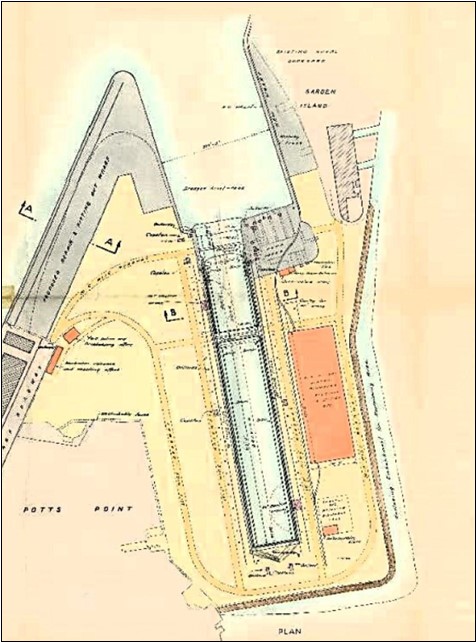
Proposed layout of the Captain Cook Graving Dock. NHSA

 When the Sutherland Dock was completed in 1890 it was one of the biggest graving docks in the world, yet it needed to be enlarged to accommodate the new battlecruiser. In the report on his Naval Mission to Australia in 1919, Admiral of the Fleet, Viscount Jellicoe of Scapa, discussed the need for improved docking facilities in Australia. However, nothing was done to improve such facilities for RAN for nearly two decades.

Then in December 1938 the Commonwealth sought advice from the United Kingdom on the site and design for a new dock capable of docking the largest capital ships and merchant ships like Cunard’s Queen Mary. Appointed to advise on sites and designs, Sir Leopold Saville of Sir Alexander Gibb and Partners, recommended that the dock be built between Garden Island and Potts Point on Sydney Harbour. The plan was approved by the Australian War Cabinet on 1 May 1940.

Herbert McClintock’s sketch of the graving dock under construction. Courtesy AWM

Site work began in mid-1940, with building of a large cofferdam in December to enclose about 13.4 hectares of Sydney Harbour. Work on the construction of the dock proceeded night and day, seven days a week, and by July 1943 the workforce on the project peaked at 4,125.

By the end of 1944 the new dock was almost complete – a massive achievement in the difficult times of World War II. The first ship to use the dock was the Royal Navy aircraft carrier HMS Illustrious on 2 March 1945 and the dock was officially opened on 24 March 1945 in time to serve the carriers and battleships of the British Pacific Fleet and the ships of the RAN for which it had been built.

The dimensions of the new dock, named the Captain Cook Graving Dock, were a little bigger than those recommended by Jellicoe in 1919, with a length of 1,139 feet 5 inches (347.29 m) and a width of 147 feet 7½ inches (45 m). It had an intermediate caisson enabling the dock to be divided into two. Since March 1945 the dock has been in continuous use.  As well as RAN ships, naval vessels from Britain, France, New Zealand, the USA and Pakistan have used the dock. Many commercial vessels ranging in size from tugs and ferries to cruise ships have also been docked there.

Today the dock is a major national strategic asset.


Naval Historical Review, Infrastructure and Facilities Captain Cook Graving Dock

Primary Sidebar

SUBSCRIBE

Sign up for our monthly e-newsletter.

  • This field is for validation purposes and should be left unchanged.

Categories

Latest Podcasts

  • The Fall of Singapore
  • HMAS Armidale
  • Napoleon, the Royal Navy and Me
  • The Case of the Unknown Sailor
  • Night of the midget subs — Sydney under attack

Links to other podcasts

Australian Naval History Podcasts
This podcast series examines Australia’s Naval history, featuring a variety of naval history experts from the Naval Studies Group and elsewhere.
Produced by the Naval Studies Group in conjunction with the Submarine Institute of Australia, the Australian Naval Institute, Naval Historical Society and the RAN Seapower Centre

Life on the Line Podcasts
Life on the Line tracks down Australian war veterans and records their stories.
These recordings can be accessed through Apple iTunes or for Android users, Stitcher.

Video Links

  • Australian War Memorial YouTube channel
  • Royal Australian Navy YouTube Channel
  • Research – We can help!
  • Naval Heritage Sites
  • Explore Naval Art
  • About us
  • Shop
  • Events
  • Members Area
  • Membership Renewals Update
  • Volunteer
  • Donate
  • Contact us

Follow us

  • Facebook
  • YouTube
  • Members Area
  • Privacy Policy

Naval Historical Society of Australia Inc. Copyright © 2026