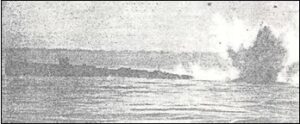
- Author
- A.N. Other
- Subjects
- History - Between the wars, Submarines
- Tags
-
- RAN Ships
- HMAS J5, HMAS J1
- Publication
- June 2025 edition of the Naval Historical Review (all rights reserved)
Intricate Machinery and its Use in War
Talking to Ships at the Bottom of the Sea
By A.C.C.S., ‘Sunday Times’ – 20 July 1919
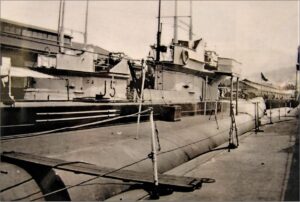
“Just about the greasiest job I ever took on,” said the photographer, as his grimy but radiant face reappeared above the hatch of the conning tower of HMAS J5 as the vessel lay alongside HMAS Encounter, her foster mother for the time being.
In order to inspect this unit of the Commonwealth Naval Forces, a representative of the ‘Sunday Times,’ accompanied by the camera man, duly armed with flashlight apparatus, paid her a visit last week as she lay in Farm Cove. Tied up to the parent ship, she looked in the distance like nothing else so much, perhaps, as a big baby whale cuddling up to its monstrous mother for protection.
A warlike vessel
The illusion, however, ends on closer inspection, when it is obvious that this baby is extremely warlike. We know that she can fight grim battles against overwhelming odds onher own. Deep down in her vitals she carries an armament of torpedoes capable of sinking leviathan battleships protected by armour-plate, whilst on her superstructure with predatory snout tilted aggressively, squats a vicious-looking gun that can tackle sea or air craft with equal ease.
Lying thus, rocking gently to the swell, and dwarfed by the man-o’-war at her side, with little else showing save her steel decks almost awash and her pulpit-like conning tower, J5 does not give the impression of deadliness and power that this class of vessel has earned for itself in the war; but come below, and you shall see the stored-up energy that makes a submarine so dangerous.
To begin with, none save a fit man and a tolerably slim one should attempt to negotiate a submarine’s hatchway. The only means of ingress proved is a perpendicular steel ladder, exceedingly greasy – and slippery at that, which leads down to a very narrow shaft some 20-feet deep into the bowels of the boat.
Our guide, Lieut. R. Pierson, DSC, the amazingly youthful-looking commander of J5, disappeared below like a streak of lightning, betokening much practice. The pressman followed gingerly, bumping faithfully with head or knees, or both, every projection enroute. These seemed to be innumerable.

Postcards taken aboard one the J class boats, with the original captions.

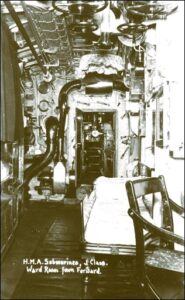
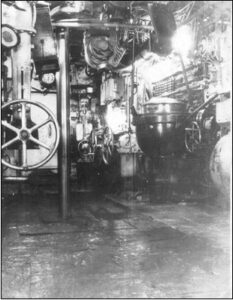
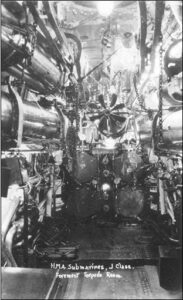
The Box of Tricks
“I suppose you would like to see the whole box of tricks,” said the Commander, as he bustled forward to the torpedo chamber, whilst we scrambled along as best we could after him, punctuating every yard of the painful journey with bumps against unseen and unexpectedly low pipes, wheels, switches and the like. The interior of a submarine at first sight appears to be one vast conglomeration of machinery.
It lies closely packed on either side, whilst overhead is an intricate mass of tubes, electric wiring, motors, clutches, valves, gyroscopes and the thousand and one parts that go to make up the modern oil engine. The stamp of power is overall, deadly power, whilst the shiny brightness of all metal parts and the fresh unscratched paintwork is such as only the Royal Australian Navy can show.
The Torpedo Chamber
The torpedo chamber is up in the bows of the boat, a low complicated looking space packed full of sudden death. Forward there were four tubes, all loaded, ready for use, and four more torpedoes are slung up on the sides in reserve. “They contain 350-lbs of high explosive,” said our guide, nonchalantly tapping one of the huge ‘tin fish’. The name of the explosive is apparently a state secret, for enquiry on the subject proved the Commander reticent. Not without cause do we call ours the silent Navy! The torpedoes are fired by compressed air, and it is not necessary for anyone to be in the chamber at all during firing, as the operation can be performed from the bridge or the control room amidship by merely pressing a button.
Each of these great steel cylinders of potted destruction is some ten or twelve-feet in length, and about four-feet in circumference, and is worth £1000. There are twelve of them aboard. It costs something to wage war with such ‘missiles’, and one must be tolerably sure of one’s mark. We learn that J5, in spite of several shots at U-boats in the North Sea, managed to bag one.
A torpedo cannot be recovered normally in wartime after an unsuccessful run, as it is set to sink to the bottom to prevent an enemy retrieving it; but we learn that in the Sea of Marmara one of our submarine commanders did, on several occasions, under the eyes of the enemy, set his torpedoes to float, thereby successfully recovering them after having missed the target. Our guide added: “I know chaps who just jumped overboard after one, and the Turks were generally scared too stiff to stop us. Spoken in a drawling, languid way, this all sounded delightfully simple and safe but remember that a torpedo has a warhead, and if it comes in contact with anything hard annihilation follows!
The Hydrophone
If there was secrecy about torpedo explosives, there was dramatic mystery about an instrument designated the hydrophone. Stripped of all technicalities, it is possible for those aboard a submarine in the depths of the sea to detect the presence of other craft around them. The hydrophone does more than this. It enables an expert, from the note produced in the instrument, to gauge the whereabouts of the other ship, and to estimate its size and speed and many other points.
The business end of this wizard machine was carefully sewed up in thick canvas in the officer’s wardroom. “Just to keep one from bumping one’s head, don’t you know,” politely explained the Commander. In spite of this touching solicitude, one could not help feeling suspicious that there were other more material reasons for concealment. Apparently, the apparatus consists of two diaphragms on the outside of the boat which transmit sound waves to a delicate registering instrument aboard, which can in turn be read by a trained man with almost mathematical accuracy, the tone of the note produced being the determining factor.

A Talking Machine
If this seems wonderful, what shall one say about the Fessenden Gear, to which we were introduced next. Here is an instrument that enables a submerged submarine to talk to other submarines in Morse code at a range of five-miles or so. Lieut. Pierson worked a machine which emitted a penetrating sort of honk, like a motorcar horn. That was all. Yet that miraculous honking must have saved thousands of lives and millions of tons of shipping in the late war. “The enemy had the Fessenden gear before us,” offered our guide, “and the hydrophone, for the matter of that, too.”
Then, as another means of communication there is the wireless apparatus. The Commander waxed eloquent and enthusiastic over this. It was evidently a favourite with him, and one gathered such words of praise as “Absolutely up to date.” “Very powerful,” and so forth. Enclosed in a little dogbox of a place off the control chamber, it seemed somewhat uncanny to hear that this wireless outfit had a range of 600-miles.
Before seeing all these “Jims,” as our guide somewhat irreverently described these various instruments which render communication between submarines possible, one had always imagined this class of warship groping about blindly at the bottom of the sea at the mercy of currents and so forth; but it is quite clear that such is not the case, and that submarines can maintain formation below just as accurately as surface ships can above.
Ship’s Nerve Centre
The nerve centre of the ship is her control room. From here radiate thousands of wires, tubes, and other parts of the vastly complicated Vickers submarine engine, which is capable of developing a hundred horsepower per-cylinder, and in this case has two engines of 12-each. These engines worked three propellers, which are all independent. This is just as well, for after bucketing about the North Sea for years, and surviving every test, one of the propeller shafts of J5 broke near Aden on her recent voyage out to Australia. She could still proceed with her other two propellers, but was towed at times.
The noise in the engine-room when the engines are running is deafening, yet the ship’s crew, which numbers 40, sleep right alongside the machinery. The bunks are in tiers, and how the men manage to get in and out of them remains a mystery. It is interesting to know that whilst one has to shout to make oneself heard against the roar of the engines, sleeping men awake with a start if they stop, and find it difficult to get repose in a quiet room ashore when on leave.
An Excellent Crew
One could not help admiring the good stamp of sailor comprising the crew. Picked men, we were told, and they looked it. In place of the tense, nervous, drawn expression one might reasonably have expected on the faces of the officers and men who for years have lived within hourly call of death, one found instead an infectious sort of gaiety and camaraderie not met with usually to such a great extent on a large battleship or cruiser. The crew are paid 2/- a day extra, submarine pay, “and, by Jove, they deserve it!” was the comment of the Commander. Submarine officers similarly draw 6/- a day extra, and one is quite sure they, too, deserve the extra remuneration.
The officers’ wardroom is in no sense elegant or luxurious. A table one side, tiers of bunks the other, and a few shelves complete the furnishings. “Yes, a chap can tumble out of bunk at eight and have breakfast straight away,” says the navigating officer, Lieut. Sim, DSC, who joined our party. Lieut. Sim represents the mercantile marine, and he received his decoration for good work in locating and placing mines in the North Sea. It was interesting to note the splendid spirit of good fellowship obviously prevailing between the RAN and the RANR officers aboard. Personality counts, and provided an officer is a decent fellow, he gets as good a spin in the RAN as anyone else.
The cooking for officers and men is done electrically, and, despite rumours to the contrary, they all fare pretty well. One thing missing apparently is a refrigerator for keeping fresh meat and other food. Enemy submarines had such things, we are told and run the freezer off the engine exhaust. It seems a pity that something of the same sort could not be installed on our own submarines, which remain below the surface of the sea occasionally as long as 24-hours on end and may be away from a base independently for 15-20-days or more on patrol.
A Big Ship
It was only after one had traversed the full length of J5 below that one realised what a very big ship she is in reality; therefore, it is not surprising to learn that she is 275-feet in length and has a surface displacement of 1200-tons. Yet this unwieldy great cylinder is as sensitive and fragile as a watch, almost, crammed full of high-power electric plant capable of generating 220-volts and carrying a multitude of bottles of compressed air showing a pressure of 2500-lbs each. J5 is just energy in tabloid form from bow to stern. The pity is that all this ingenuity should be concentrated on destruction alone.
Seated around the wardroom table, over a pipe, we discussed the life aboard a submarine. During the war there was a great rush to serve on them. There is not so much of a rush in peace time, yet the separate commands just suit the ambitious young officer.

If a submarine’s quota of officers pulls well together, and they nearly always do, life can be very jolly indeed; but if they don’t, existence in an undersea boat can be utterly impossible. In such cases the only remedy would probably be for the whole personnel to be changed.
A Crash Dive
We heard of concerts aboard whilst J5 lay bumping on the bottom of the sea, of wonderful sights of enemy ships split in half in the act of sinking as seen through the periscope, and with no photographer handy to secure a record. Then for our benefit was enacted the procedure for what is known as a ‘crash dive.’ Imagine that the officer and lookout man on deck see some menace that calls for immediate action. The orders for immediate submerging are telephoned down, and the men on deck themselves leap down the conning tower in order not to be shut out.
Simultaneously with the order a loud rattle is sounded on board, which is the signal for everyone to spring to his special post. Hatches are closed, tanks filled, and in 45- seconds the submarine can be completely submerged. Woe betides the luckless inmates of the ship if saltwater gets into the engine room from the conning tower hatch. Chlorine gas is created if it does, and this makes life below intolerable.
Chances of Rescue
Questioned as to the chances of the crew of a submarine being rescued if she failed to rise to the surface from below, the commander told us that it might be possible to blow out the tanks and go full speed ahead and gradually work up to the surface, or, failing this, as a last desperate effort to save some of the crew, to let water into the conning tower shaft and neutralise the pressure of the water outside, and then shoot as many men as possible up to the surface through the open hatch. This would be a desperate chance, but has actually been resorted to in at least one recorded instance.
We were told of the effect of a depth charge dropped near a submarine, how the dull, heavy detonation shakes the craft, and, if severe enough, may put out all the lights, or worse still, stave in the sides, and thus end the chapter, so far as the submarine is concerned. But don’t you think our submarine sailors deserve that 2/- a day extra?