- Author
- A.N. Other
- Subjects
- None noted
- Tags
-
- RAN Ships
- HMAS Vendetta II, HMAS Queenborough, HMAS Vampire II, HMAS Voyager II, Tribal Class destroyer
- Publication
- March 2025 edition of the Naval Historical Review (all rights reserved)
By Walter Burroughs
In late 2020 the Naval Historical Society was approached by colleagues from across the Tasman for help in finding a Mortar Mark 10, required for their naval museum at Torpedo Bay, near to Devonport, in Auckland. The well-known, and now retired, Naval Armaments Officer Robert (Bob) Curran was consulted. Bob knew of an ex-RAN anti-submarine mortar held by the Cowra War, Rail & Rural Museum, also known as the Cowra Fun Museum.
Investigating
After further research we discovered that the Cowra Museum had closed in 2017. The display equipment was then auctioned by Burns & Co of Mildura and the items dispersed far and wide. Listed in the catalogue held by the museum was an anti-submarine mortar, ex-HMAS Tobruk. Bound by confidential agreements, the auction house was unable to say who had purchased this equipment.
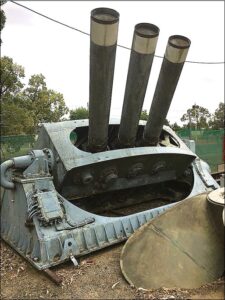
As there was a change in configuration between the RAN’s two mortar systems, carried by HMA Ships Anzac and Tobruk and, the later HMAS Vampire, closer inspection revealed that the mortar held at the Cowra museum was in fact the subsequent Limbo system, whereas Tobruk fired the earlier Squid system. The probable origin of the Cowra mortar was that it came from Vampire, when converted to the training role in 1980 and the Limbo system removed. This weapon quite likely ended its days at a store’s depot awaiting disposal.
Local help
With the trail going cold the helpful local newspaper, The Cowra Guardian, agreed to run an advertisement under the banner, ‘The Navy Needs Your Help’, with a précis of the story. Within days this had been picked up by a sharp-eyed local resident, John Davidson. John’s twin brother, Geoff, had made his name as a weapons system engineer and served at Garden Island, on exchange in the United States of America, and later with the Department of Defence.
Now retired in Canberra, Geoff kindly telephoned this writer, saying, he recalled, in about 1998, coming across some old weapons at the Moorebank Depot destined for scrap. Thinking of a more dignified end to these historic relics, Geoff contacted Ron Horsfall, who ran a museum at his hometown of Cowra. Ron agreed to take the mortar, at no charge, but the museum paid for transportation.
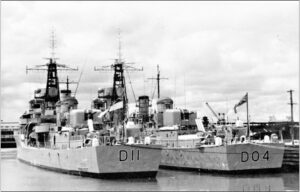
So, by August 2021 we could now claim to have tracked down a Mortar Mark 10 (most likely from Vampire) for our Kiwi cousins. However, its final resting place remained a mystery for a few more years.
Eventually the mortar was located at Yarralumba Play Station, at the Weston Park Railway. Established in 1973, the railway first ‘chugged to life’ with ‘a little red train’ and quickly became a favourite for the local children. Over time the track was extended and changed from an oval to a figure eight. A new train, named ‘Bluebell’, was also commissioned to be built by the Bermagui Foundry. Later, the carriages had canopies installed to help keep the sun and light rain at bay. ‘Bluebell’ would journey past some Full-size 1910 railway carriages, the Lake Walter mini-golf courses, and the 60-plus-year-old Limbo anti-submarine mortar from the Daring class destroyer Vampire.
From Hedgehog to Limbo
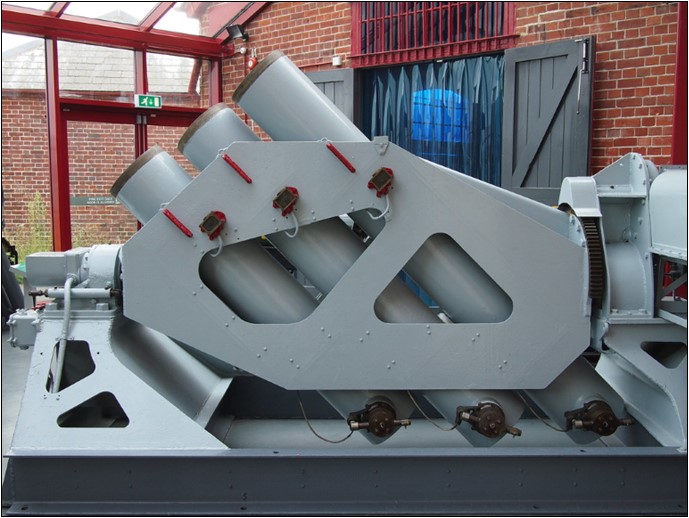
During the development of ship-based anti-submarine mortars, the first system, known as Hedgehog, was initially deployed in 1942. Used widely during the Second World War, it was eventually replaced by the Squid three-barreled depth charge mortar, armed with a much larger explosive charge. The final phase of this development was the Limbo depth bomb mortar, also known as the Mortar Mark 10 (MM10).
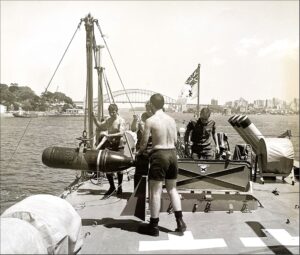

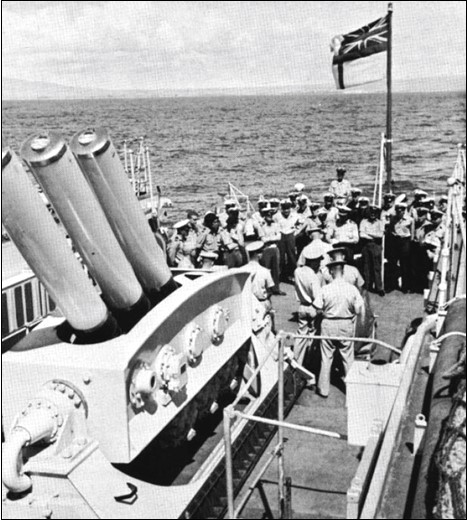
Limbo was loaded and fired automatically with the crew under cover, and was stabilised in pitch and roll. The firing distance of the mortars was controlled by opening gas vents, with rounds able to be fired from 400 to 900-yards. The weapon was linked to the sonar system of the ship, firing on command when the target was in range. The rounds were projected so that they fell in a triangular pattern around the target in any direction around the ship.
On British warships the total system weight was 35-tons, including 51-projectiles (17-salvoes). Limbo offered an improved range from Squid’s 300-yards, to Limbo’s 900-yards.
Australian Fleet usage
Squid was originally fitted to the first Australian post-war destroyers, Anzac and Tobruk, as well as the modernised anti-submarine destroyers, HMA Ships Arunta and Warramunga. The three subsequent Daring class units were all fitted with the MM10.
Limbo was able to automatically load and fire three depth bombs, each weighing 400-pounds with an explosive warhead of 207-pounds. Set at various ranges and depths, if they landed in close proximity, they would prove most deadly to the submarine.
Limbo mortars were also fitted to:
– three of Australia’s four Q class frigates, HMA Ships Queenborough, Quiberon and Quickmatch,
– the six River class frigates (destroyer escorts), HMA Ships Parramatta, Yarra, Stuart, Derwent, Swan and Torrens.
The first River class pair originally carried two Limbos, the remaining four ships, just one MM10. The removal of the second Limbo from Parramatta and Yarra allowed space to fit the more advanced Ikara missile launcher and reloading system. For the RAN, the Limbo continued in use until the last was removed from Derwent in the late 1980s.
Two other MM10s survive, one held for display purposes by the training establishment HMAS Watson and another spare at Spectacle Island.