- Author
- A.N. Other
- Subjects
- Biographies and personal histories, Royal Navy
- Tags
-
- RAN Ships
- None noted.
- Publication
- March 2025 edition of the Naval Historical Review (all rights reserved)
By L.H. Blakeney
Mr. Blakeney wrote these memoirs in 1973 at the age of 83. He had previously served in the Navy for 49 years, beginning as a cadet in 1906 and retiring as ‘captain’ of the Navy’s dockyard tug Bronzewing in 1955. This extract graphically describes conditions in the lower deck in the first decade of the twentieth century, when iron men and iron ships was the rule of the day.
In 1906 at the age 16, I joined the Cadet Corps for training at the New South Wales Naval Brigade Depot, Rushcutters Bay, under Commander Brownlow and Lieutenant Bracegirdle. Petty Officer instructors, ex Royal Navy, were provided from the NSW Naval Brigade.
The hours of training were Thursdays, 1900 to 2200, and Saturdays, between 1300 to 1700. On completion of training the cadets were regarded capable of taking their place on a seagoing vessel.
When I reached the age of 18-years the sea called. It must have been in the blood. My great grandfather, Commander Charles William Blakeney, RN, HMS Pelican, served on the East Coast of Africa subduing dhow pirates. In those days captains of ships were allowed to have their wives at sea with them with the result that his son, Edward William, my grandfather, was born at sea. He was christened and educated at Royal College, Port Louis, Island of Mauritius. On completion of his education, he took part in the Indian Mutiny as midshipman and later as master in sailing ships. In the years 1861 to 1864 he served as a pilot in Port Jackson and later in charge of a pilot schooner with the Brisbane Pilot Service of Queensland.
HMS Pyramus
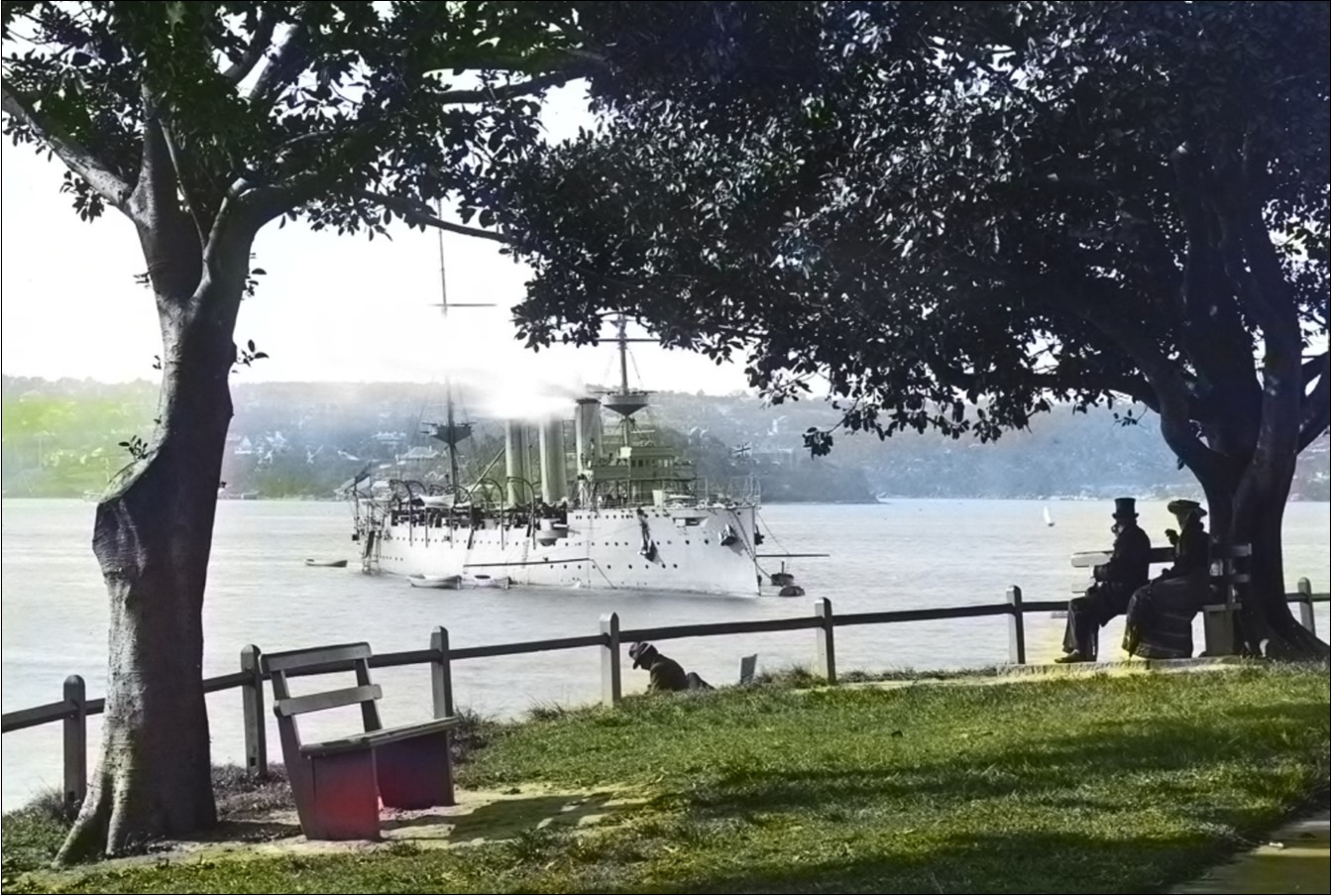
It was in October 1908, after a strict medical examination, I was admitted to the Royal Navy, joining the P class cruiser HMS Pyramus on 29 October, as ordinary seaman. Boys admitted to the Royal Navy were classified Boy Seamen and were not allowed to smoke. If caught they were given Captain’s punishment. The captain, Commander Radcliffe, was a strict disciplinarian.
I well remember the morning half an hour before the normal time of calling hands, the Quartermaster calling all boys and ordinary seamen, muster on quarter deck to witness punishment.
The cruiser Pyramus carried two 18-inch torpedo tubes, one each side of the quarterdeck. On arriving on the quarterdeck, I saw the Duty Officer of the Day, the ship’s doctor, the Master at Arms, and the Ship’s Corporal, the chap who administered the punishment. Lashed down to the lip of the torpedo tube was a boy, ankles one side, wrists the other side, tight to ring bolts. His rump, hunched up, was clad in a pair of light duck trousers and a cotton singlet.
The Corporal selected a Malacca cane from a canvas bag, and swished it down until satisfied with its length, weight and thickness. On the order to commence punishment he administered twelve strokes. I have seen blood appear when the trousers begin to split, but this lad was a tough boy, not a murmur or tear, but when released those within hearing heard some choice language.
First sea voyage
Shortly after this episode, Pyramus was ordered to Brisbane, my first trip to sea. I was too seasick to remember much about it, but strangely I was never sick again! We returned to Sydney and then south to Norfolk Bay, Tasmania, for gun layers’ tests. Pyramus was an unlucky ship. While in Norfolk Bay, a mate of mine, Will Snudden, fell out of a boat which had been hoisted in the ship’s davits. Unfortunately, he hit his head on the ship’s side in falling, and when he surfaced, the back of his head was showing blood. The Chief Boatswain’s Mate and I dived after him but failed to find him. His body was never found, but 18 months later his serge jumper was picked up on a beach.

A few months after losing Snudden, a chap called Morris passed away. This chap slept in the hammock alongside me, within arm’s length. He was a chap who snored a lot, and being a light sleeper, I was often awakened. One night at 0100 , I awoke, and Morris was snoring loudly. I put my hand across to give his head a shake, but my hand touched something wet and sticky. I thought his nose was bleeding, and decided to call the Quartermaster, with his hurricane lamp. We found Bill Morris had cut his throat.
Bill was a very quiet chap. His parents lived at Parramatta and as his father was leaving per Mail Boat for further military training (Officer). He got leave to visit him, but had to report back on board on Tuesday morning 0700. Unfortunately the train had a breakdown, and he arrived back on board one hour late which resulted in him receiving 14-days stoppage of leave. He wanted so much to see his dad off on the Saturday.
Visit to Chile
By 1911 I was serving in HMS Challenger, (Captain G. Gaunt, a fine gentleman in command), as an Able Seaman on way to Valparaiso, Chile, for Centenary celebrations. After visiting most of the large island groups we called at Tahiti, Pitcairn and Easter Island. First port of call on the West Coast of South America was Callao to coal ship and then to Valparaiso where we joined up with HMS Kent from the China Station.
When the celebrations were over, we called at the Panama Canal (west side). The canal was still under construction. We coaled ship in 119° Fahrenheit. One chap received severe sunstroke; another became a bit funny in the head. It was then on to Acapulco. Some sort of uprising was taking place there. I was sent ashore in a cutter to procure fresh meat. There was only one butcher shop, and it was closed. The butcher was in the surrounding hills fighting revolutionaries!
Transfer to RAN
Then it was back to ‘Aussie’, calling at Fiji, then Lyttleton, South Island, New Zealand and Sydney. My brother Charles was serving in the torpedo boat destroyer HMAS Parramatta, and he influenced me to turn over to the RAN. I believe my brother entered the RAN some time in 1910 for short service. He later served with the AIF at Gallipoli.
On arrival back on ship I requested the Captain to be transferred to RAN. The request was approved, and I entered Williamstown Naval Depot on 13 December 1911. I joined Parramatta on the 17th.
This article originally appeared in the December 1973 edition of NHR.