The United Nations Transitional Authority Cambodia (UNTAC) was established in 1992 and given the mandate to enforce a cease fire in the war-torn nation and deal with refugees and the disarmament of warring groups. Australia provided over 500 personnel to UNTAC with the bulk being the Force Communication Unit (FCU) but also HQ UNTAC staff and movement control personnel. While the Australian Army provided many of those deployed there were also a number of RAN and RAAF personnel involved as well. To understand the situation that these men and women were sent to a brief history of Cambodia is essential.
Cambodia has been inhabited since pre-historic times but it was not until about 802 AD that Prince Jayavarman II declared himself king and united the various warring principalities under the name Kambuja. This led to the creation of the Khmer Empire which flourished for over 600 years. In the 15th Century the Khmer Empire (Cambodia) declined while neighbouring Thailand and Vietnam grew larger and stronger.
In 1863 Cambodia was annexed by the French and incorporated into French Indochina consisting of Cambodia, Laos and Vietnam. During 1941-45 Indochina was jointly controlled by Imperial Japanese forces and the Vichy French Government that supported the Axis forces. In 1945 full French control was restored following the defeat of Imperial Japan.
Cambodia was granted independence from France in 1953 and became a constitutional monarchy under the leadership of King Norodom Sihanouk and in 1955 he became prime minister.
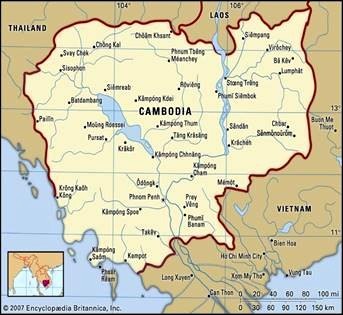
Sihanouk continued to lead Cambodia during the 1960’s and stated the nation was neutral, however, allowed the North Vietnamese Government, based in Hanoi, to use Cambodia as a safe haven and supply route for Communist forces fighting in South Vietnam. As a result of these actions the United States conducted bombing raids on Cambodia which killed Vietnamese and Cambodians alike. In 1970, while Sihanouk was visiting the Peoples Republic of China, a military coup took place with General Lon Nol and Prince Sisowath Sirik Matak seizing power. Cambodian forces then commenced operations against the North Vietnamese to remove their forces from Cambodia. US forces continued bombing portions of Cambodia held by the North Vietnamese until 1973.
To make matters worse the North Vietnamese began supporting the Cambodian Communist Party known as the Khmer Rouge. They were led by Saloth Sar who changed his name to Pol Pot; meaning the ‘original Cambodian’. Corruption and disunity plagued the Cambodian Government while the Khmer Rouge grew in strength with training and weapons provided by the North Vietnamese. In early 1975 the Khmer Rouge launched a major campaign to seize the country and after months of heavy fighting the Lon Nol Government surrendered in Phnom Penh on 17 April 1975.
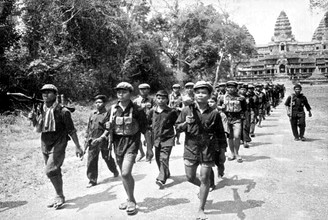
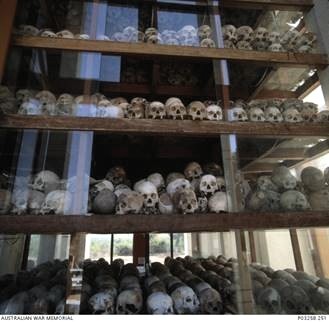
The country was renamed the Democratic Republic of Kampuchea and this ushered in a horrific phase of genocide where the Khmer Rouge killed over a quarter of the population, approximately two million people, with minority groups such as the Cham Muslims and the ethnic Vietnamese population singled out for persecution. The 1984 biographical drama film The Killing Fields highlighted the horror of Cambodia under Khmer Rouge control.
1975 also saw the collapse of the South Vietnamese Government with the fall of Saigon on 30 April 1975 and the country unified under Communist rule. Within Kampuchea the Khmer Rouge leadership began to fracture with many fleeing from Pol Pot’s wanton killing and destruction. Others became no better than criminals conducting raids into the Socialist Republic of Vietnam. Against this backdrop Vietnamese troops invaded Kampuchea in November 1978 and installed a puppet government; the People’s Republic of Kampuchea.
As a result civil war broke out in Kampuchea with Vietnam supporting the puppet government against a collation led by Sihanouk comprising the United Front for an Independent, Neutral, Peaceful and Cooperative Cambodia (FUNCINPEC), the Khmer Rouge and the Khmer People’s Liberation Front (KPNLF). These opposition forces operated from north-west Cambodia and Thailand. In addition Sihanouk created a government in exile in 1981; the Coalition Government of Democratic Kampuchea.
Political pressure and economic sanctions, by the United States and its allies, were also brought to bear on Vietnam; in an effort to force the withdrawal of Vietnamese forces. It was not until October 1991 that long running peace talks, held in Paris, succeeded in a peace settlement. The United Nations was thus given a mandate to enforce a cease fire, enforce the disarmament of the warring factions and manage the return to Cambodia of many thousands of refugees held in camps in Thailand.
Initially the United Nations Advance Mission in Cambodia (UNAMIC) began operations in Phnom Penh in November 1991 to prepare for the larger follow on force – the United Nations Transitional Authority in Cambodia (UNTAC). Australia provided 65 army signals corps personnel to UNAMIC.
UNTAC forces began arriving in Cambodia during March-April 1992 and the military component was placed under the command of Australian Lieutenant General John Sanderson who eventually commanded over 16,000 personnel including 12 infantry battalions[i]. Peace keepers and police were provided from 46 countries including Bangladesh, Bulgaria, Canada, Eire, Fiji, France, Ghana, Great Britain, Hungary, India, the Netherlands, Pakistan, the Philippines, Singapore, Tunisia and Uruguay. Some of the peace-keeping troops were conscripts and more trouble than they were worth due to poor training and ill-discipline. Overall control in Cambodia was vested in the UN administrator Yasushi Akashi, a capable career diplomat, who supervised the peace process and elections.
The main role for UNTAC was to oversee the cease fire and disarmament of the warring factions, which at times proved difficult, while also providing security to ensure a peaceful and democratic election process could take place in May 1993. This required a strong military presence to ensure voter registration across the entire country could take place effectively and providing the necessary logistics and security for the actual elections.
As part of Operation Gemini, Australia committed 550 personnel with the bulk of the force comprising the Force Communications Unit (FCU) which included some infantry undertaking force protection duties. The FCU was mainly Australian Army personnel but the Navy and RAAF each provided a small number of communications personnel as well[ii]. The senior RAN member of this small group was Chief Petty Officer Electrical Technician Karl Brenner. Lieutenant Karl Blackman was initially the only RAN officer deployed to Cambodia for duties in UNTAC Headquarters in Phnom Penh.
The Australian signalers were deployed throughout the country setting up a communications system using UHF, VHF and HF radio, telex, telephone and courier services and eventually also a data transfer via modem. When the Australians arrived in Cambodia the country had two functioning telephones; by the time they left over 10,000 telephones had been installed. This communication unit was essential to allow the widely dispersed peace keeping forces to communicate with UNTAC Headquarters in Phnom Penh. In some cases signals dispatch riders were used to physically carry documents between locations until tele-communications could be properly installed.
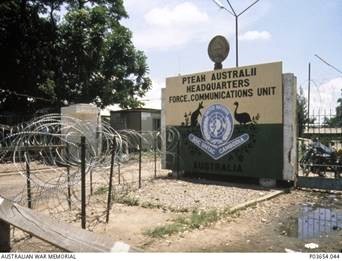
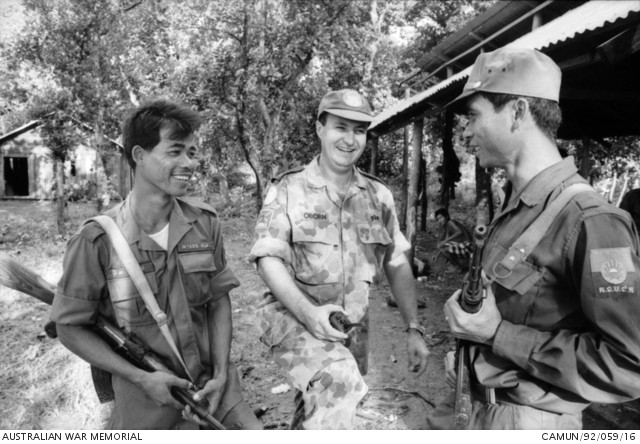
The warring factions made Cambodia a dangerous place for the Australian’s. The Khmer Rouge were particularly violent and killed a number of UNTAC personnel in a variety of attacks across the country as they considered the electoral process was flawed and would not favour the Khmer Rouge. A raid by 200 Khmer Rouge soldiers, on Siem Reap in early May 1993, forced Australian personnel to ‘stand to’ in their weapons pits with Steyr rifles and wearing helmets and body armour.
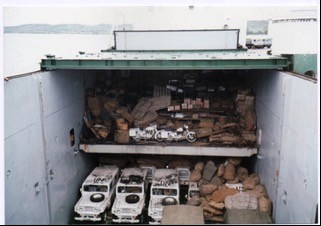
Additionally 30 Australian Defence personnel were required at extremely short notice to provide the UNTAC Movement Control Group. This included three RAN officers, a warrant officer and three chief petty officers. Their job was to plan, coordinate and execute the deployment of all UN military forces into Cambodia – a major task as this required the movement of 16,000 troops, and their associated equipment that was coming into the country by land, sea and air.
The Navy personnel deployed to Phnom Penh, the port of Sihanoukville (Kampong Saom) and also to Sattahip in Thailand to undertake the movement of equipment and personnel by sea. The RAN movements control personnel departed Cambodia in mid-August 1992.
Lieutenant Ric Leahy was one of those movements control officers and later wrote:
The active service environment of Cambodia was always going to prove a challenge. Jungles and paddy fields covered a countryside littered with millions of landmines and patrolled by 200,000 troops of the four warring factions. Cambodia was a country of endless contrasts. Burnt out and abandoned tanks and fire-scarred buildings sat adjacent to brand new hotels in the capital Phnom Penh. Mine warning signs were placed along a path leading to a beautiful white sandy beach with palms swaying gently in an afternoon breeze. He also stated: For all the difficulties that the Cambodians have had to endure they are surprisingly friendly. They are very open people, readily smiling and they appear genuinely happy to see the UN here
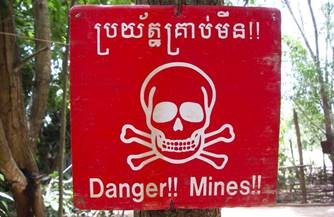
Apart from the ever present danger of land mines there was also the potential for a flare-up of fighting between the various ex-warring factions. While the various forces were supposed to hand in their weapons this was difficult to police due to the sheer quantity of weapons in the country and the porous borders which allowed weapons to be brought in from other countries. There were frequent shootings and grenade attacks, particularly on the local markets, and during the immediate lead up to the election period the ADF deployed four Blackhawk helicopters to provide additional troop lift and insertion if required.
The Chief of Naval Staff, Vice Admiral Ian MacDougal, AO, RAN visited the naval personnel of the Force Communications Unit during a brief visit to Cambodia in late February 1993. After a year in Cambodia the first FCU contingent personnel were replaced by the second FCU contingent of Australians during March-April 1993. Again the RAN and RAAF provided a small number of personnel each to the Force Communications Unit. In mid-1993 twenty ADF military police, including three RAN personnel, were deployed to Cambodia for security and policing duties.
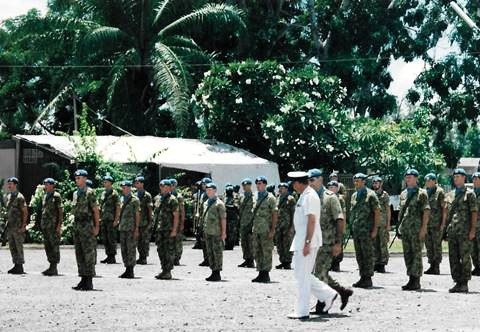
The following members of the RAN served in Cambodia (rank at time of service):
UNTAC Headquarters
Lieutenant Karl Francis Blackman, RAN
Force Communications Unit (Rotation 1)
Chief Petty Officer Electrical Technical Communications Karoly Brenner
Petty Officer Radio Supervisor Michael John Mansfield
Petty Officer Radio Supervisor Guy James Oborn
Leading Seaman Signalman James Douglas Phillips
Leading Seaman Radio Operator Donna Maree Nipperess
Leading Seaman Electrical Technical Communications Lee Robert Starick
Leading Seaman Radio Operator Shane Darren Taylor
Able Seaman Radio Operator Alastair John Bakker
Able Seaman Electrical Technical Communications Trevarren Marcus Baldwin
Able Seaman Radio Operator Stephen David Binstadt
Able Seaman Radio Operator Anthony Edwin Brown
Able Seaman Signalman Benjamin John Culliver
Able Seaman Signalman Kevin James Dowling
Able Seaman Signalman Marcus Emmerton
Able Seaman Radio Operator Paul Sidney Joseph Jewell
Able Seaman Radio Operator Russell Leeming
Able Seaman Radio Operator Troy Colin Miller
Able Seaman Signalman Michael John Ploenges
Able Seaman Radio Operator Penelope Jane Reason
Able Seaman Signalman Christopher Robert Roach
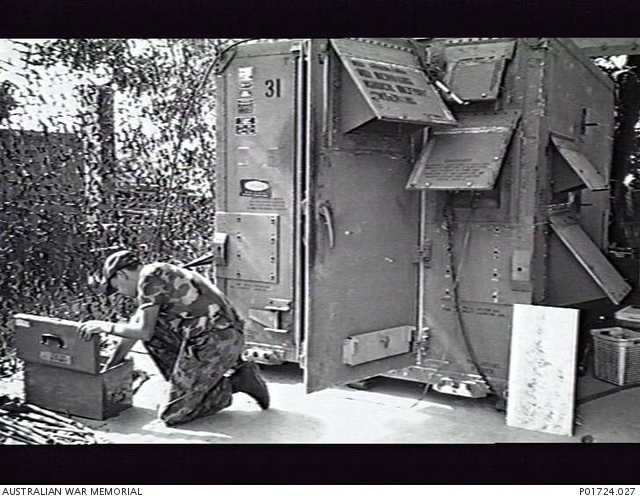
checking communications equipment in Cambodia (AWM)
Force Communications Unit (Rotation 2)
Chief Petty Officer Electrical Technical Communications Peter John Clulow
Petty Officer Radio Supervisor Donald Leigh Paterson
Petty Officer Radio Supervisor Jeffrey Peter Todd
Leading Seaman Radio Operator David Marc Hellier
Leading Seaman Signalman Carl Scott Levinge
Leading Seaman Signalman David Mundy
Leading Seaman Radio Operator Kim Nutland
Able Seaman Radio Operator Todd Wesley Burden
Able Seaman Signalman Peter Stuart Durrant
Able Seaman Radio Operator Mathew Vincent Dyson
Able Seaman Signalman Anthony Lionel Goodger
Able Seaman Signalman Tony Cornelius Keaton
Able Seaman Radio Operator Debbie Maree McCallum
Able Seaman Radio Operator Jason Keith Murray
Able Seaman Radio Operator Anthony Gerard Nuttall
Petty Officer Geoff Todd (First Rotation) was the Signal Troop ‘Sergeant’ at Battambang and recalled:
‘You may well ask what an Australian Naval Petty Officer is doing in the middle of Cambodia? The answer is pretty simple. UNTAC is a tri-service mission and the Australian Navy and Air Force have both contributed about twenty members. We live and dress as soldiers 24 hours a day, 7 days a week, an interesting experience, one I don’t think I’ll forget in a hurry.
I have 12 diggers (soldiers) working for me on the Communications Centre ranging from a Corporal to a Gunner, an Air Force person and a Kiwi. The work is constant and challenging. The Battambang province consists of eight districts and the distance to each varies, the closest being about three kilometres away and the furthest about six. Civilian police and electoral personnel man all the districts and one our main roles is to provide these people with communications.
The main means of communications in Cambodia is VHF Motorola. These are similar to walky-talkies and are used extensively. It is pretty challenging trying to explain to people that a Motorola is not a mobile phone and to avoid excessive use in case of operational emergency.
Our accommodation differs to those in other areas of Cambodia and consists of a mass of white weather-haven tents. The biggest downfall is that they hold in the heat during the day, however they are quite comfortable in the evenings and are fairly spacious. The mess tent is a huge weather-haven and the kitchen is a cook’s dream – this makes a significant contribution to the high standard of meals served up to the troops and of course to our morale.
Physical training (PT) is the order of the typical Army day, which comes as a bit of a shock to us sea lovers and blue suiters. Four days a week at 0615 you will find the squadron formed up for PT. Activities vary but the work is always physically draining. On Saturday afternoon the Squadron plays sports – anything from touch football to soccer or cricket. We all have fun and enjoy the teamwork[iii].
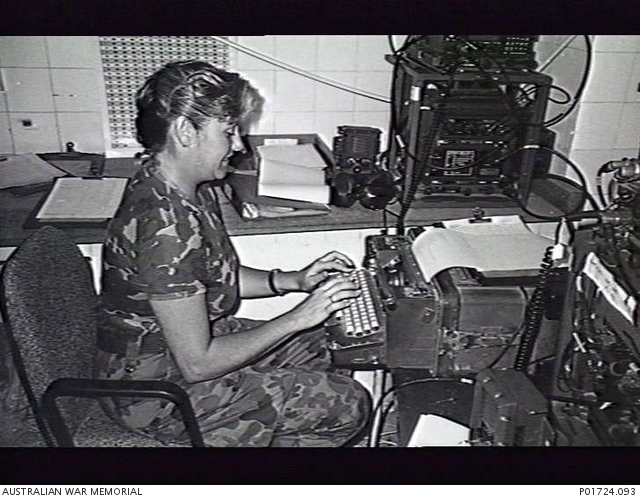
Leading Seaman Radio Operator Dave Hellier was part of the second FCU rotation to Cambodia arriving in March 1993. He recalled the Navy contingent trained at Randwick barracks which included weapons training as well as training on the newly introduced RAVEN RTF-100 radio’s (and the RTF-500 radio’s associated Clark masts, antennas and UHF/VHF repeaters that had recently been introduced into ADF service. Dave Hellier later stated: At the risk of being biased, it was difficult to get the skill sets required to run the COMMCEN (Communications Centre) from the Army folks. Navy predominantly could do all the functions from voice to messaging and teletype whereas the army sigs were specialized and could only perform one or two skillsets required to run a communications centre. All in all, seeing what a warship of that period could do, it was all a bit ‘primitive’.
The back-haul national communications to Australia was provided from the headquarters at 1 Signal Squadron at Watsonia in Victoria. This consisted of a High Frequency shot supporting a BRAHMS (Secure) Facsimile for messaging back to Australia. This was a bit odd at the time as all Army off-shore communications was normally provided by the Navy Long-Haul High Frequency system based in Canberra using the facilities at Belconnen and Bonshaw.
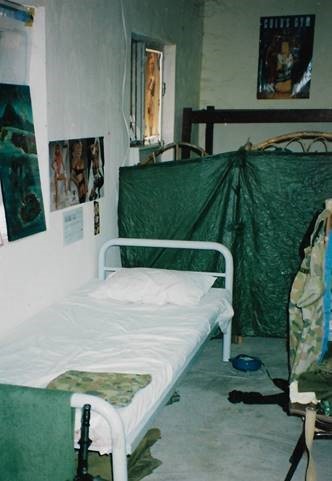
Conditions of service for those deployed was generally quite good with many recalling the catering being first-class regardless of location. Accommodation varied with location; at Siem Reap each person had a single bed demountable cabin (that was air-conditioned) with bed, desk, chair and rifle stowage while in Phnom Penh they lived in an old military barracks that was quite run down and not air-conditioned. Television was available in dedicated recreation rooms but in places power usage was restricted to four hours in the morning and four hours in the evening.
The dangers of illness and disease were ever present with cuts and scratches turning septic if not treated quickly and the use of Doxycycline (as opposed to Primaquin or Nivaquin) to combat Malaria. Many who served in Cambodia claim the use of Doxycycline increased stomach and urinary tract infections.
For those undertaking six months or more service there was a re-union leave travel entitlement of two weeks that enabled them to return to Australia to see their family; or have their spouse fly to a location in Southeast Asia. Mail to the deployed member, from Australia, was free but those deployed still had to pay the normal rations and quarters levy and their pay was also still taxed. A United Nations daily allowance was paid which did compensate for some of these costs. Access to local restaurants, bars and markets was allowed and some enterprising local entrepreneur’s imported Australian beer, particularly Victoria Bitter (VB) to cater for the Australian’s in country.

Dave Hellier also recalled the horrors of the Khmer Rouge regime were ever present: There was a myth that the killing fields were only around Phnom Penh. In fact the whole country was littered with human remains. You could scratch the dirt anywhere and find remnants of checked cloth, teeth and bones. The other interesting thing was the jungle as you could not hear a sound of any insects, birds or animals as they had all been eaten during the years of famine.
Movements Control Group
Lieutenant Richard Charles Alfred Leahy, RAN
Lieutenant Christopher Byron Kent Roberts, RAN
Lieutenant Stephen Peter Woodall, RAN
Warrant Officer Naval Police Coxswain Colin Steven Greef
Chief Petty Officer Writer Trevor Wayne Sweeney
Chief Petty Officer Marine Technical Propulsion Peter Thomas Bellemy
Chief Petty Officer Signals Yeoman Peter Robert Cook
Chief Petty Officer Trevor Sweeney was working at HMAS Stirling (Western Australia) and recalled being contacted on the morning of Friday 1 May 1992 and requested to deploy to Cambodia as part of the Movements Control Group. The understanding at the time was another nation had failed to provide the 30 personnel required and Lieutenant General Sanderson quickly sought Australian support to fill the gap. The seven RAN personnel arrived in Sydney over the weekend and received two days of weapons and field training as well as being issued disruptive pattern camouflage uniforms and field kit on 4-5 May; they then flew out on a civilian flight and arrived in Cambodia on Wednesday 6 May.
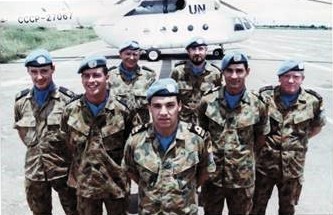
The RAN Movement Control Group 1992 in front of a Russian supplied UN helicopter.
Left to Right – Warrant Officer Greef, Lieutenant Leahy, Chief Petty Officer Bellemy, Lieutenant Roberts, Chief Petty Officer Sweeney, Lieutenant Woodall and Chief Petty Officer Cook.
UNTAC Military Police Unit
Chief Petty Officer Naval Police Coxswain Alan Charles Ward
Petty Officer Naval Police Coxswain Edward Birtles
Petty Officer Naval Police Coxswain Anthony Luvisi
Chief Petty Officer Alan Ward and RAAF Corporal Matthew Humphries were deployed to the town of Poipet, on the Thai-Cambodian border, to prevent the smuggling of arms and other contraband into Cambodia. Alan Ward recalled he had a section of tough and capable Dutch marines to assist him as well as some Hungarian police; but the latter proving to be quite ineffectual. Regular vehicle patrols were also conducted along the border to try and prevent smuggling of weapons and other contraband.
Despite the many difficulties the UN mission succeeded in conducting elections and the new Cambodian Government was formed on 21 September 1993. Under the leadership of Prince Norodom Ranariddh (Son of Prince Sihanouk) the FUNCINPEC royalist party obtained 45.5 % of the vote. Former Khmer Rouge leader Hun Sen formed the Cambodian People’s Party that also received a substantial portion of the vote thus resulting in a hung parliament. This impasse led to discussions between the two parties with Prince Ranariddh becoming First Prime Minister and Hun Sen named as Second Prime Minister. This arrangement ultimately failed when Hun Sen staged a coup d’état in 1997, toppling Prince Ranariddh from power, and installing himself as leader of Cambodia which continues to this day.
UNTAC began to reduce its personnel numbers and the Australian contingent began preparations for its return to Australia. The Chief of the Defence Force, Admiral Alan Beaumont, AC visited Australian personnel in Cambodia shortly before their departure and also conducted discussions with the leaders of the Cambodian National Armed Forces regarding future ADF support under the Defence Cooperation Program. The last Australian UNTAC personnel completed their duties in Cambodia on 7 October 1993 and a welcome home parade was conducted in Sydney on 9 October 1993.
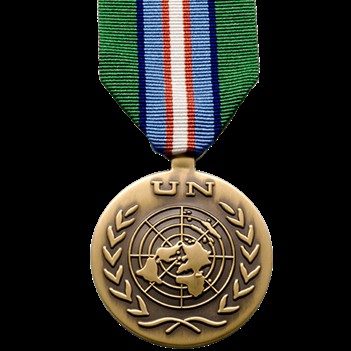
Those who served in Cambodia during 1991-1993 were originally awarded the Australia Service Medal (ASM) with Clasp Cambodia. The award period for the ASM was from 20 October 1991, when the first UNAMIC personnel arrived in country, through to 4 October 1999 when the last Australians were withdrawn. A review of service in Cambodia was later conducted and due to the serious danger to personnel, during 1991-1993, the medal for Operation Gemini was upgraded to the Australian Active Service Medal (AASM) for the period 20 October 1991 – 7 October 1993. The area of operations was deemed as within Cambodia but also included the border areas with Laos and Thailand out to 50 kilometres from the Cambodian border. Additionally in September 2014 those who served in the FCU during 1992-93 were awarded a Meritorious Unit Citation.

Several honours and awards were presented to the ADF personnel who served in Cambodia and Chief Petty Officer Karoly ‘Karl’ Brenner (1st FCU rotation) was subsequently awarded a Medal of the Order of Australia (OAM) in the 1994 Australia Day Honours List for his services in Cambodia.

Despite the departure of the FCU in 1993 this did not see the end of Australian personnel deploying to Cambodia. Under the Defence Cooperation Program Australia agreed to provide naval personnel to provide maritime maintenance and support training. Additionally Australian Army personnel provided support for communication training. A separate Australian Army team were to support training of local men in the clearing of minefields as part of the Cambodia Mine Action Centre. Apart from Australia, support for this activity was provided by Canada, The Netherlands, New Zealand and Norway .
Operation BANNER (Defence Cooperation Program)
Following the late 1993 request from the Royal Cambodian Armed forces, for technical assistance for its navy, the RAN commenced a study on how this could be achieved. The Cambodian naval base was located at Ream approximately 32 kilometres south-east of Sihanoukville (Kampong Saom) and 240 kilometres south-west of Phnom Penh. The project was approved by the Australian Government in February 1994 and a project team, led by Commander Bronko Ogrizek, visited Ream in December 1994 to make an assessment regarding the building and staffing of a maintenance and training facility.
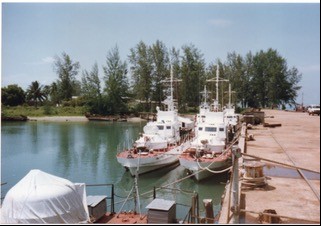
Construction of the facility started in late 1995 and training courses for Cambodian Navy technicians commenced in June 1996. The Royal Australian Navy training team was under the command of Lieutenant Mark Proctor, RAN who was assisted by Lieutenant Kevin Mclean, RAN. The team also included four technical sailors (Chief Petty Officer Ron Conder, Chief Petty Officer Steven Dawson, Chief Petty Officer Ian Jones and Leading Seaman David Ludlow) who assisted with construction of the facility and setting the various equipment to work as well as mentoring the new Cambodian technical sailors. In June 1996 two RAN patrol boats (HMA Ships Dubbo and Launceston) visited the port of Sihanoukville while on a Southeast Asia deployment thus allowing the Cambodian Navy trainees to visit the vessels.
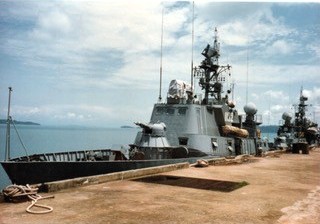
The RAN personnel departed Cambodia, in July 1997, following the coup led by former Khmer Rouge leader Hun Sen. Lieutenant Mark Proctor, RAN was subsequently awarded a Conspicuous Service Medal (CSM), in the Queen’s Birthday Honours List (8 June 1998), for his outstanding leadership and command of the security forces at the Australian embassy during the coup and the evacuation of Australians from the city.
RAN vessels recommenced visits to Cambodia in 2003 when the minehunters HMA Ships Gascoyne and Norman visited Sihanoukville in June of that year. Australian warships have visited Sihanoukville intermittently since then but the naval connection was re-newed in 2020 with the appointment of Captain Bernard York, RAN as the Defence Adviser to Cambodia.
2022 marked the 30th Anniversary of the UNTAC deployment to Cambodia and the Australians who deployed to the war ravaged country can be justifiably proud of their service there. Years of war had reduced Cambodia to a year zero status and while there are still issues in that country the 1992-93 UN mission succeeded in restoring order to what was a completely destroyed country.
Further Reading:
Frost, Frank, Cambodia’s Troubled Path to Recovery, Research Paper 34 (1995-96), Foreign Affairs, Defence and Trade Group.
Horner, David, The Good International Citizen, Australian Peacekeeping in Asia, Africa and Europe, 1991-1993. The Official History of Australian Peacekeeping, Humanitarian and Post-Cold War Operations. Volume III, Australian War Memorial, Canberra, 2014.
Leahy, R.C.A. The Royal Australian Navy in Cambodia, Australia’s Navy 1992-93, Australian Government Publishing Service, Canberra, 1992.
Londey, Peter Other Peoples Wars: A History of Australian Peacekeeping, Allen & Unwin, Crow’s Nest, NSW, 2004.
Palmer, Alexander M. Australian Peacekeepers and Peacemakers, Military Minded, PO Box 94, Mosman Park, Perth, Western Australia
Um, Kharhrya, One Step forward, two steps back: Cambodia and the Elusive Quest for Peace, Southeast Asia Affairs, 1998.
[i] The first Australian contingent to the UN Advance Mission in Cambodia was from late 1991- early 1992 but consisted only of Army personnel.
[ii] Approximately 40 New Zealand Army personnel also served in the Force Communications Unit.
[iii] Defence Update No. 7 December 1993 – United Nations Transitional Authority in Cambodia (UNTAC).