From the Sydney Morning Herald (NSW: 1842-1954), Saturday 12 April 1930, pg, 11
(by Lieutenant Commander Gerald A. Hill R.A.N., Retd.)
On the night of 9–10 April 1918 the Italian destroyer, RN Benedetto Cairoli was part of a force of several Italian and French Navy destroyers escorting the three battleships of the Italian 2nd Naval Division from Brindisi to Taranto, Italy. During the predawn hours of 10 April, two of the French destroyers, Faulx and Mangini, collided in the Strait of Otranto and Faulx sank.
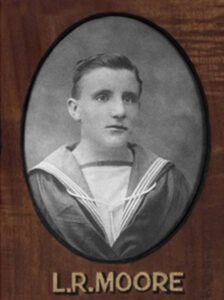
About an hour later, after the ships entered the Ionian Sea, Benedetto Cairoli′s sister ship Giacinto Carini accidentally rammed her, and Benedetto Cairoli sank a few hours later off Santa Maria di Leuca, Italy. The Royal Australian Navy destroyer HMAS Torrens rescued her survivors, but one member of Torrens′s crew, 17 year old Ordinary Seaman Leslie Moore, of Brighton Victoria, was swept overboard and drowned in heavy seas during the rescue operation. Meanwhile, Giacinto Carini reached port with a severely damaged bow and remained under repair for the rest of the war.
The following is based on a first-hand account provided to the Sydney Morning Herald and published 17 years after the event.
While employed in the Adriatic, the units of the Australian flotilla were occasionally despatched on outside errands. Oil fuel ships arrived and departed from Brindisi at regular intervals, and these and other ships always needed an escort. So it happened that now and again we would be switched off our patrol duties, and ordered to escort SS So-and-So to Patras in the Gulf of Corinth. From there they found their way through the Corinth Canal and the more or less landlocked waters immune from the lurking Fritz, to Milos, where they would pick up the Malta convoy and accompanying escort to their destination.
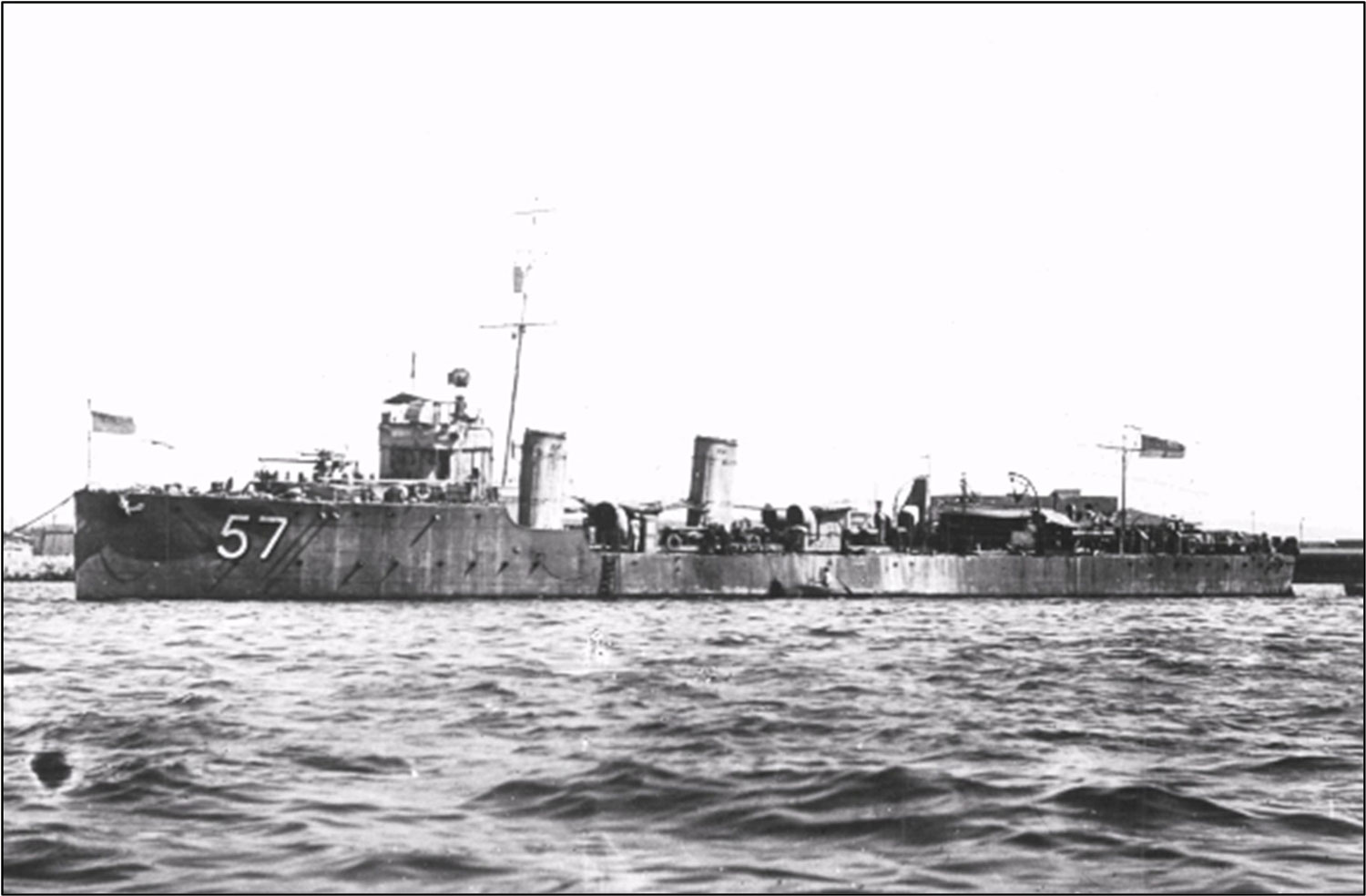
Torpedo Boat Destroyer (TBD)
Another time a ship was required to escort the C. in C. Mediterranean from Malta to Alexandria and Port Said and back. The Torrens was told off for this duty, and a very pleasant trip it proved, although it did not lack Its note of tragedy. In fact, in those, days, tragedy was ever at one’s elbows,
Torpedoed Convoy.
After arriving at Alexandria, the Torrens was detailed to proceed to the outer limit of the swept channel and scout round for submarines until the fast convoy departed. The convoy got clear about 4.10 p.m. At 4 p.m. the following afternoon Torrens, outward bound from Alexandria, met the survivors of the Lissowe Castle returning in the gunboat HMS Ladybird to Alexandria.
They had been torpedoed about midnight the previous night, with the loss of many gallant men. The two ships cheered each other as they passed, even as they did the previous day as the convoy passed to the westward and Torrens back to Alexandria. Again it was the Torrens, in company with the destroyer HMS Redpole, which was ordered by wireless to the rescue of the Italian TBD Cairoli, I cannot do better than quote from a letter wrltten by an officer on the Torrens about this incident.
To the Rescue
Four nights ago we got an S.O.S., and shortly after were ordered by wireless to the rescue. This was at 5 am, very dark, blowing three-parts of a gale. ‘Dispatch Is necessary,’ ran the signal. From a comfortable 12 knots we went on to 19, when things were anything but comfortable, as we were steaming into it. At 5.30am we increased to 21, and things began to hum. It was only occasionally I could get a glimpse of the Redpole who was leading us and what time I did see her she appeared as a black pebble in a setting of cotton wool, so immersed in foam was she.
On Board the T it seemed as if we were moving in a sort of travelling Niagara, and every moment I expected the bridge to be swept away. At 6.10 ‘Dispatch is necessary* once more came through. People were drowning; break the ship, but save the people. Twenty-three knots was ordered, and I held my breath to see what would happen. I did not wait long, for the next moment the bridge was smashed in, and the quartermaster and myself were knocked flat, and were wallowing in a torrent of water. Jumping up, we eased her down, repaired the damage as best we could,and went on again.
Destructive seas.
Five minutes after this she shipped a beauty, which swept away the forward gun shelters, broke the anchors adrift from their securing chains, twisted a lot of shot racks out of all shape, and flung the shells over-board, broke and twisted all the quarter-deck awning stanchions, and, last of all, sent the youngest and smallest rating on board to his death. He was swept over the side in a torrent of foam which nothing human could resist and the poor little beggar was never seen again.

By 7 a.m. we arrived at the scene of the disaster. A TBD (not one of ours, I am glad to say) had rammed another, which had sunk, while the ramming ship stood by with her bows twisted out of all semblance. A French TBD. was also standing by. She had picked up thirty-nine survivors, and was looking for more. Wreckage and bodies were everywhere. Very horrible. We searched for over an hour without any success, when, on the crest of a wave, we saw an arm feebly waving. On approaching closer, we made out the owner, who was clinging to a raft, together with what appeared to be two bodies. The weather being far too bad to lower a boat, the ship was manoeuvred at slow speed until we brought the raft alongside, when lines were thrown to the man.
Difficult Salvage.
He was too weak to make it fast and our gunner, making a line fast round his body. Jumped overboard, and swam to the raft. Just then a huge sea came along and washed all the occupants off. The two whom we suspected to be dead had now come to life, and, seeing a chance of being saved, were taking a more or less intelligent interest in things. Fortunately, they were washed against the ship, where dozens of hands were waiting to pull them on board.
This sounds easier than it really was. In sinking, the TBD’s oil tanks had burst, and the sea for some two or three miles was covered in thick fuel. In consequence, these poor devils were one mass of oil, and, as fast as we got a grip of them, they slipped through our fingers. All the time they were moaning dreadfully. It was most piteous. However, by dint of getting out over the side, and with the able help of the gunner, we eventually got ropes round them, and dragged them all aboard, landing them on our decks like so many gasping trout.
Taking them below to the engine-room, being the warmest place in the ship, ripped their clothes oil, cleaned the oil off them roughly, pumped the water and oil out of them, and brandy and cocoa in. One poor beggar had his teeth so tightly clenched that we had to employ a chisel to force them, apart. All the time he kept on moaning ‘Molto frodo, molto frodo’ which, being interpreted, means very cold. It is not surprising, seeing he had been in the water for three and a half hours.
Grateful Survivors.
Further search revealed no more living souls, and we were ordered to escort the damaged TBD to the nearest port, which we reached some four hours later. Here we discharged our three survivors, and I have never seen men more grateful. They had fully recovered by that time, and went over the side munching bully sandwiches, and clasping each a tin of cigarettes, which our men had given them. I called the attention of one of them to the fact that he was now an English sailor, pointing to his clothes our people had rigged them out-and they all seemed most pleased, Inglese marinero molto molto bono (English sailor very very good), and insisted on shaking hands with everyone.
During this time, from 5 a.m. to noon, we received two other S.O.S. calls, neither of which, of course, we could succour, but other ships went to their assistance. Of these, one was sunk, but I do not know with what lose of life.
The Torrens, after landing her survivors, returned to patrol.
Further Reading:
Italian destroyer Benedetto Cairoli, Wikipedia
HMAS Torrens (I), Sea Power Centre – Australia