By Richard Pelvin
This paper by former RAN historian Richard Pelvin was first published in ‘Australia’s Navy 1990-91’. It is republished with the kind permission of the Director, Sea Power Centre-Australia. Richard Pelvin worked for ten years in the historical sections of the Army and Navy. He was also Curator of Official Records at the Australian War Memorial and has written and published widely on military, naval and aviation history.
1940 was a year of enormous transition in Australia. It was the year after war had started in Europe and the year before it would be declared in the Pacific. The nation was concerned with events in Europe and vowed to assist Britain with her defence. Yet at the same time there was concern about the deteriorating situation in East Asia where Japan had captured most of China and was poised in Indochina ready to pounce on South-East Asia and ultimately Australia. What about the ‘Singapore strategy’? Would Britain really come to the aid of Australia and New Zealand? Who would stand between Australia and the Japanese?
On the morning of Sunday, 3 September 1939, Neville Chamberlain told the British people that a state of war existed between Britain and Germany. Several hours later, Robert Menzies informed Australia that it too was at war. The burdens and hardships of war would doubtless be severe on the Australian people who numbered just over seven million. Of the armed forces, only the Navy was prepared. After taking delivery of the Mod-Leander class light cruisers from the mid-1930s and with the commencement of an enormous naval construction program after 1937, the RAN was the largest service consisting of 5500 men. The Army numbered just 2800.
With the declaration of war, the Australian Squadron proceeded to sea immediately patrolling the vital trade routes around the coastline and making for their assigned war stations. It was not until January 1940 that the first contingent of the Second AIF (6th Division) was ready for transportation to Egypt. From the outset, Australia had to decide where its ships would be deployed. Land forces were readily drawn from the population and could be re-organised as the contingencies of the war demanded. The questions being asked about naval defence provided no easy answers. How many ships could Australia afford to have in Europe? How long would they remain there?
Whatever the answers to these questions, the nation had to press on with preparing for war and an increasingly likely conflict with Japan. But what form should that preparation take? What type of ships should Australia build if it hoped to prevent the Japanese thrust through the Archipelago into our northern waters? In other words, naval force structure had become a vital national question. Once decided, the construction of warships would depend upon efficient shipyards. As the Japanese moved further into Indochina throughout 1940, the pace of naval construction activity quickened substantially.
Thought has also been given to ensuring the ships could remain at sea. Repair and maintenance of the fleet became just as important as construction. In 1940, work commenced on the Captain Cook Graving Dock. It was to be the largest engineering feat ever undertaken in Australia, surpassing even the harbour bridge in its magnitude and complexity.
By the middle of 1940, RAN ships were making their mark on the European theatre of war and proving the professionalism of the Australian sailor.
When war broke out in 1939, under the prior terms of agreements between the Australian and British Governments on Imperial defence, the RAN was placed under Admiralty control. However, the Australian Government retained the right to determination of the disposition of its ships. The Government initially refused to release a second cruiser for overseas service (the new light cruiser HMAS Perth, on her delivery voyage to Australia, had been retained in the Caribbean). However, the Government soon realised that the local strategic outlook made it impossible to release the five ships of the Australian Destroyer Flotilla, HMAS Vampire, Vendetta, Voyager and Waterhen, led by HMAS Stuart (Commander H.M.L. Waller, RAN) to reinforce the British Mediterranean Fleet and the light cruiser Hobart to the East Indies Station.
The start of 1940 found the remaining major warships of the RAN, the cruisers Adelaide, Australia, Canberra and Sydney, reinforced from April by the Perth, on the Australia Station where they conducted long, uneventful patrols searching for blockade runners, raiders and their supply ships. In that month they also began escorting the convoys of large liners transporting Australian and New Zealand troops to the Middle East. It was a task that lasted for most of the war.
Precautionary minesweeping operations, which had started in 1939, continued throughout 1940 in port areas and obvious choke points such as Spencer and St Vincents Gulf and in Bass Strait off Wilsons Promontory and Cape Otway. The sweeping was carried out by the 20th Minesweeping Flotilla, formed at the outbreak of the war from sloops and auxiliary minesweepers converted from small merchant vessels. A minesweeping group made up of auxiliary sweepers was based in each of the major ports as well. During 1940 eight new auxiliary minesweepers were converted. One of these vessels, HMAS Goorangai, was rammed and sunk in Port Phillip Bay with the loss of her entire complement of 24 on the night of 20 November. She was the first ship lost by the RAN during the war and the only vessel lost in 1940.
Work on port defences was well underway especially at Darwin and Fremantle. During the year two boom defence vessels were added to the fleet and another ordered.
The Naval Control Service continued its work of overseeing the movement of merchant shipping on the Australia Station. In June the Government formed the Shipping Control Board and the Commonwealth Government Ships’ Chartering Committee which requisitioned nearly all Australian shipping and fixed freight charges and allocated cargo priorities.
With the commissioning of the sloops Parramatta and Warrego, 1940 saw the conclusion of the smaller ships naval construction program commenced in 1934. Work also proceeded on the construction of the first two Tribal class destroyers, Arunta and Warramunga, the Arunta being launched in November.
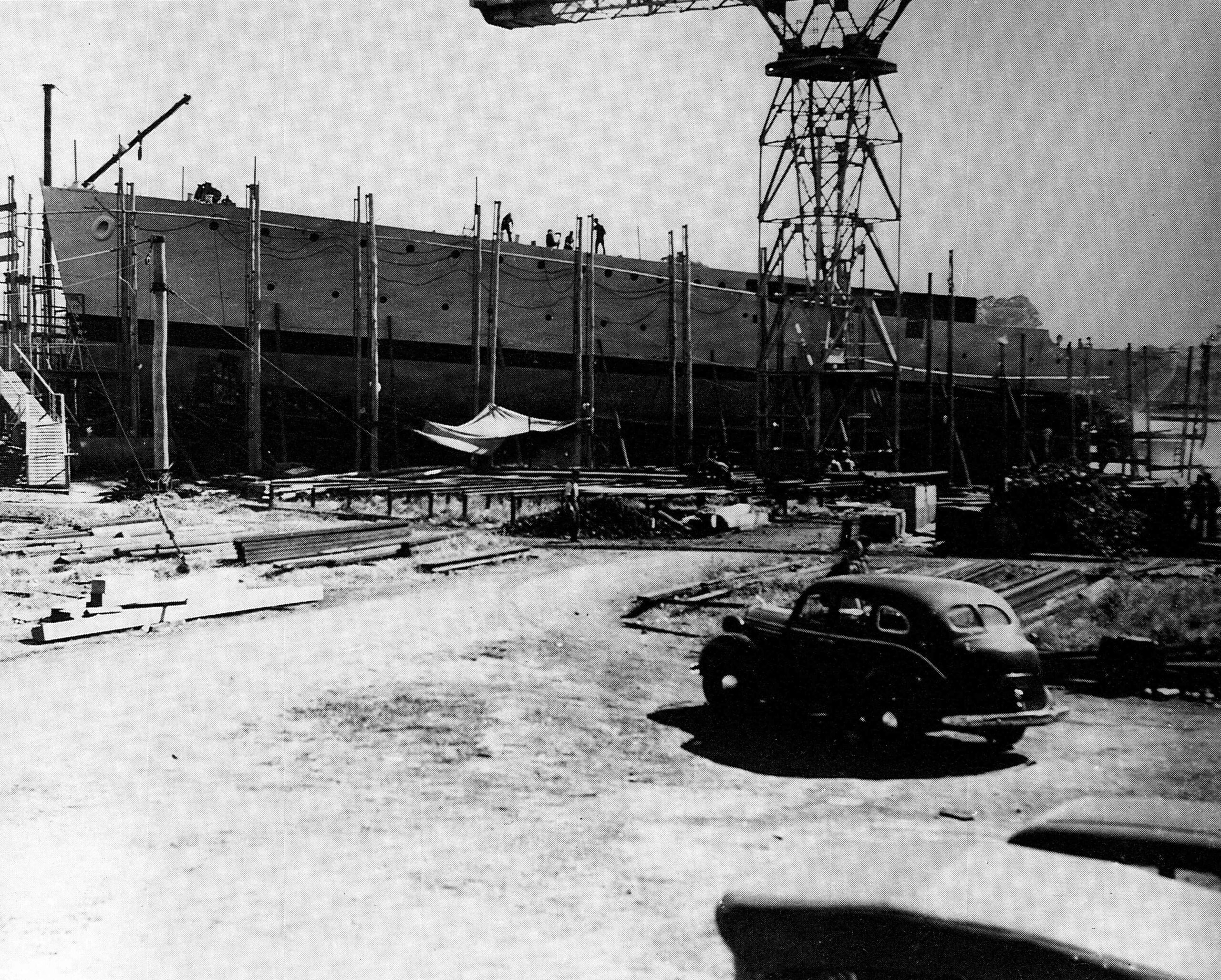
PHOTO: RAN
Of major importance to the Australian shipbuilding industry was the laying down of the first of a class of escorts which eventually totalled 60 units (four for India and 20 built to the Admiralty’s account but manned by the RAN). Known initially as Australian Minesweepers (AMS) and later as ‘corvettes’, these vessels were conceived as an economical design capable of being built in small Australian shipyards. They were designed for coastal patrol work with an anti-submarine and minesweeping capability. For the first time, rather than importing equipment, Australian made items such as auxiliary machinery, electrical equipment, armament and ammunition were to be used almost exclusively, and orders for these ships were placed at seven different shipyards. Nineteen of these versatile vessels were laid down in 1940 and the first, HMAS Bathurst, was commissioned on 6 December of that year.
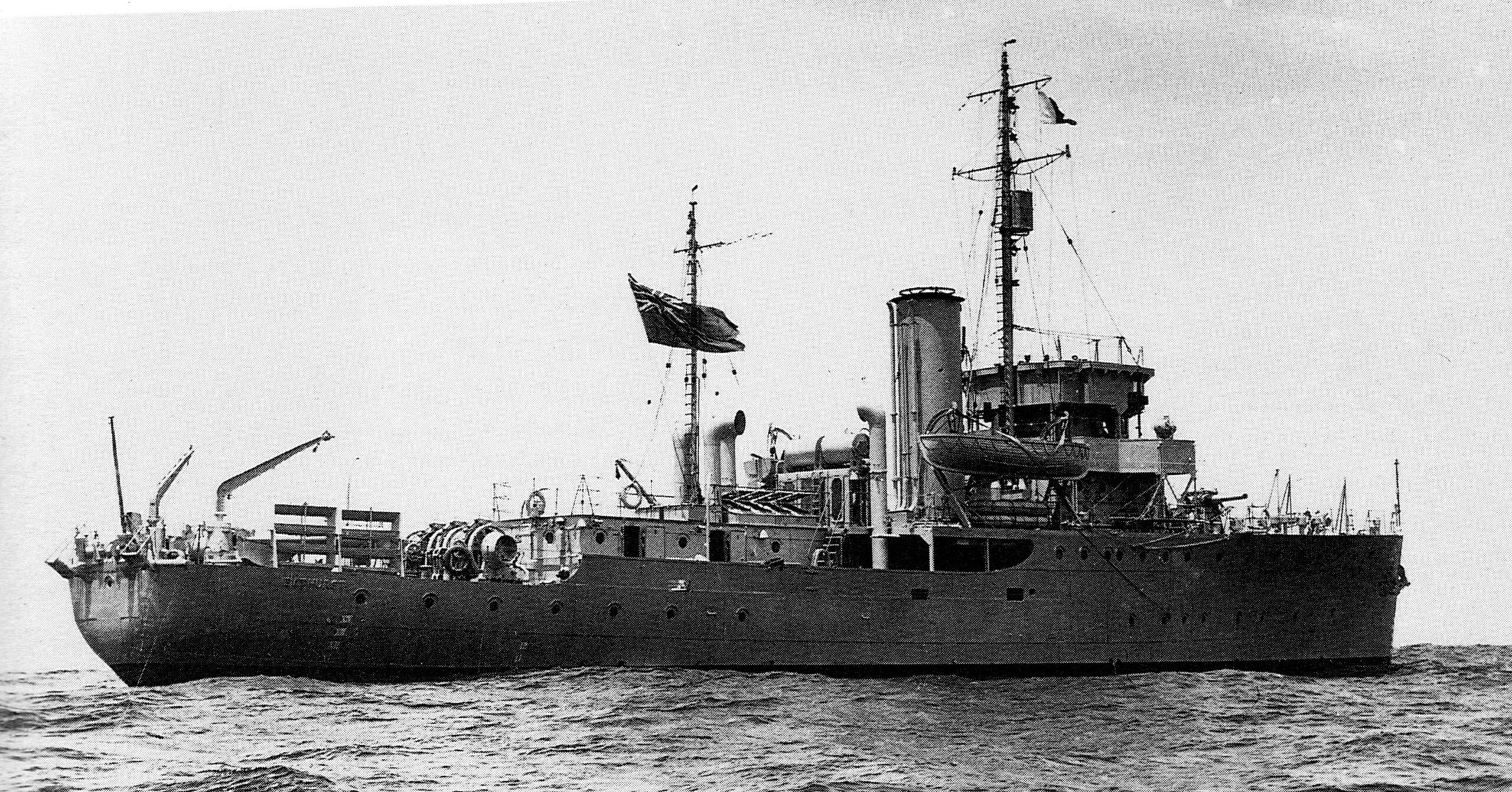
PHOTO: RAN
In addition to shipbuilding, the dockyards, especially Garden Island, were kept busy in repairing, refitting and converting ships for their wartime roles. The myriad of tasks performed included the construction of launches, the conversion and arming of small ships for minesweeping and anti-submarine work and the fitting of defensive armament to merchant ships. Two of the more important tasks were the conversion of the liner Manunda to a hospital ship and the partial refitting and degaussing of the battleship HMS Ramillies. In May approval was given by the War Cabinet for the construction of the Captain Cook Graving Dock.
As the Axis powers extended their occupation of Europe, from April the RAN took steps to secure the shipping of the occupied countries by intercepting those ships at sea and, where necessary, placing armed guards aboard those due to undertake a voyage. When Italy entered the war on 10 June the armed merchant cruiser HMAS Manoora (Commander A.H. Spurgeon RAN) hunted down the liner Romolo which scuttled herself south-west of Nauru on 12 June.
The fall of France in June 1940 had far-reaching effects on Australia’s strategic outlook. The loss of the French Fleet made it more difficult for Britain to send a useful naval force to the Far East should Japan enter the war, an event that appeared more and more likely as French Indochina was absorbed by the Japanese and a military alliance was concluded with the Axis powers. Of more local concern was the situation in New Caledonia where a pro-Vichy administration governed a pro-de Gaulle populace. As New Caledonia straddled vital lines of communication between Australia, the Pacific and the United States it was important that it should be firmly in Allied hands.
There had even been some concern that with the fall of France the colony might be ceded to Japan. In September HMAS Adelaide (Captain H.A. Showers RAN) escorted the Gaullist French Resident Commissioner in the New Hebrides to Noumea and supported his installation as Governor of New Caledonia.
Given the deteriorating situation in Europe it was difficult to justify the retention of major units on the quiet Australia Station. Consequently, there was an exodus of Australian warships to areas nearer to combat.
HMAS Hobart proceeded in April from the East Indies to the Red Sea: May saw Sydney join the Mediterranean Fleet and the Australia deploy to the South Atlantic. In June the Westralia was transferred to the East Indies Station and the next month the Australia went to the United Kingdom and the Canberra to the South Atlantic for two months. The Parramatta and Yarra were sent to the Red Sea in July and September respectively.
The Australian Destroyer Flotilla or the Scrap Iron Flotilla as it would become known, had been with the British Mediterranean Fleet since the end of 1939. Prior to Italy’s declaration of war on 10 June the flotilla was involved in convoy work and serving on the screen of the battle fleet. Between 26 and 28 March, Stuart was involved in the salvage of the British tanker Trocas which had broken down in heavy seas and strong winds off Italy.
On 26 May Sydney (Captain J.A. Collins RAN) joined the Fleet, becoming part of the 7th Cruiser Squadron. The next day the Australian destroyers were joined by four British destroyers to form the 10th Destroyer Flotilla and Commander Waller was promoted to Captain in command. After the Italian declaration of war the Australian ships made a significant contribution to the work of the Mediterranean Fleet. There was a continual round of patrols, escort duty on convoys to Malta and through the Aegean, bombardments in support of the Army and Fleet operations. Italian bombing was common.
In addition to these routine operations, which are the essence of the exercise of sea power, the Australian ships had their share of battles. On 28 June the 7th Cruiser Squadron engaged an Italian force of three destroyers, sinking the Espero before the remainder escaped in poor light. On 6 July Sydney, Stuart, Vampire and Voyager were involved in the action off Calabria where the Italian Fleet withdrew after its flagship had been hit by fire from the British flagship.
Early on the morning of 19 July Sydney achieved a resounding success while supporting four British destroyers, HM Ships Hyperion, Hasty, Hero and Ilex, on an anti-submarine sweep north of Crete. A fifth destroyer, HMS Havock, accompanied the Sydney. The destroyers were engaged by the two Italian cruisers Giovanni DeIle Bande Nere and Bartolomeo Colleoni. The destroyers drew the Italian cruisers onto the Sydney’s guns. Taken by surprise and mistaking the Havock for a second cruiser the Italian admiral turned away. In the ensuing stern chase the Sydney hit the Colleoni stopping her. She was finished off by destroyer torpedoes. The Bande Nere eventually escaped by dint of superior speed although not before the Sydney had inflicted damage and casualties. After the action the cruiser returned to Alexandria to a triumphant welcome by the Fleet. Captain Collins received an immediate CB. The Sydney was again engaged in a surface action in the early morning of 12 November when the 7th Cruiser Squadron destroyed an Italian convoy in the Straits of Otranto.
The Australian destroyers took part in a number of anti-submarine operations and on 30 September the Stuart sank the Italian submarine Gondar, a remarkable feat in itself.
Meanwhile RAN ships were also in action in the Red Sea where the cruiser Hobart (Captain H.L. Howden RAN) transported troops to British Somaliland in June. By August it had become necessary to evacuate British Somaliland and the troops were embarked from the port of Berbera between 16 and 19 August, Captain Howden acting as Senior Naval Officer. The sloops Parramatta and Yarra were also in the Red Sea, engaged mainly in convoy escort duties. They were often bombed and on one occasion Yarra was in action with Italian destroyers which unsuccessfully attacked a convoy for which she was part of the escort.
The ships deployed to other stations carried out the patrol and escort duties with which they had become familiar on the Australia Station. The Australia was to venture as far as Bear Island. In September she took part in an unsuccessful operation to install a Gaullist force in Dakar in Senegal in the course of which she heavily damaged the large French destroyer L’Audacieux. These overseas deployments left only the Manoora, Adelaide, Perth and, from September, Canberra on the Australia Station in the latter half of 1940 and it was just at this time that German raiders struck. On 7 November the steamer Cambridge was mined and sunk off Wilsons Promontory. The next day the City of Rayville suffered the same fate off Cape Otway as did the Nimbin on 29 November off Norah Head. On 7 December the Hertford was mined in Spencer Gulf but reached port safely. Minesweeping operations quickly swept up sufficient mines to allow reasonably safe passage. However, many mines were sighted and exploded at sea or washed ashore in subsequent years and the fields could not be considered totally cleared until postwar sweeping operations were concluded.
The mines had been laid by the German raider Pinguin and her tender Passat. They had come from the Indian Ocean where the Pinguin had sunk a number of merchant ships and captured the Passat (ex-Norwegian Storstad). They returned to the Indian Ocean where Pinguin sank four more ships before proceeding to the Antarctic.
Previously the raider Orion had mined the Hauraki Gulf off New Zealand in June causing the loss of one ship and then, after operating in the Pacific, steamed southwards through the Coral and Tasman Seas sinking two ships. The raider then moved to the south of the Australian continent before proceeding to a rendezvous with another raider, the Komet in the Carolines. The two raiders operated in New Zealand waters sinking two ships, then proceeded to Nauru and conducted a highly successful attack which netted them five ships between 6 and 8 December. Komet returned on 27 December and shelled installations on the island.
Despite these German successes at the end of the year, 1940 was a year of enormous transition for the RAN. The Navy had sent its ships and men to every ocean in the world. They had performed admirably all those unspectacular routine tasks which are necessary for maintaining command of the sea and had amply demonstrated high standards of leadership, training and morale in battle. Of great importance was the support infrastructure that was being steadily strengthened in Australia. It was to prove invaluable in the years ahead. In now seems that 1940 was the calm before the storm.