
This paper has been developed from material provided by renown vexillographer John Vaughan OAM and other sources to recognise the origin and evolution of flags flown by the Royal Australian Navy and Merchant Navy. Both share this anniversary with the National Flag. The Naval Historical Society is most grateful for the ongoing support of John both as a member and services to Australia. We also thank Doug Shaw, President, Flag Day Australia for his assistance with this paper.
On 3 September 2026 Australia celebrates the 125th anniversary of the launch of the Australian National Flag (ANF) in 1901. This followed the Federation of Australia on 1 January 1901, which was the formation of the Commonwealth of Australia.
The original flag was slightly different to its present-day form (which started in 1908), in that each star of the Southern Cross on the original flag had a unique number of points and size, showing the brightness of each star.
On 3 September 1901, the Prime Minister, Sir Edmund Barton was the master of ceremonies for the first raising of the Australian blue national flag over the Royal Exhibition Building, Melbourne, the initial Parliament House.
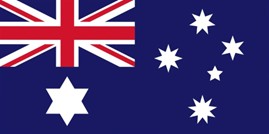
By 1903, the stars of the Southern Cross were standardised, with seven points each while the smaller star remained at 5 points.
In 1908, the Commonwealth star was changed from 6 to 7-points, with 6 points representing the states, and the 7th point representing all federal territories.
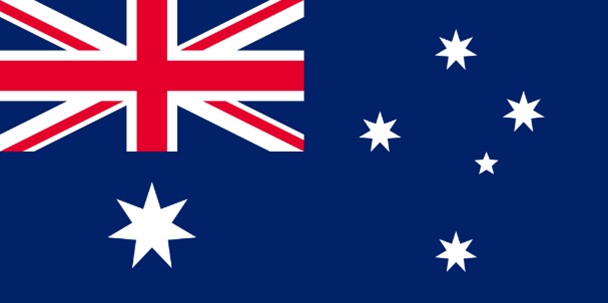
In 1996, the Governor-General, Sir William Deane formally proclaimed 3 September as Australian National Flag Day.
Incorporation of the Union Jack into the flag reflects the origins of our constitutional and institutional roots relating to the UK, the Commonwealth Star the unity of all Australians in our states and territories. The constellation of the Southern Cross indicates our nation’s position in the southern hemisphere. The Southern Cross serves to link Australians of all origins together in our Commonwealth to the many Indigenous legends of the Southern Cross, united under our national flag of “Stars and Crosses”.
1823 Australian National Colonial Flag
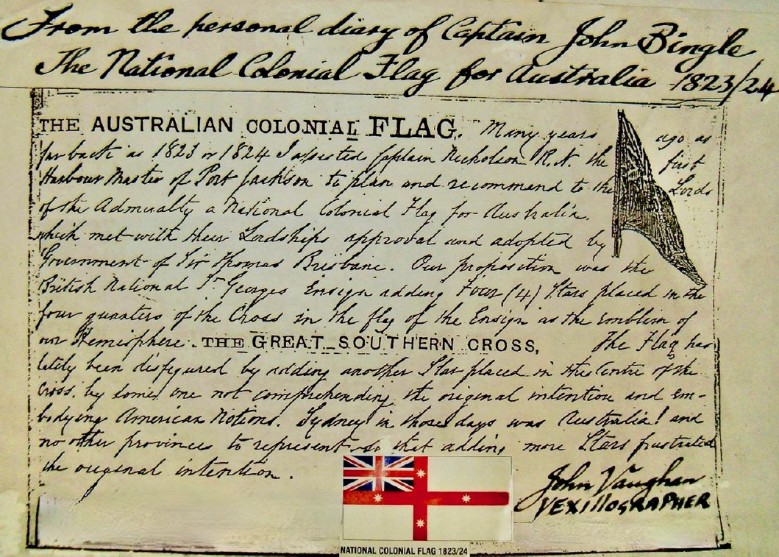
The 1823 National Colonial Flag represents the first recorded attempt to design a distinctive, unified national flag for Australia.
Based on the White Ensign of the Royal Navy, popularised by the Victory at Trafalgar the flag features a white background divided by the red, naval cross of St George, with the Union Jack situated in the upper-hoist quarter (the canton). Crucially, it added four white, eight-pointed stars—one positioned on each arm of the red cross—to symbolize the constellation of the Southern Cross.
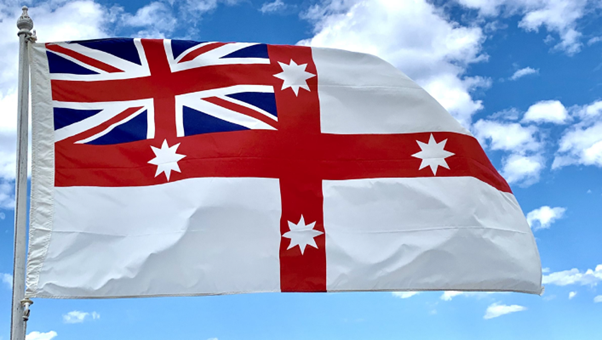
The flag was co-designed by Captain John Bingle and Captain John Nicholson (the Harbour Master of Sydney), both prominent residents of New South Wales. According to Captain Bingle’s personal journals, the design was officially accepted and adopted in 1823 or 1824 as a national colonial flag by the Government of Sir Thomas Brisbane, who served as the Governor of New South Wales from 1821 to 1825.
This design established a major aesthetic tradition in Australian vexillology. It was the very first time the Southern Cross and the Union Jack were combined on a single flag—a structural layout that directly influenced later designs like the ‘Australian Ensign’ from 1831 later known as the Australian Federation Flag and, ultimately, the Australian National Flag.
Australian Red and Blue Maritime Ensigns
The ANF was selected by the unique public design competition in 1901. The newly formed Government accepted the flag judges report and designated the Australian Blue Ensign as the flag of the Commonwealth and the Red Ensign as the official flag of the Merchant Navy and private pleasure craft. The Commonwealth Naval Forces thus adopted the Blue Ensign as the flag of Commonwealth vessels.
Though the Commonwealth Government Gazette No 8 of 1903 clearly specified the role of the red “Merchant Flag”, the Government did cause confusion in the first half of the 20th century by claiming exclusive use of the blue Australian flag.
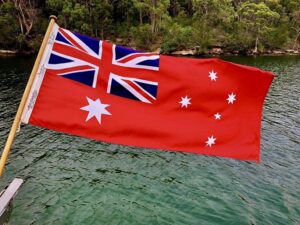
This etiquette was clarified with the passage of the Flags Act 1953 which confirmed under law the title of the Blue Ensign as the Australian National Flag. In 1981 the Shipping Registration Act confirmed the Australian Red Ensign as the official flag (“National Colours” afloat) to be flown at sea by Australian registered merchant ships. It can also be flown on land by organisations and individuals for ceremonial purposes such as Merchant Navy Day, 3 September annually. When the Australian Red Ensign is flown ashore along with the Australian National Flag, the Australian National Flag is flown in the position of honour, at sea the Red Ensign is recognised internationally as having the status of our national flag.
Commonwealth Naval Forces
From 1902 to 1911, the Commonwealth Naval Forces flew the Australian Blue Ensign.
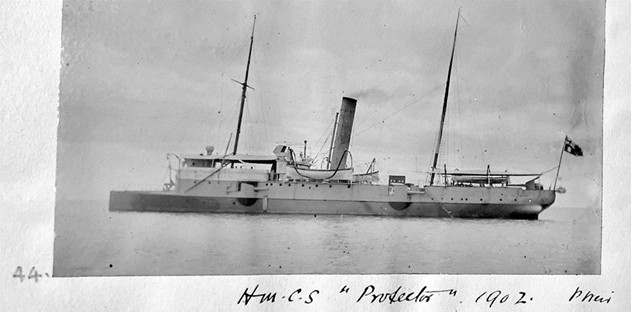
Protector was built for the South Australian government in the UK in reaction to the colonies’ long-standing fear of a threat from Russia. In the 1870s. William Jervois, the colony’s governor believed the Russian navy, if war broke out with Britain, would harass South Australia’s merchant ships to disrupt its economy. Protector was intended to defend South Australia’s coastal ports and towns from seaborne assault as part of a larger coastal defence system comprising shore-based artillery batteries, a submarine mining (or torpedo) station at the North Arm in Port Adelaide, and volunteer militias.
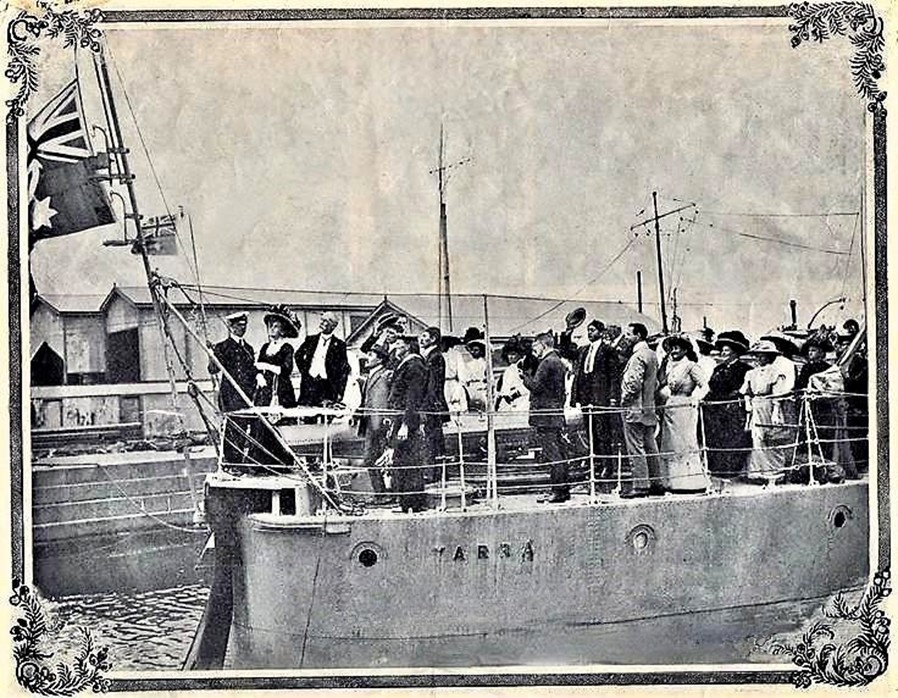
HMAS Yarra (I) was one of 6 River class torpedo boat destroyers built for the Royal Australian Navy (RAN) between 1909 and 1916. During the First World War they formed the Australian Destroyer Flotilla. Yarra was commissioned as HMS Yarra at Greenock on 10 September 1910 and departed Portsmouth on 19 September 1910 as a Royal Navy ship for the voyage to Australia in company with HMAS Parramatta (I) and escorted by HMS Gibraltar. They arrived at Broome, Western Australia, on 15 November, where the 2 destroyers passed to the control of the Australian Government. On entering Australian waters HMAS Parramatta lowered her RN White Ensign and hoisted the Australian Blue Ensign as the Admiralty had not granted permission for the Imperial White Ensign to be worn by ships of the Commonwealth Naval Forces.
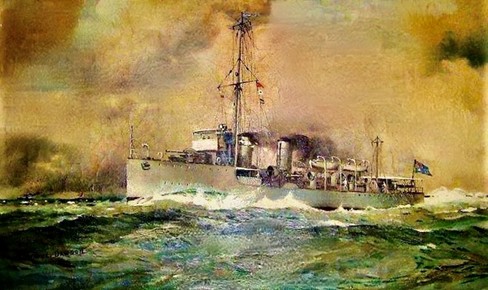
Royal Australian Navy – Imperial and Australian White Ensigns
Use of the white ensign in Australia evolved from reliance on the Royal Navy until Federation to the distinctively Australian White Ensign from 1 March 1967.
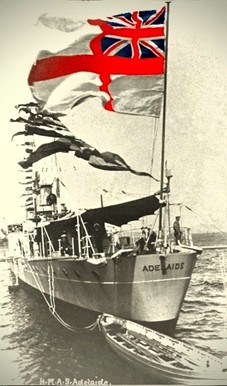
Prior to and immediately after Federation, Australia’s naval forces were divided into separate colonial navies (and later the Commonwealth Naval Forces). When operating outside local colonial waters, these ships were often temporarily commissioned into the Royal Navy (RN) and flew the Imperial White Ensign which features the Union Jack in the canton and a large red St George’s Cross on a white field. The Commonwealth Naval Forces flew the Australian Blue Ensign from 1902 to 1911.
From its inception in 1911 the Royal Australian Navy flew the Royal Navy’s Imperial White Ensign which had been flown since 1864 when its status as the principal ensign of the Royal Navy was specified. There were proposals at the time that a distinctively Australian flag should be adopted but these were overruled by the Admiralty who considered it more appropriate and less confusing that all Commonwealth navies should continue to fly a common ensign.
This flag arrangement had sentimental appeal and was accepted for many years as the RAN had been founded upon the traditions, regulations, laws and procedures of the Royal Navy and its officers underwent much of their training in UK and most RAN ships, aircraft and material continued to be of UK origin or design.
An initiative by the Chief of Naval Staff, Vice Admiral Sir Alan McNicoll in 1965 to make RAN ships readily identifiable, particularly when projecting Australia national policies as a sovereign nation and independent of overseas control, change came about in 1967 with the involvement of RAN ships in the Vietnam War. It was inappropriate to fly an ensign identical with that of another country not engaged in the war.
Australian White Ensign first flown on 1 March 1967, by the requisitioned cargo ship HMAS Boonaroo. She was the first ship commissioned under the newly created Australian White Ensign. Image courtesy of Royal Australian Navy.
The Royal Australian Navy adopted the distinctive Australian White Ensign in 1967. The Australian White Ensign is an Australian National Flag with a white background and blue stars. It is flown from the stern of naval vessels and at the peak of the gaff at sea. The Australian National Flag is flown from the bow in port and as a Battle Ensign when at Action Stations.
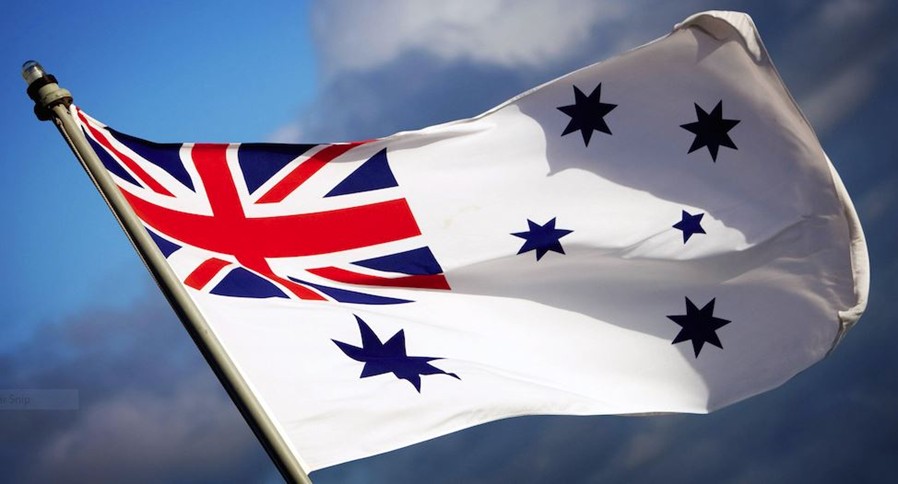
Australian White Ensign flying on the requisitioned cargo ship HMAS Boonaroo. She was the first ship commissioned under the newly created Australian White Ensign. Image courtesy of Royal Australian Navy.
References:
Department of Prime Minister and Cabinet, National Symbols. Australian Flags booklet and website at, Australian flags.
Flag Day Australia, www.FlagDayAustralia.com.au
Australian National Flag Association, NSW, Flag History.
Rivett, Norman C, Fifty Years under the Australian White Ensign, published in the March 2017 edition of the Naval Historical Review,
The Australian White Ensign published in the June 2002 edition of the Naval Historical Review.
Sea Power Centre – Australia, Unit Histories.