- Author
- A.N. Other
- Subjects
- History - general
- Tags
-
- RAN Ships
- None noted.
- Publication
- June 2025 edition of the Naval Historical Review (all rights reserved)
By Walter Burroughs
This story is a tribute to Gerald Ellott our New Zealand correspondent whom we unfortunately, never met. At the age of 99 he passed away on 6 December 2024.
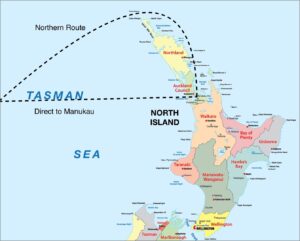
| A member of the NHSA recently asked us to assist with research relating to the loss of HMS Orpheus on the bar at the entrance to Manukau Harbour on the west coast of New Zealand on 7 February 1863. With the loss of 189 lives it was New Zealand’s worst maritime disaster. |
This led us to explore further the interaction of shipping between Port Jackson and Manukau. Claiming some personal interest, the author sailed from Onehunga and safely through the bar at Manukau on 31 August 1965 as Second Mate in the Northern Steamship Company coastal ship Tawanui. Moving forward nearly sixty years he now finds himself an honourable member of the New Zealand ‘Fencible’ Society!
Manukau Harbour and the Port of Onehunga
The west coast of New Zealand’s North Island contains two large inlets open to the Tasman Sea, but both hindered by treacherous sandbars, which exposed to the pounding of strong westerly swells, are liable to shift. The northern most and largest of these is Kaipara and slightly smaller to the south is Manukau.
The importance of the latter is its proximity to Auckland, the main settlement and first capital of the New Zealand colony. Taking advantage of prevailing westerly winds Manukau lies south-east of Port Jackson and is considerably closer, by 250-nautical miles, than proceeding around the top of North Cape and down the east coast to Auckland.
One of the earliest Europeans to visit the Manukau was the pioneering missionary Samuel Marsden who having befriended Māori visitors to Sydney gave him protection when making voyages from Sydney to the Bay of Islands. He was also able to assist HMS Coromandel seeking procurement of New Zealand timber for naval shipbuilding. This enterprising parson first paddled a native canoe across the waters of the Manukau on 9 November 1820.
In 1835 Thomas Mitchell a Sydney-based timber merchant chartered the schooner Fanny under command of Thomas Wing to take him and a missionary, the Reverend William White, into the Manukau. Mitchell negotiated with local Māori leaders for the purchase of 40,000-acres in return for 166 gold sovereigns, 1,000 pounds’ weight of tobacco, 100 dozen clay pipes for smoking tobacco, and six muskets.
The following year Mitchell moved to this property on the northern shore of the Manukau and established a timber mill. Regrettably six months later he died there by drowning. In 1851 a pilot station was established and Captain Thomas Wing, who had conducted detailed surveys of the harbour and its bar, was later made harbour master and pilot, a position he held for the next 30-years. It took until 1874 for a lighthouse to be built at South Head some 385-feet above sea level with oil lamps visible 26-miles to seaward.
Visits
From these humble beginnings the Port of Onehunga evolved and was at times used as a base for visiting Royal Navy ships. In 1861 Captain Wing reported that during the calendar year 23 war steamers, 31 merchant steamers, nine sailing vessels and 48 coastal vessels entered the harbour.
While the first capital of the New Zealand colony was at Auckland facing the east coast the quickest passage from the New South Wales capital of Sydney was via Manukau on the west coast, and only a few land miles from Auckland. Accordingly, shipping preferred, but not exclusively, to trade between Manukau and Port Jackson. In an early description the Reverend Rowe (1863) said: Manukau Harbour is only six miles to the west, reckoning by the road, along with the pensioners’ settlement of Onehunga is fast advancing to meet the suburbs of the capital. Manukau Harbour itself has a channel deep enough to admit vessels of the largest class and is unencumbered by the usual sandbank off its mouth.

Calliope Graving Dock
The opening of the Calliope Graving Dock in Auckland in 1888 with associated workshops became the impetus for a naval base. Now, without the need for ships to return to Sydney for docking and refit this spelt the end of the Manukau as a naval facility.
However, on 9 October 1899 the Auckland contingent of volunteers for the Boer War departed from Onehunga in the steamer Rotoiti bound for Wellington where they would join the first troops to sail for South Africa. This amazing small port continued to prosper during both world wars. In the latter conflict American troops were based at Onehunga and Fairmile B patrol boats were also built there. In 1962 a survey of the harbour approaches was conducted by the Royal New Zealand Navy hydrographic department who found the once treacherous bar no longer constituted a major hazard. This was nearing the zenith in the port’s history when in the following year Onehunga was described as “perhaps the most successful secondary port in New Zealand and has shown a remarkable rise in trade, with every other coastal port showing a decline.”
A record was achieved in 1967 when 293 ships visited the port. But this was short-lived, with trade moving to larger ships and interstate goods moving to road transport a decline set in. By 2017 the once proud Port of Onehunga waved farewell to its last commercial ship and so came to an end 180-years of shipping history. The port is now used extensively by fishing vessels.
The Māori Wars – now known as the New Zealand Wars
With a mild climate and fertile land New Zealand was especially attractive to British migrants who came in droves from the 1840s. There were inevitable disputes over land with the indigenous population resulting in conflict which escalated into a series of wars. The colonial government brought in numerous heavily armed troops and naval forces against local tribes who fought admirably, but in an uneven contest the result was never in doubt.
Earlier, on 7 February 1788 Captain Arthur Philip RN had formally taken possession of the Colony of New South Wales which at that time included adjacent islands to the westward including New Zealand. It was not until 1 July 1841 that Captain William Hobson RN took formal possession as Governor of the independent Colony of New Zealand.
Earlier conflicts resulting in inter-tribal warfare were known as the ‘Musket Wars’ which were fuelled by the indiscriminate availability of European muskets leading to the deaths of thousands of Māoris. They used muzzle loading single shot, often smooth bore guns, of thankfully limited rate of fire.

It was not until 1867 that the Royal Navy began converting its standard Pattern 53 Enfield muzzle loading rifle to a breach loader using the Snider mechanism, and the far more lethal Henry repeating magazine fed rifles did not come into use until the 1870s.
A growing involvement
The 26-gun frigate HMS Iris was the first flagship of the Australia Station under command of Commodore William Loring RN. She arrived on station in 1859 and was soon involved in New Zealand unrest and politics leading to the early resignation of the Commodore. A Naval Brigade of 150 officers and men with 12-pounder guns from Iris was sent to assist land forces to suppress a rebellion in Taranaki.
The Naval Brigade grew to over 600 men drawn from various other Royal Naval ships and the Victorian Colonial ship HMCS Victoria1. Most of the RN shipping was based at Auckland, but HM Ships Harrier and Eclipse became the guardians of Manukau, with HMS Cordelia and Victoriaacting as transports between Manukau and other ports.
To assist in colonial defence, in 1861 the New Zealand Government acquired a small (60-foot-long and displacing 40 tons) commercial paddle steamer Avon, then in Lyttelton. In 1862 she steamed to Onehunga and was refitted with iron plating and armed with a 12-pounder gun and a rocket tube. In addition, four armoured barges (30 to 35-foot-long) were prepared as troop transports.
Avon and her barges were towed to Waikato Heads by HMS Eclipse on 25 July 1863. Another stern paddle wheeler, Waikato (140-foot-long and displacing 300-tons), was built by the Australian Steam Navigation Company at its Pyrmont shipyard to navigate her namesake river.
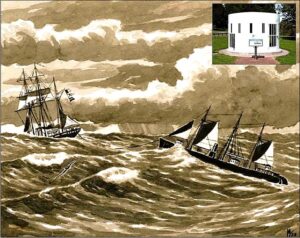
In April 1863 Commodore William Wiseman RN, in HMS Curacoa, assumed command of the Australia Station. A small convoy departed from Port Jackson on 22 September 1863 comprising HMS Curacoa and Eclipse towing Waikato, which had been acquired by the New Zealand Government.
In heavy weather the major warships lost sight of one another with Curacoa continuing to Auckland and Eclipse and her tow to the Manukau. They all arrived at their destinations at roughly the same time on 2/3 October. A detachment was marched from Curacoa to Onehunga where they took command of Waikato which was now armed as the New Zealand Colonial ship Pioneer. Included in this detachment was Midshipman Cecil Foljambe2 who kept a journal of his time in Pioneer3.
Two more stern-wheel iron gunboats, named Koheroa and Rangiriri, were also built in Sydney and taken in sections to the Government dockyard and stores depot at Port Waikato where they were commissioned in 1864. A number of other small vessels were requisitioned by the colonial government for use in riverine warfare.
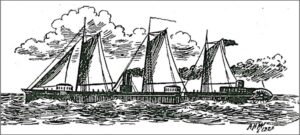
In summary, during the main battles of the New Zealand Wars between 1859 and 1865, a total of 12 naval ships were involved in supporting land forces with 1,198 New Zealand medals awarded to officers and men of the Royal Navy and Royal Marines.
Two Victoria Crosses were also awarded; the first to Leading Seaman William Odgers from HMS Niger for displaying conspicuous gallantry in storming by the Naval Brigade of a native stockade at Taranaki in 1860, and secondly, to Able Seaman Samuel Mitchell of Harrier in 1864 during an
attack by the Naval Brigade at Tauranga (Gate Pa) where disregarding an order, to retire and look to his own safety, he recovered his mortally wounded commanding officer, Commander Edward Hay RN, who before dying, recommended Mitchell be recognised for his great act of bravery.
The Royal New Zealand ‘Fencibles’
The term ‘Fencible’ is derived from defensible used to describe regiments raised from retired servicemen for local defence and garrison duties. They were used in Britain during periods of unrest and threats of invasion where mainly military pensioners still fit enough for military service formed a limited reserve force and in return, received a small payment.
When Captain Arthur Phillip RN returned home after his service as the first Governor of New South Wales he was given a semi-retirement position in command of the Hampshire Sea ‘Fencibles’.
Owing to the potential threat to the small European settlements from a native uprising the Governor, George Grey, sought 2,500 troops to defend the colony with 1,000 of these being reservists who could also be employed to support the capital. This was refined into a scheme whereby a small garrison of Imperial troops was sent to the colony in two transports followed by a detachment of reserves known as the Royal New Zealand ‘Fencibles’ (RNZF). These personnel first arrived in four ships in 1847, followed by a further six ships, with the to last arrive in 1852.

The RNZF were recruited in Britain from abled bodied men with previous military service in the Army or Marines, of good character and under the age of 48. They would retain current military pensions and in addition during their seven- years’ service as a ‘Fencible’ receive a further payment from six-pence to one-shilling and three-pence-per-day. They and their families would be shipped to New Zealand free of charge where they would be granted an acre of land on which a rent-free, two-roomed cottage, would be built to accommodate them.
The cottages were built on the dividing line of adjacent allotments, so they were semi-detached dwellings built of prefabricated wood with roofs of thatched flax, but the chimneys and fireplaces were of brick imported from Sydney.
Many ‘Fencibles’ came from Ireland which suffered from unemployment and poverty. The families would live in a number of armed settlements south of Auckland, as a counter to potential attack from disaffected Waikato Māori, with villages established at Howick, Onehunga, Otahuhu and Panmure. Each village had a schoolhouse which could double as a chapel. With the settlements often unready for occupation many of the cottages were constructed by their future owners.
‘Fencibles’ were obliged to undertake 12-days of military exercises each year and muster under arms with their families at church parades each Sunday. They would be guaranteed work for the first year of their service after which they were encouraged to find local employment. After seven-years the cottage and allotment would become their property.
The first detachment of ‘Fencibles’ sailed from Tilbury on 14 April 1847 in the 750-ton barque Ramilles, arriving in Auckland on 5 August 1847. They were under the command of Major William Kenny of the 73rd Regiment, accompanied by naval surgeon Dr Cunningham and Lt. Colonel Bolton a Royal Engineer. This detachment comprised 67 ‘Fencibles’, 55 wives and 103 children. The first detachment had to make do with temporary ‘raupo’ houses built of reeds and flax over a wooden frame with wattle walls of clay and thatched roofs.
They were followed by further ships bringing a total of 2,581 persons to Auckland. Of these 721 were able bodied men classed as ‘Fencibles’. At the start of this program the European population of Auckland was only 2,800.
An historic village is maintained at Howick showing ‘Fencible’ housing and how the community lived.
In summary, it was a great pleasure to have benefitted from the knowledge of the Royal Navy, the Naval Brigade and the ‘Fencibles’ provided by 98-year-old Gerald Ellott who was married at the historic Howick ‘Fencible’ church and continued to live at Howick. Gerald died in his 99th year, on 6 December 2024.
Notes:
- HMCS Victoria was the first warship built for an Australian colony, arriving at Hobsons Bay on 31 May 1856. After her delivery voyage Victoria was handed over to the colonial government with the complement reduced to just 58 officers and men. During the Māori Wars she was seconded to the Royal Navy with 32 of her crew loaned to the Naval Brigade. Surprisingly during this period, she remained under the Victorian flag. Her crew were envied by other members of the Naval Brigade as they had the latest model of Enfield rifles and received additional pay – the Victorian Government paying a bonus, lest crews deserted to the gold fields.
- Foljambe is an ancient family who came to England with William the Conqueror. Cecil Foljambe was educated at Eton before entering the Royal Navy as a Midshipman and retiring as a Lieutenant. He then had an extensive political career and was elevated to the peerage first as Baron Hawkesbury and later Earl of Liverpool. His eldest son became Governor and later Governor-General of New Zealand.
- HMCS Pioneer provided useful service during the Waikato uprising but on 24 December 1866 she broke her moorings at Port Waikato and drifted out to sea. During an attempt to steam her into harbour she became yet another victim of the Manukau Bar.
References:
Auckland Council Heritage Unit, Onehunga Heritage Survey Report, December 2013.
Brett, Henry, White Wings Vol II – Founding of the Provinces and Old-Time Passenger Ships from 1840-1885, Brett Printing Company, Auckland, 1928.
Ellis, Nicholas L, The New Zealand Naval Forces, in Our Australian Navy, Published J W Ward, Melbourne, 1938.
Ellott, Gerald, Histories of various ships on the Australia Station, available at www.ellott-postalhistorian.com.
Higham, George, Early Manukau: Secrets of Yesterday, self-published T G Higham, Papakura, 1990.
Foljambe, Cecil, George, Savile, Midshipman, New Zealand Wars 1861-1866, Letters from the Foljambe Archive available online.
Rowe, G, The Reverend, The Colonial Empire of Great Britain – The Australian Colonies, The Society for Promoting Christian Knowledge, London, 1863.

