- Author
- Editorial Staff
- Subjects
- History - Between the wars, Royal Navy
- Tags
-
- RAN Ships
- None noted.
- Publication
- March 2025 edition of the Naval Historical Review (all rights reserved)
The city of Melbourne, then the nation’s capital, hosted the fleet, the Special Service Squadron, from 17 – 25 March 1924. The world’s largest and fastest capital ship, the one-of-a-kind battlecruiser HMS Hood, was accompanied by another battlecruiser, HMS Repulse and four light cruisers.
Massive numbers
The visit proved a sensation with over 500,000 visitors to the ships, supported by a RAAF flyover, ceremonial marches, dinners, dances and fireworks. The fleet of six warships, led by the flagship Hood, was commanded by Admiral of the Fleet Vice-Admiral Sir Frederick Field. Sailing with the Fleet, aboard Hood was the heir to the British throne, the Prince of Wales, later King George VIII. Bringing the heir to the throne on a worldwide tour was an added attraction for the crowds. Also travelling with the Fleet was Lord Louis Mountbatten, then a young midshipman.
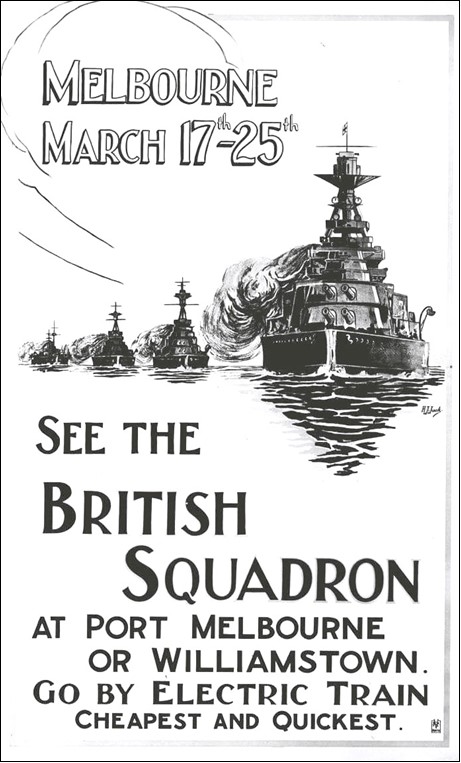
The Melbourne Sun newspaper of 17 March 1924 described the Fleet entering Port Phillip Bay with HMS Delhileading the light cruiser squadron, followed by Hood and Repulse, for all in attendance, a majestic and impressive sight.
The Sydney Morning Herald had earlier stated: The Special Service Squadron comes to us as a great, living symbol of our very safety and protection. From Sydney, the ships headed for Port Melbourne for docking where the crowds would have several days to view the great warships.
Melbourne surpassed all previous welcomes the British Squadron had received. On 17 March Hood and Repulse passed through the sea passage at Port Phillip Heads (50 miles from Melbourne):
Just inside the entrance we were met by a large number of yachts filled with cheering humanity… The whole distance we steamed through lines of boats of every description filled with men, women and children enthusiastically waving… and yelling themselves hoarse.” Wilfred Woolman.
Bad news
On the following day, 18 March, the British Prime Minister Ramsay MacDonald announced to Parliament that his government was suspending construction of the Singapore base in the interest of austerity and international peace.
The government concluded the base was expensive, unnecessary, and contrary to the disarmament spirit of the Washington Treaty. The news was discussed in the Australian national and local press: ..the unpleasant fact is that Australia and New Zealand have now to face is that they will have to rely more on themselves than they have ever done in the past, the Sydney Morning Herald, reported 19 March 19 1924.
At an official dinner at which there was an outlining the Commonwealth naval policy, the Prime Minister (Mr. Bruce) criticised the British Government’s decision to abandon the Singapore base project. Vice-Admiral Sir Frederick Field, in replying to the toast of the visitors, advised Australia about the replacement of obsolescent cruisers. (Friday, 21 March 1924. The Argus).
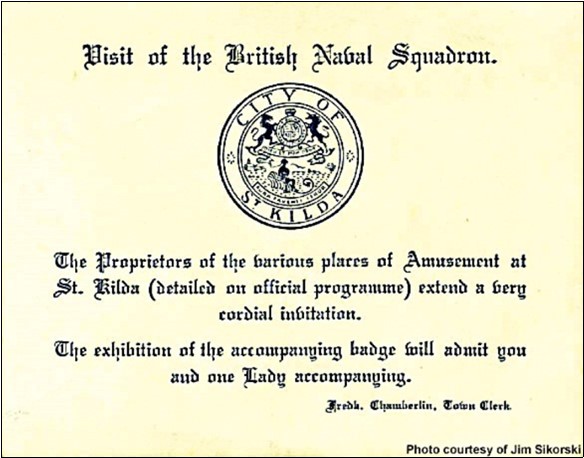
Charles Benstead, an officer aboard Hood also estimated that on the battlecruiser’s first afternoon in Melbourne alone, over 30,000 people visited the ship. An extensive range of entertainments was provided for the crews, including dinner at State Government House, the Lord Mayor’s Ball, excursions into the country, free admission to local attractions and the Governor’s Ball at the Wattle Path Palais (a huge ball room with about 2,000 guests).
Despite the atmosphere of uncertainty, the people in Melbourne and the surrounding area welcomed the sailors. On opening Hood up to visitors, they: Lined every foot of deck space, climbed every ladder, adorned every excrescence upon which a man could stand.(Benstead).
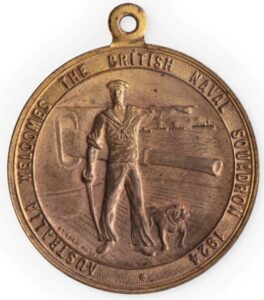
The ships departed Melbourne on 25 March. On leaving Admiral Field, in charge of the Squadron, notified the Admiralty that: It cannot be fully realized in England with what consternation this decision has been received in Australia and I should be failing in my duty if I did not record the impression conveyed to me that this decision has been generally received in Australia with genuine feelings of alarm.
* * * *
Narrative courtesy National Museum of the Royal Navy.