- Author
- Editorial Staff
- Subjects
- History - general
- Tags
-
- RAN Ships
- None noted.
- Publication
- June 2025 edition of the Naval Historical Review (all rights reserved)
The final cruise – A report from ‘our cruiser‘
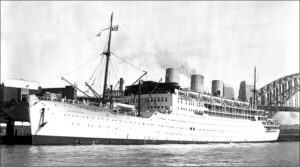
RMS STRATHAIRD
For more than two centuries shipping interests that eventually became the iconic Peninsular and Oriental Steamship Company built an impressive global business. Then, in the early part of this century, the P & O Company was broken up and sold off.
In 2000 its passenger ships were purchased by the American Carnival Cruise Lines, and in 2006, the much larger P & O Maritime Logistics business, mainly involving worldwide cargo handing operations, was sold to the Dubai based DP World. Finally, in 2019 its European ferries were also sold to DP World. The brand name is all that remained of this once dominant part of Britain’s maritime industry, and even this has now disappeared from the Australian lexicon.
The author had the pleasure of being a passenger aboard MV Pacific Adventure on her last ‘mini-cruise’ before the well-known brand of P & O Australia ended on 14 March 2025. This final voyage was not without its pitfalls. Expected to sail from Sydney to Moreton Island, the recent Cyclone Alfred was directly in our path, so the itinerary had to be rapidly changed, and the ship proceeded south about to Twofold Bay and Eden. Twofold Bay is also home to the historic one-time whaling settlement of Boyd Town.
With insufficient cruise berths in Sydney, the small port of Eden has enjoyed a significant increase in tourism, and with a new deep-water berth at Snug Cove, close to the town, it expects to host 46 cruise ships this season. Naval ships also call there for ammunitioning using a separate wharf at the southern side of the harbour. This is connected to an ammunition depot about 15-km distance inland.
While passengers were offered a full refund if they wished to cancel, very few availed themselves of this opportunity. So we sailed with a full complement of about 3,000 passengers and 1,300 crew on the evening of 10 March. Departing from Circular Quay, and backing towards the Harbour Bridge, we then turned to seaward with the attendant tugs giving full vent with their water cannons. As we passed the Opera House a magnificent firework display lit up the harbour to which the ship saluted with her siren.
Upon return to Port Jackson Pacific Adventure passed under the Sydney Harbour Bridge at first light. At nearly 109,000 tons she was one of the largest ships to sail under the bridge, to berth at White Bay. A few hours later, without passengers, she was on her way again, this time to Melbourne to start a makeover to become Carnival Adventure.
P & O – a brief history
P & O originated in Britain in 1837 with the founding of the Peninsular and Oriental Steam Navigation Company. It delivered mail, but soon also carried ‘excursionists’ to Greece, Spain and Egypt. In 1852, P & O won the contract to transport mail to and from Australia, and with this, a regular passenger service, lasted until overtaken by air transport in the 1960s.
With a downturn in passengers and freight caused by the Great Depression, P & O took a gamble and advertised its first Australian cruise in December 1932, this Christmas cruise selling out in 24-hours. The mail liner Strathaird sailed with 1,100 guests from Sydney to Brisbane and Norfolk Island.
Of the ship’s three funnels, only the centre funnel served as a smokestack, the others were just decorative and helped set off her white painted hull, providing quite a glamorous appearance. Prior to this P & O ships with their black hulls looked solid but dour.
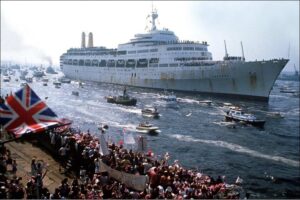
P & O was part of Australian maritime history for some 173-years. The company was also involved in numerous conflicts providing troopships from the time of the Crimean War. Many may recall the fine ship Canberra which spent much of her life gracing our shores, to be requisitioned as a troopship in 1982 during the Falklands War (1), taking a Commando Brigade right into the heart of the conflict. Still painted white, Argentine pilots respected her neutrality thinking her a hospital ship, noting that the liner Uganda also painted white marked with red crosses was used as a hospital ship. At the end of the war Canberra repatriated captured Argentine troops to their homeland. This rust-stained veteran was greeted with rapturous fanfare when she finally returned to Southampton in July 1982 before resuming her normal peacetime role.
From the 1950s, P & O began operating fully fledged cruise ships such as Himalaya, which sailed from Sydney into the South Pacific. Between 1945 and 1972 P & O ships such as Canberra and Oriana carried ‘10-pound Poms’ and other immigrants from Europe to Australia. The ‘Australian run’ peaked in 1969 with 80,000 passengers. In 2000 its cruising arm was split off to create brands including P & O Cruises Australia, which operated ships such as Pacific Sky, Pacific Star and Pacific Jewel.
The Future of Low-Cost Cruising
The last two locally based ships were Pacific Explorer, homeported in Brisbane, and Pacific Adventure,homeported in Sydney. After a short transition in Melbourne, they were renamed Carnival Adventure and Carnival Encounter.
Carnival Corporation CEO Josh Weinstein put the move down to the “strategic reality of the South Pacific’s small population and significantly higher operating and regulatory costs.”
Cunard and Virgin voyages have also pulled out of homeporting in Australia. Carnival Corporation commands almost 60% of the market here with 19 ships operating in the region, so the company remains committed to the local market.
Until recently Adventure and Encounter have been registered in London but under the Carnival banner they are now expected to be registered in Nassau, Bahamas. The Bahamas is a Commonwealth country off the coast of Florida regarded as a ‘Flag of Convenience.’ This means reduced regulation and lower taxes which cut operating costs.
To the dismay of millions of Australians who have sailed on P & O ships, the low budget holiday is now perhaps over as the cost to consumers under the new banner is expected to rise with fares estimated to increase by at least 30%.
Notes
- During the Falklands War over 50 ships were taken up fromtrade ranging from the transatlantic line Queen Elizabeth 2 to the salvage tug Yorkshireman – a feat no longer possible with the much smaller British register of merchant ships.
References
Brown, David: The Royal Navy and the Falklands War, Arrow Books, London, 1989.
Howarth, David & Howarth, Stephen: The Story of P & O,
Weidenfeld & Nicolson, London, 1986.
Johnston, Brian: There goes P & O, Sun-Herald, 16 June 2024.