- Author
- A.N. Other
- Subjects
- History - general
- Tags
-
- RAN Ships
- None noted.
- Publication
- September 2025 edition of the Naval Historical Review (all rights reserved)
by Walter Burroughs
In the far west of New South Wales, near its border with South Australia, lies the city of Broken Hill. Being much closer to Adelaide than Sydney, it even relies on South Australian time. Broken Hill is therefore a long, long way from the sea and it seems incongruous that here lies a memorial to RMS Titanic.
Then the largest ship afloat, Titanic was thought to be unsinkable, but after striking an iceberg she sank on 14 April 1912 on her maiden voyage from Southampton to New York. While exact numbers are disputed, out of 2,240 passengers and crew, some 1,500 perished in this tragedy.
Origin
So why is there a memorial in remote and sunburnt Broken Hill at the start of the ‘Outback’? Firstly, it has much to do with modern communications as the then infant ‘wireless telegraphy’ was the new wonder child, permitting instant news to be broadcast right around the globe. Secondly, the author just happened to be visiting Broken Hill near the 111th year anniversary of this event where an excellent tour guide was aware of its significance.
The memorial stands near the city centre at Sturt Park which commemorates the inland explorations of Army captain and explorer Charles Napier Sturt in 1844-45. Sturt had noticed mineral deposits, but it was not until the late 1860s that silver was discovered at Silverton some 25-km north of Broken Hill. A settlement quickly sprang up and at its peak had more than 3,000 inhabitants, including the famous poet Mary Gilmore who taught in the school and whose image later adorned our $10 bank notes.
In 1883, Charles Rasp a boundary rider from a large sheep station, first realised the commercial significance of mineral deposits at nearby Broken Hill. This led to the formation of the Broken Hill Proprietary Company that began mining arguably the world’s richest and largest deposit of lead, silver and zinc. With these more productive discoveries the mines at Silverton gradually closed, with most of the population moving to the richer deposits.


At the start ore was extracted by hand and taken by camel trains, ox carts and pack mules to South Australia for smelting and export. In 1888 the Broken Hill to Silverton tramway was opened, which in the same year connected to the South Australian narrow gauge rail system. This allowed large scale mining, with ore going to Port Pirie in South Australia, to be exported to Britain, Germany the Netherlands, Japan and the United States. It was not until 1927 that a standard gauge rail line linking Broken Hill with Sydney was opened.
Broken Hill grew so rapidly that by 1907 it was the second largest town in New South Wales after Sydney, with the population peaking at about 35,000 in 1915. During the Great War lead and zinc were critical to the manufacture of ammunition. Now, in 2025, the town has about half this number of inhabitants, with mining remaining important, while tourism has grown in prominence.
But back to the Titanic in time of extremis, water rushing in, lights going out and listing heavily. Many realised that they were doomed when the ship’s band came to the boat deck and played music in a valiant effort to quell panic amongst the passengers. They are said to have been playing the immortal hymn ‘Abide with me’ when the ship was going down, taking these heroic musicians with her.
Abide With Me, first verse:
Abide with me, first falls the eventide.
The darkness deepens, Lord with me abide.
When other helpers fail and comforts flee,
Help of the helpless, oh, abide with me.
These poignant words struck a chord with the many musicians who played in the four principal brass bands, traditional to mining towns, which were a prominent feature of community life in Broken Hill. The bands formed a fund to provide a memorial for their brave fellow musicians who had sacrificed their lives.
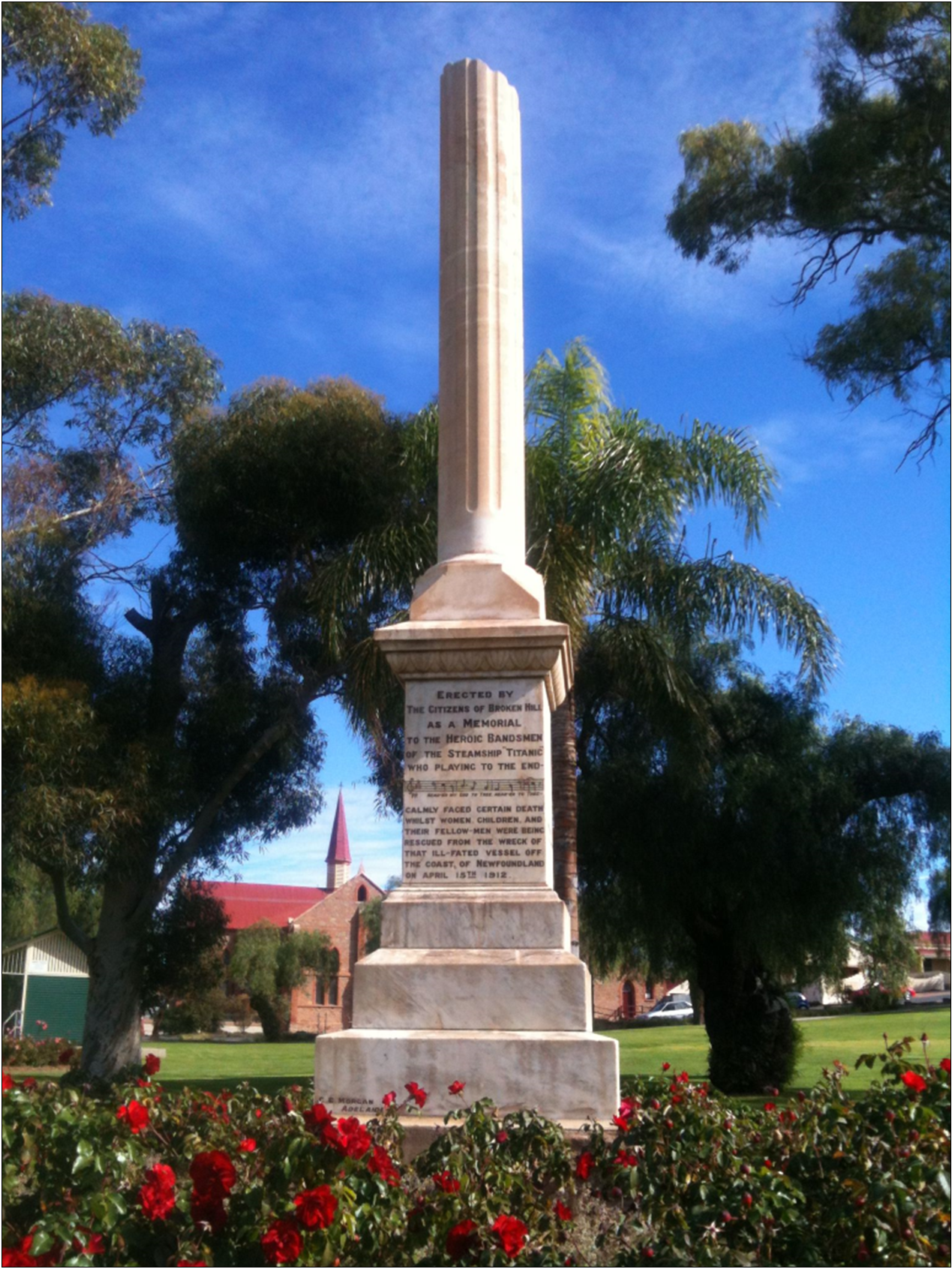
The memorial has at its centre a 5.8-metre-tall marble column with a broken mantle, symbolising life cut short. Monumental mason George E Morgan of Adelaide designed it. On the front there is an inscription telling the story of the Titanic’s brave musicians along with the words of the hymn they played. The reverse side bears the musician’s names.
Only a year after the tragic loss, on 21 December 1913, the monument was unveiled in Sturt Park fittingly adjacent to a rotunda built a few years earlier. Could we organise such a wonderful tribute in this period today? Possibly not as consultation could go on for many years, with political and legal hurdles, allowing further procrastination.
Perhaps finding Titanic in the Outback is best summed up by a homesick Dorothea Mackellar in another literary gem who more than a hundred years ago in an exert from ‘My Country’ wrote:
I love a sunburnt country,
A land of sweeping plains,
Of ragged mountain ranges,
Of droughts and flooding rains.
I love her far horizons,
I love her jewel-sea,
Her beauty and her terror –
The wide brown land for me!
This is not quite the end of our Titanic story, as in another twist of fate, we came across a well-preserved local Synagogue. At one stage Broken Hill had a thriving Jewish community, mostly from the Ukraine, Lithuania, Poland and Russia. Unfortunately, these persons have all but passed away or moved elsewhere and in 1962 the synagogue was closed.
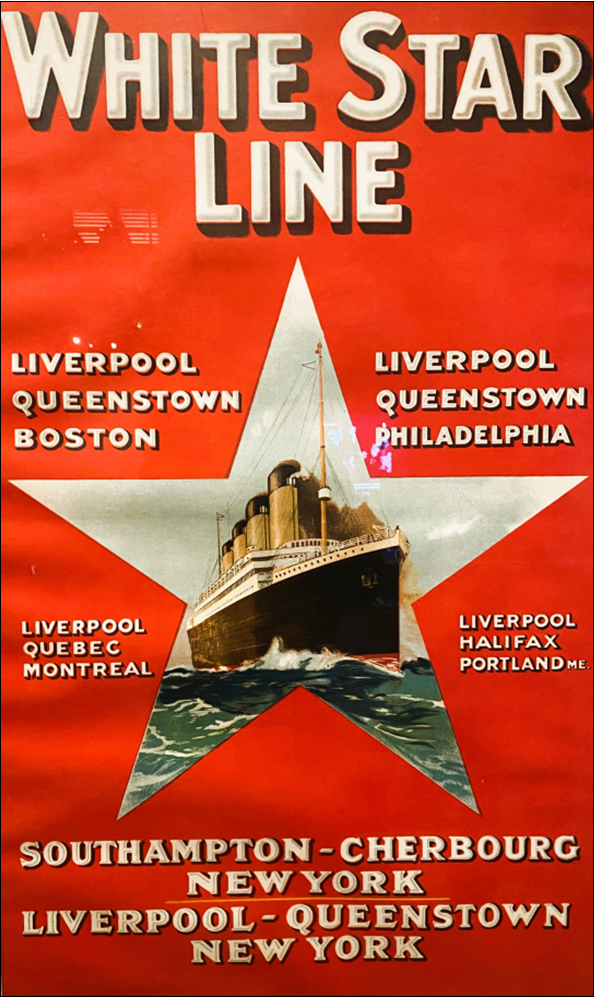
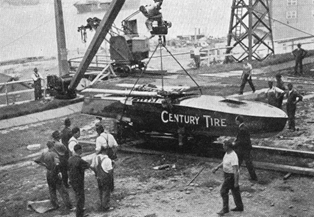
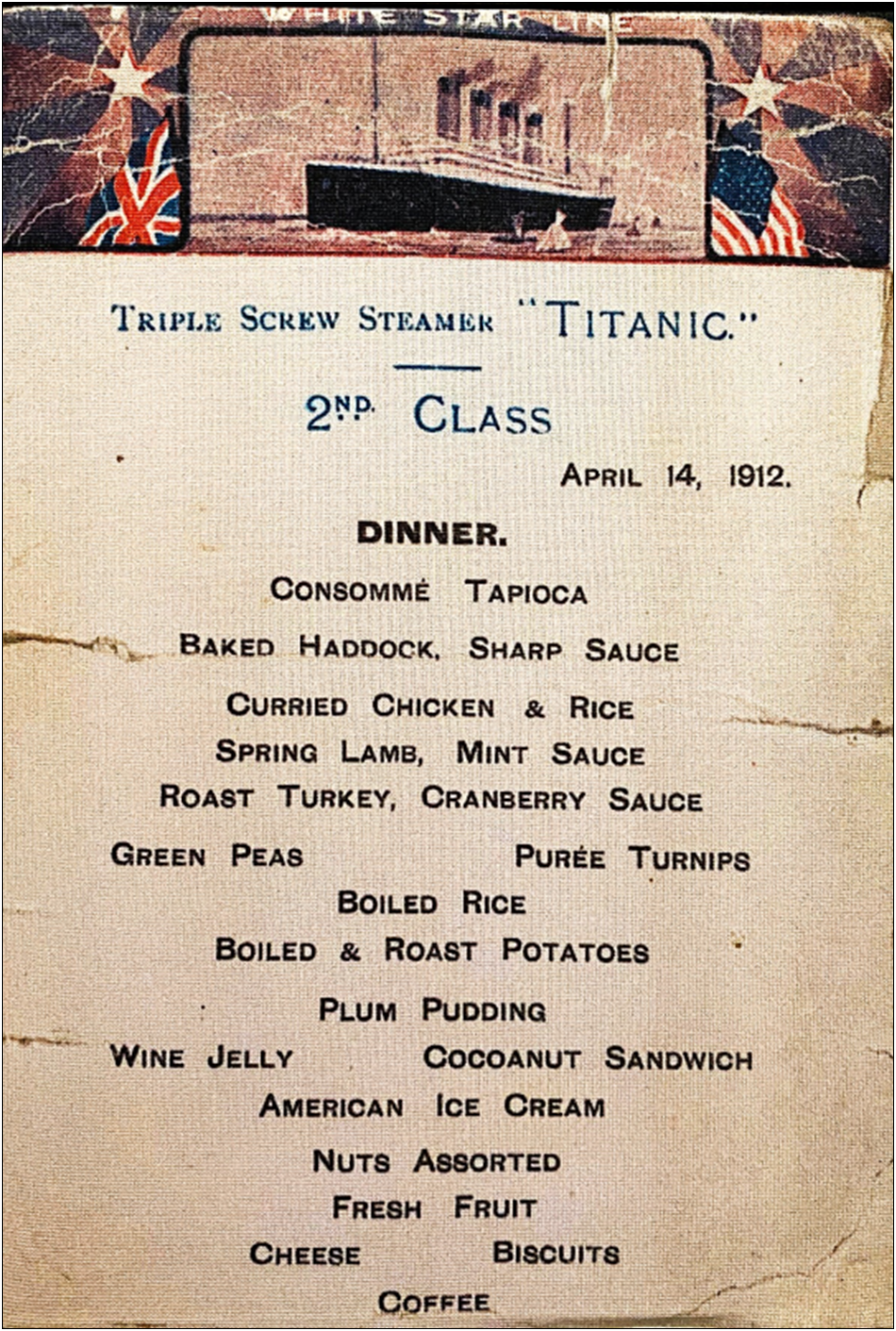
The vacant building has been restored and is now the heritage listed headquarters of the Broken Hill Historical Society and houses a small museum. For many years Bradley Wayne Falappi had built up a collection of Titanic memorabilia and in 2018 this collection was bequeathed to the Historical Society. So, visitors to Broken Hill are doubly blessed in firstly seeing the Titanic memorial at Sturt Park and secondly, calling at The Synagogue of the Outback Museum (above) to see the Titanic memorabilia. The Museum is situated at 165 Wolfram Street and is open on Monday, Wednesday and Sunday or by appointment.
In conclusion, for those who take the time to observe there is much more than a memorial to a long past shipping tragedy to be found in Broken Hill and its sunburnt country. This short story is just one of many such adventures to be found in the magnificent Outback.