- Author
- Editorial Staff
- Subjects
- Ship histories and stories, History - Between the wars
- Tags
-
- RAN Ships
- HMAS Queenborough
- Publication
- March 2025 edition of the Naval Historical Review (all rights reserved)
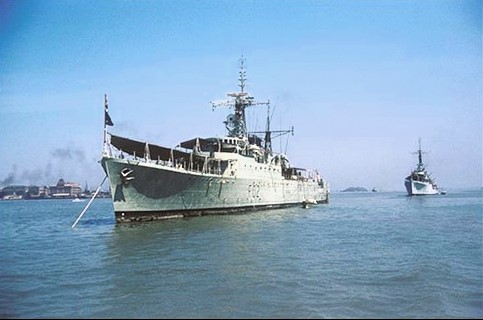
HMAS Queenborough sailed from Sydney for the United Kingdom on 24 February 1955. Her task, to gain experience in the latest methods of anti-submarine warfare and to evaluate the capabilities of the ship’s recently upgraded weapons and detection equipment.
During the passage to Portsmouth the Australian Type 15 anti-submarine frigate called into Singapore (11-14 March), Colombo (19-22 March), Aden (27-28 March), Suez (1 April) and Gibraltar (8-9 April). She arrived at Portsmouth on 12 April and would be away from Australia until near the end of December.
Shortly after she arrived in the UK Queenborough was attached to the Royal Navy Training Squadron, operating from the Joint Anti-Submarine School at Londonderry (Northern Ireland). From here she would then participate in exercises against all types of submarines. In late May she called at Hvalfjord, Iceland whilst taking part in exercises in that area. After participating in large-scale exercises with the Home Fleet in the North Sea in August and September, Queenborough also visited the Norwegian ports of Trondheim (28 September to 1 October) and Oslo between 3-10 October.


France
On 6 June Queenborough berthed in the French port of Nantes in the Loire River Valley and remained there for a week. The Mayor and citizens of the town gave a cordial reception to the officers and men, for whom trips had been arranged to places of interest such as a local chateau, a vineyard, a brewery and distillery. One of the highlights of the visit was a party for sixty impoverished and orphan children given on board by the ship’s company. The children were fascinated by a First Nations Australians’ cave which had been built on the deck and contained models of kangaroos, koalas, wombats and kookaburras. As a climax to the party the children watched from the dock the destruction of a ‘pirate galleon’ in the middle of the Loire River.
England
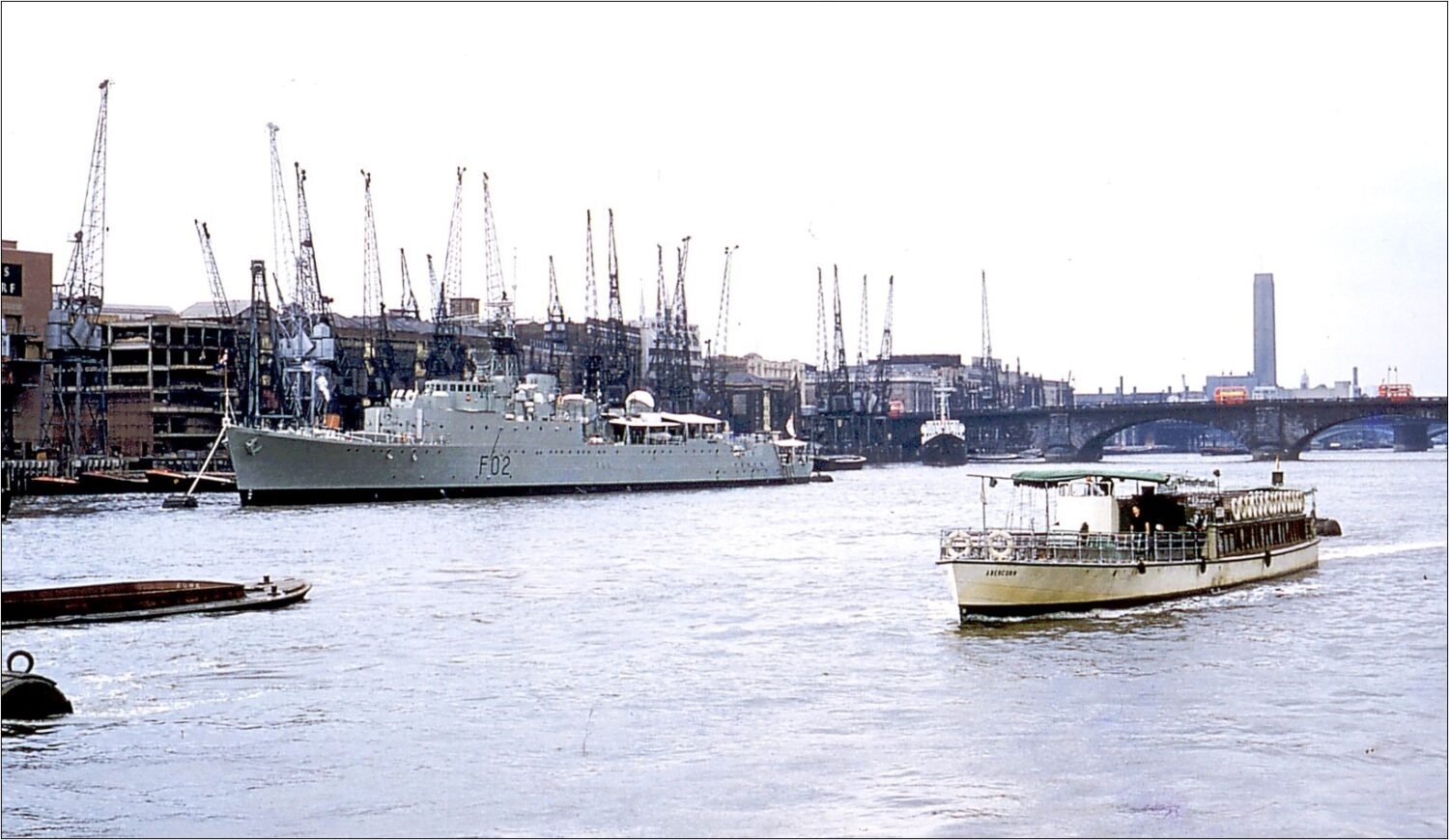
Queenborough become the first RAN ship to visit the port of London when she proceeded up the Thames for a six-day visit on 2 August during her summer leave period. The ship’s company received a great deal of hospitality from the Londoners, and parties were taken for tours of Windsor Castle, Hampton Court and the House of Commons.
September was a busy month for Queenborough, which continued her training with NATO nation ships in the United Kingdom and North Sea. At the ‘beginning of the month she took part in anti-submarine exercises with HNMS Evertsen and KNM Stavanger against the Norwegian submarine Kya. Comments made by foreign officers in the accompanying ships indicated that they were surprised by the way the frigate’s anti-submarine equipment enabled Queenborough to hold firm contact and ‘run rings around them’ during the hunts.
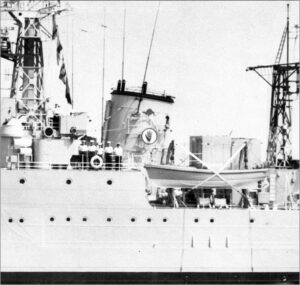
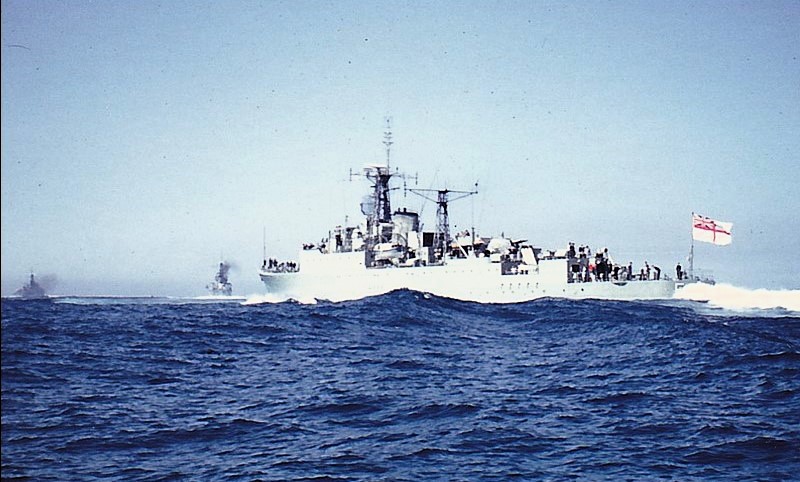
On 17 September, while Queenborough was preparing to leave Londonderry after four months in that area, Captain (D) Third Training Squadron came on board to address the Ship’s Company. He presented the Chief Boatswain’s Mate with a crest of HMS Wizard, and the Captain with two small plaques of the Red Hand of Ulster. The Red Hands were worn on the funnel until Queenborough arrived in Portsmouth in October and were then installed on the bridge superstructure. Queenborough slipped after Captain (D) left, and, as she sailed down the line of NATO and Third Training Squadron ships present in port, she was given a cheerful farewell with music playing, rockets being fired, brown smoke-puffs and Verey cartridges.
Scotland
The next day Queenborough arrived at Invergordon, Scotland, where most of the Home Fleet were present, gathering for the large-scale exercise ‘Sea Enterprise’. Queenborough had been called to Invergordon to be visited by the Prime Minister, Sir Anthony Eden, and the Commander-in-Chief, Home Fleet. On the following day, however, the Captain was advised that the Prime Minister was unable to visit the ship because of ill-health. Other special arrangements for his inspection of the Home Fleet were also cancelled.
The fleet sailed for the exercise on 20 September, the two senior ships being Glasgow (Flag Officer Flotillas Home-Rear-Admiral R.G, Onslow, CB, DSO) and Eagle (Flag Officer Aircraft Carriers – Rear-Admiral A.R. Pedder). The broad outline of exercise ‘Sea Enterprise’ was as follows.
For:
(a) fast carrier operations against land targets in Norway; anti-submarine patrols by helicopters and Fairey Gannets and strikes on enemy shipping, Queenborough formed part of the carrier screen,
(b) hunter-killer operations against enemy submarines by HMCS Magnificent and five Canadian escorts,
(c) replenishment from fleet train ships escorted by both Norwegian and Canadian escorts,
(a) shore-based aircraft giving distant support to surface forces.
Against:
(e) submarines,
(f) shore-based aircraft attacks on the fleet train.
(g) heavy cruiser attacks on the carriers and fleet train.
Several incidents occurred during the exercise. Two helicopters ditched, but the crews were safely recovered. A Wyvern aircraft from Eagle crashed near Queenborough. Helicopters searched for the pilot, who, however, was lost. As well, fueling operations at night from Albion and Wave Sovereign resulted in two collisions and several parted hoses (none concerning Queenborough).
Norway
On completion of the exercise, the ships proceeded to the Norwegian port of Trondheim on 28 September. The exercise critique was held in one of Eagle’s hangars, and several hundred NATO representatives were present, including the Crown Prince Regent of Norway and the Commander-in-Chiefs of the NATO forces taking part. As far as Queenborough was concerned, it was confirmed that the submarine ‘kill’ that had been awarded to HMS Diana and Queenborough was the only one of the exercise and was the only submarine to attack the carrier force. Several submarine attacks on the replenishment force were not followed by successful hunts. The weather was bad during the stay in Trondheim, and the various ships’ companies had only limited opportunities to go sight-seeing ashore. Trondheim was not a large town (population 15,000) and there were over 20,000 sailors in port. The local inhabitants, however, did their best to provide hospitality for the substantial number of visitors.
After her visit to Trondheim during late September, Queenborough rendezvoused with ships of the Home Fleet, Tyne (CinC Home Fleet), Eagle (Flag Officer, Aircraft Carriers) and Centaur, off the entrance to Oslo Fjord. The ships formed in single line and proceeded up the fjord, to the berths at Oslo, firing salutes prior to securing alongside.
Queenborough was given the ‘Berth of Honour’ (like Sydney Cove) and the presence of an Australian ship received favourable comment from high State officials, the Commanders-in-Chief of the Norwegian Forces, and from the Crown Prince Regent.
During the ship’s stay in Oslo, from 3-10 October, the Norwegian people were found to be more reserved towards sailors in uniform than the French had been during Queenborough‘s earlier visit to Nantes in France. There was, nevertheless, much to be seen from the sightseeing point of view in Oslo, and more than half of Queenborough‘s ship’s company were taken on bus tours to Sweden.
Soviets
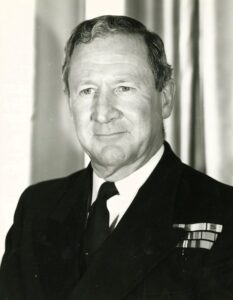
On arrival at Portsmouth on 14 October, the Captain of Queenborough (Commander D. C. Wells, RAN) called on Admiral Golovko, the Soviet Admiral aboard the cruiser Sverdlov, and was invited to lunch. On board Sverdlov were some 200 guests, including representatives from most of the foreign embassies in London.
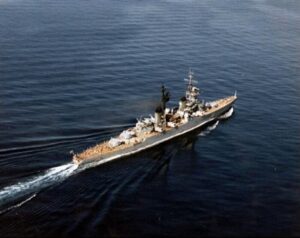
Few of the Soviet officers appeared to be able to speak English, and those that could were not very proficient. They made obvious efforts to be friendly in a very reserved way, and vodka, caviar and smoked salmon were passed around with more than ordinary frequency.
A return lunch was held in HMS Bulwark on the following day and Commander Wells was invited to act as a host. The Russians obviously enjoyed themselves; they asked and answered questions , and their English underwent a noticeable improvement. Immediately after lunch the party moved to the hangar, where Soviet ratings provided a show of singing and dancing. This was a very polished performance, and, in the opinion of most present, of a standard equal to the ‘best than can be seen on the London stage’. It was hard to believe that the artists were also capable of knotting and splicing!
After this entertainment Commander Wells invited the Captains of the three Soviet destroyers on board Queenborough. They were unable to come, as they had not been given ‘permission’. Later, an invitation was sent to the Senior Soviet Destroyer Captain for several officers from each of the ships to come on board Queenborough on the following Sunday forenoon. This invitation was immediately accepted, it being expected, no doubt, that the necessary approvals would be forthcomings. At 1100 on Sunday, however, a telephoned refusal to the invitation was received, with an excuse that the ships were shifting berths, which they were, but it was completed by 1145. No further attempt was made to contact the Russians.
The Soviet ships were open to visitors, but no-one was allowed between decks and all points of detail on the upper deck were well covered and guarded. The upper decks, superstructures and ships’ sides were well kept.
Farewell
On 22 October Queenborough sailed from Portsmouth. Besides the usual ports of call the frigate also visited Karachi in Pakistan between 17-19 November, and Kochi in India from 22-24 November. Sydney was reached on 19 December.