
- Author
- A.N. Other
- Subjects
- History - general, Ship histories and stories
- Tags
-
- RAN Ships
- None noted.
- Publication
- December 2024 edition of the Naval Historical Review (all rights reserved)
By Peter Christopher
Fast clipper ships with fine lines and handsome appearance, such as the Cutty Sark, have pride of place in famous museums. Well on her way to restoration, another famous olden-time clipper ship City of Adelaide, now residing at a purpose-built berth in her namesake city, must take the crown as the world’s oldest clipper ship.
A new ship for Adelaide
Launching his new composite clipper ship City of Adelaide in 1864, Captain David Bruce could have had no awareness that it would survive for the next 160 years. The vessel’s remarkable story has recently been further enhanced with it being moved into a permanent dry dock in South Australia.
There are three intertwined stories which help to better comprehend the significance of this vessel. Firstly, the ship itself, secondly its social history based on passengers and crew and finally the extraordinary campaign by Adelaide volunteers to save the vessel from destruction.
Recognising a commercial opportunity for a luxury fast passenger ship between the United Kingdom and South Australia, Captain David Bruce commissioned the building of the City of Adelaide as a composite clipper ship. She was built by William Pile, Hay and Company in Sunderland, England and launched in May 1864.
Ships were traditionally owned in units of 64 shares. In the case of City of Adelaide 16 shares were held by the master, Captain David Bruce, a further 16 by two Harrold brothers, Joseph and Daniel, 16 by Henry Martin, and the final 16 by Joseph Moore.
Henry Martin had major mining interests in the Flinders Ranges, 400 kilometres north of Adelaide, and wanted a secure way of sending copper from his mines to London. The City of Adelaide not only provided this, but being a part owner gave him a level of control, with the ship visiting Port Augusta as its only Australian port of call other than Adelaide. The ship’s agents were Devitt & Moore, with Moore individually being a quarter owner. The firm was closely identified with Australian trade and became well known as ship owners as well as agents.
Composite Construction
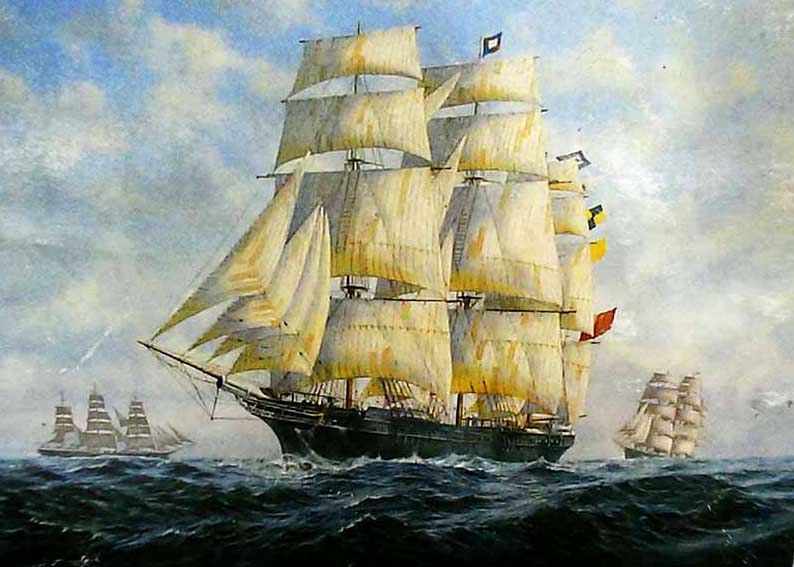
The City of Adelaide is one of only two composite clipper ships surviving today, the other being the world-famous Cutty Sark which is five years younger. Composite construction involves timber planking over iron frames, giving the ship a narrow bow, something not possible beforehand in wooden ships. The result was a ship that could travel at about three times the speed of its predecessors. Two of her three masts were iron, including the massive main, which rose 40 metres above the upper deck.
She had a very strong hull with a wrought-iron frame of closely fitted ribs, some might say over designed. With a gross tonnage of 696 tons she was 176 feet in length, with a beam of 33 feet and a depth of 18 feet. She was sheathed in timber, with her keel and planking from the keel to the bilge of elm. Planking from the bilge to Light Water Mark (LWM) was of oak and from the LWM to the Wales of teak.
The rudder, stern and stem posts were of oak, the windlass and other deck fittings of teak. Deck planking was of pine. She had three masts and was initially fitted out as a fully rigged ship. The hull below the waterline was sheathed in yellow metal and felt.
The ship subsequently undertook twenty three return voyages between London and Adelaide, carrying up to three hundred passengers on a voyage, and played an important part in immigration to Australia. These numbers reduced dramatically following the opening of the Suez Canal in 1869 and the introduction of reliable iron steamships, and in 1887 the City of Adelaide returned from Adelaide to London for the last time. The rest of that year was spent ingloriously as a collier, carrying coal from Newcastle to Dover.
A Pattern of Trade
Thomas Dixon & Sons bought the vessel in 1888, putting her into the North Atlantic timber trade, carrying timber from Canada to the United Kingdom. Significant numbers of migrants were carried to North America on the outward journey. Not only is City of Adelaide the only surviving ship to carry passengers between the UK and Australia, it is also the last survivor of the passenger and timber trade between the UK and North America.
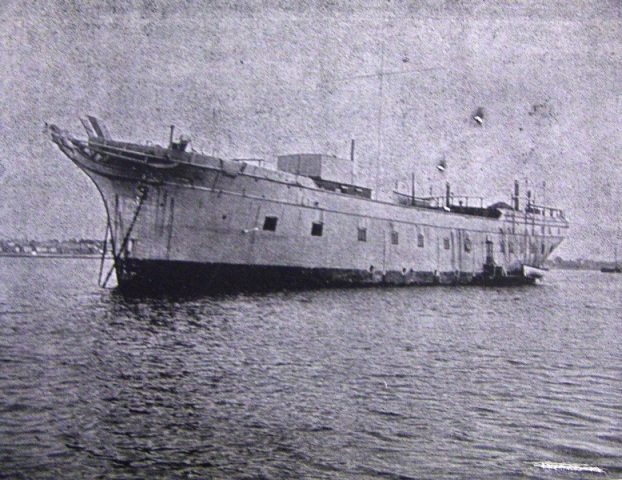
In 1893 the City of Adelaide ended her sailing career but was saved from being broken up as Southampton needed a new isolation hospital for patients with infectious diseases. The solution was to buy the vessel and strip her down by removing her masts and fittings. For the next thirty years City of Adelaide housed a total of 277 men, women and children with infectious diseases, mainly smallpox and scarlet fever.
Royal Naval Service
On 16 March 1923 an offer of £2,500 was received from the RNVR Scottish Division for the purchase of the City of Adelaide for use by the Admiralty as a head-quarters at Greenock for the Clyde Division RNVR, and the offer was accepted. After conversion at Irvine the ship was renamed HMS Carrick by the Marchioness of Graham on 16 May 1925 at Greenock. This change was to avoid confusion with a new cruiser which had recently been built by Cockatoo Dockyard and commissioned into the RAN as HMAS Adelaide.
As HMS Carrick, she was moved to Scotland, where following the mounting of guns on her top decks, naval cadets lived aboard and undertook gunnery training. The main deck gun battery had three 4-inch guns and also a 3-inch, with an additional 20-mm Oerlikon anti-aircraft gun on an upper deck. Defensively Equipped Merchant Shipping (DEMS) training was provided to crews of merchant ships from 1940 with the DEMS organisation taking responsibility for this vessel. Larger guns were fitted, and accommodation aboard increased from 60 to 200 ratings. In 1941 the guns were fired in anger as Scotland faced aerial attack by German bombers and Greenock was blitzed.
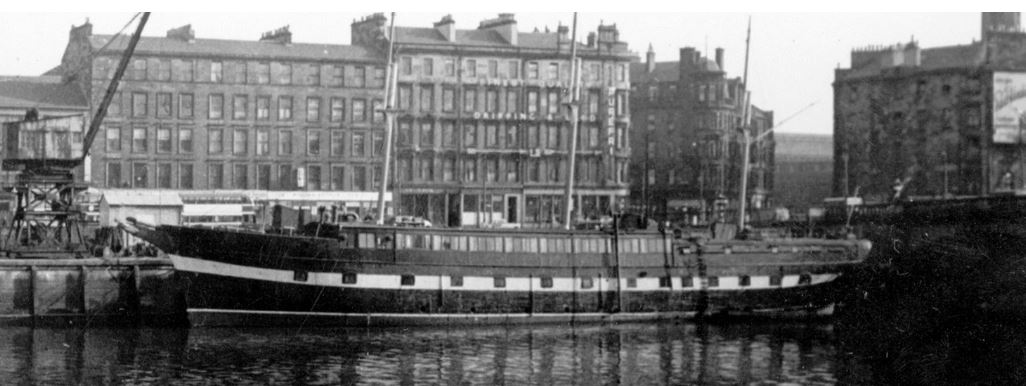
Carrick was scheduled for breaking-up in 1947, but the Admiralty gave her to the newly formed RNVR Club (Scotland) for use as a floating clubhouse. She was refitted at Harland and Wolff’s shipyard at Scotstoun in 1948. Her new fittings included a sun-lounge, lounge and snack-bar ‘in place of the master’s cabin, officers’ and passengers’ accommodation in the clipper,’ a massive fireplace and bearskin hearthrug, and a ‘unique buffet in the shape of a ship’s bow crowned by the 3-ft figure of a Highland piper.’ Her figurehead, removed by G. Napier & Sons in 1903-4, was replaced by that of the Triad, ‘the last sailing ship to ply between Kirkaldy and the Baltic’. She was originally moored at Custom House Quay, Glasgow, then at Carlton Place on the opposite bank of the Clyde. In 1989 she was transferred to the Clyde Maritime Trust for £1.
She was then moved to Prince’s Dock, where she sank in February 1991.
The Scottish Maritime Museum salvaged and refloated Carrick in 1991 and moved her to a private slipway in Irvine. According to the National Historic Ships register she reverted to her original name, City of Adelaide, in 1992, but other sources continue to refer to her as Carrick until at least 2001. The Scottish Maritime Museum intended to conserve her, but the loss of funding in 1996 led to a long drawn out struggle to save her and she became derelict. In 2010 permission was given for her removal to her namesake city in South Australia to be preserved as a land-based exhibit.
Decline and Restoration
The dilemma faced by the authorities was that the ship sat on private land which the owner wanted cleared, and he was owed back rent for her storage. While the heritage status, which had not been removed, prevented the authorities from breaking her up, this seemed the only logical option as it was believed impossible to move the ship without breaking her up.
Discussion in the UK regarding deconstruction led to the establishment of the Adelaide volunteer group to save the vessel. Better understanding of why the group was formed and its significance to South Australia needs to be recognised. Principally the City of Adelaide sailed into South Australia when the colony was only decades old. Therefore, many of the original inhabitants of Adelaide and the state of South Australia, or their descendants, were passengers or crew. It has been estimated by genealogists that in excess of 250,000 people in Australia can trace their heritage back to this particular ship.
In 2000 the group formed itself with the express purpose of trying to save the vessel, and initiated a worldwide campaign to prevent the delisting of the vessel’s heritage status.
The success of this group resulted in His Royal Highness Prince Philip, Duke of Edinburgh, convening a conference held in Glasgow in 2001 to discuss what could be done in respect to the vessel.
Adelaide volunteers were represented at the conference and put the case for being given the vessel. A significant outcome of the conference, which was attended by approximately 20 people, mainly representing government and maritime authorities, was that if anybody could come up with plans, financial and engineering, to move the ship they could have her. This in effect gave the authority for the ship to leave the United Kingdom in the event that the Adelaide group was successful. Knowing this the Adelaide group was then able to commence a major campaign aimed at gaining more support to save the old vessel. They also came up with a unique methodology to move the ship. Based on a laser survey of the hull, a 100-ton bespoke steel cradle was designed.
Back at Home
By this time tens of thousands of hours and millions of dollars were being spent, mainly by twenty South Australian engineering firms involved in the restoration project. A cradle was built in Adelaide and then disassembled as if it were a giant Meccano set with the component parts all shipped to Scotland in five 40 foot containers. The cradle was then reassembled under and around the base of the vessel during 2012/13, and then jacked into position to receive the hull and placed on to a Self-Propelled Modular Transporter (SPMT).
The ship wasn’t lifted directly, the cradle was lifted with the ship safely within it. Just like eggs in a carton, the ‘egg’ was not touched. Safely moved onto a barge, the vessel was taken to the Netherlands for carriage as deck cargo on a heavy lift ship MV Palanpur. En route they called into London, where HRH Prince Philip, officially renamed her with her original name of City of Adelaide at a ceremony in front of the Old Royal Naval College, Greenwich.
The City of Adelaide arrived in Port Adelaide in February 2014, where she was offloaded onto an enormous barge, which was to be her temporary home for ten years. After a year of internal work to make the vessel safe it was opened up to the public for daily tours. Pre COVID she was seen by 20,000 visitors annually, with tours generating much needed income.
In 2019 the barge was moved to its temporary home at Dock 2 in central Port Adelaide, the location which was to become its future home. It had always been planned that the vessel would be moved onto land into a dry dock so that major external works could be undertaken on her which were not possible while she was on the barge. This includes masts being installed. The main mast stood 40 metres above the top deck.
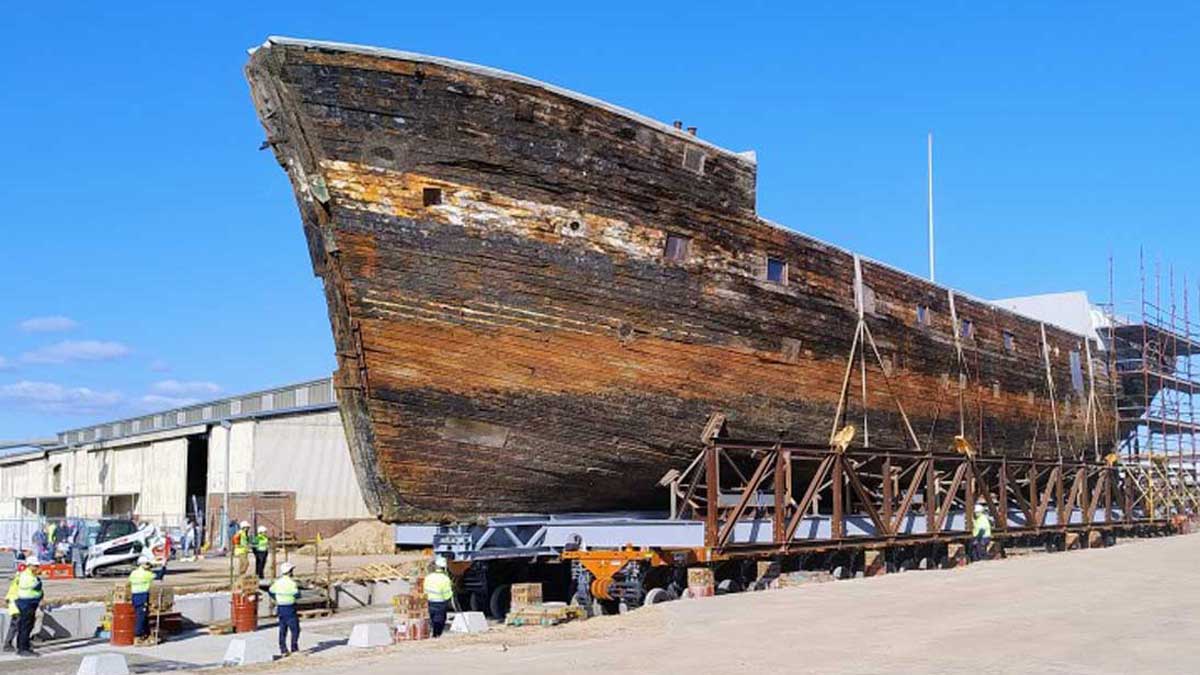
Planning for this move from the barge onto land has taken about three years. The culmination of all this work was that on the 16 June 2024 City of Adelaide was moved into its permanent home on land at Dock 2 which was provided by the Government of South Australia. The lead-up to this was enormous. A shallow pit needed to be excavated on the wharf in order to provide a better angle for future disabled access into the vessel, and also to partially hide the cradle which was to remain under the ship permanently.
Fortunately, given the very high cost involved, the group received direct support from Bardavcol, who were able to excavate the enormous pit at no cost to the group, and the Hallett Group that provided all the necessary concrete, in the order of more than 150 cubic metres. Countless other supporters provided crane and other services as necessary, together with the assistance in relocating the barge as was required from time to time. Another major element was the support from Australian Naval Infrastructure, which provided the self-propelled modular transporters and their operators to move the ship. This enormous task involved a complex operation. The barge had to be correctly positioned against the edge of the wharf, appropriate planning made for tidal movement and very large volume pumps put in to move water into and out of the barge for ballasting. This was to cope with not only the tidal movements but the changing weight upon the barge as the ship progressively rolled off the barge onto land. This was an extremely complex operation which saw almost 1000 tons being moved off the barge, the combined weight of the ship and SPMTs. It was planned to such a degree that it went flawlessly. Mark Gilbert, volunteer director and engineer and heavy lift specialist with Wallbridge Gilbert Aztec, the group’s project manager, said of the move ‘We are fortunate to have people within our team with the necessary expertise to carry out such work’. Within five days of the move public tours were recommenced.
Future plans include the development of a Seaport Village, with City of Adelaide as its centrepiece. The Visitor Information Centre and related infrastructure are being progressively relocated closer to the drydocked vessel. Plans are also well advanced to fit a disabled access ramp and finishing off work in the first-class saloon, which is well under way.
The project has been an enormous undertaking involving detailed planning, funding and arranging logistical supplies over huge distances. Negotiations have been conducted on an international scale and many demanding technical and environmental hurdles have been overcome. All this has been achieved by a not-for-profit volunteer organisation of well-intended people committed to a worthy cause.
Further details and video of the move can be found at cityofadelaide.org.au