- Author
- A.N. Other
- Subjects
- Biographies and personal histories, Ship histories and stories, History - WW2
- Tags
-
- RAN Ships
- None noted.
- Publication
- September 2025 edition of the Naval Historical Review (all rights reserved)
Tony Vine continues the story of Able Seaman Hilton (Harry) George Weigand, RAN
When the Burma railway was completed, Harry Weigand and most of the men were moved to Tamarkan in Thailand where they would remain until February 1944. Beaten and broken, members of the 2/12th would continue to die after the railway’s completion, some whilst maintaining the railway and others at Tamarkan.
In late February 1944, the Japanese had selected 900 fit men to go to Japan, and as Harry was in reasonable health he was amongst those selected. The men were issued with new AIF clothing, their first in two years and by early April they were in railway cars heading for Saigon in Indo-China.
In Saigon the food was relatively plentiful, the work light and the men began to recover their health. Twice they were placed on standby to embark on ships for Japan, and twice their embarkation was cancelled because of USN submarine activity.
In late June, the frustrated Japanese changed their plans. Harry and the rest of the Japan force were shipped to Singapore by rail, not to Changi, but to the River Road Camp where, in the words of their doctor Captain Rowley Richards the “food was woefully poor, even by railway standards.” They would be used as slave labour building a dry dock until a ship was available.
Rakuyo Maru
That ship would be the 23-year-old cargo passenger liner Rakuyo Maru. On 5 September, over 700 of the Australians, along with 500 Britons, all survivors of the Burma Railway, would be crammed on board. Many men desperately tried to stay with mates, brothers and cousins, some swapping with others to get into the draft. At the last moment, the doctors deemed that Hugh Forrest from Mildura was too sick to travel, his brothers Bert and John begging to no avail that he be allowed to come with them. Petty Officer John Turnbull, a survivor from the light cruiser HMAS Perth, boarded with his two younger brothers, Privates Ken and Bill Turnbull. John had run into his brothers in a POW camp in Java. Gunner Russ Savage was onboard with his older cousin Lindsay. Amongst the men from the 2/12th Field Coy were brothers Bernard and Leslie Perry from Sydney who had joined the unit just four days before the capitulation of Singapore in February 1942. In all, there would be at least 13-sets of brothers and cousins onboard, of whom only three individuals would survive the war.
Rakuyo Maru subsequently steamed from Singapore. The sheer numbers of men onboard meant that the cooks could only manage to feed them a mug of rice twice a day along with a ‘dollop’ of watery fish stew. The conditions below were dreadfully hot and the Japanese relented on an earlier directive that only one third of the men could be on deck at any one time. On the eleventh they enjoyed a torrential rainstorm, dancing naked in the rain. Knowing the dangers posed by submarine attack, Captain Arthur Sumner of the AIF worked with Rowley Richards and Petty Officer Vic Duncan from Perth on contingency plans in the event they had to abandon ship. Vic gave briefings to each group of men as to what to do if they had to abandon. Also, on the 11th, ships from Manilla joined the convoy, making it an even bigger target for the marauding American submarines! The ships had no protection; they were neither marked as carrying POWs nor did the Japanese advise the Protecting Power that they were transporting POWs. They were therefore legitimate targets.
American submarines
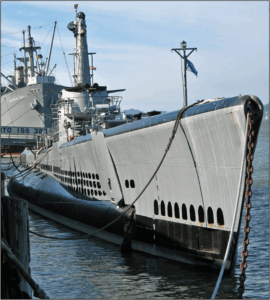
In early September, the USN had intercepted and decoded messages about the convoy and its route, including the ships joining from Manilla. Two submarines, USS Growler and USS Pampanito, were tasked to intercept, whilst a third, USS Sealion, was ordered to make haste to join them. Two more submarines, USS Barb and USS Queenfish, were designated as backstops. The noose was tightening around the Rakuyo Maru’s neck.
Growler was the first to make contact, by radar at about 29,700-yards at 0100 on 12 September. Within 30-minutes both Pampanitoand Sealion were also tracking the convoy in the South China Sea. Growler attacked first, firing at short range at what the commanding officer thought was a fast-approaching cruiser. The ship, which was in fact the escort Hirado, was steaming directly towards Growler, and it was hit with a remarkable bow-on shot. The ship exploded and very quickly disappeared. The other escorts began an attack on Growler, whilst the convoy turned away.
When Hirado exploded, Harry Weigand was sleeping on top of Number Three hold by the bridge superstructure. Hearing the explosion, he jumped up and saw the escort blazing and sinking fast. He later reported that the Japanese crew and the guards on Rakuyo Maru were in a state of panic, unlike the prisoners who remained calm, some even standing at the top of the hatches giving a running commentary to the men below.
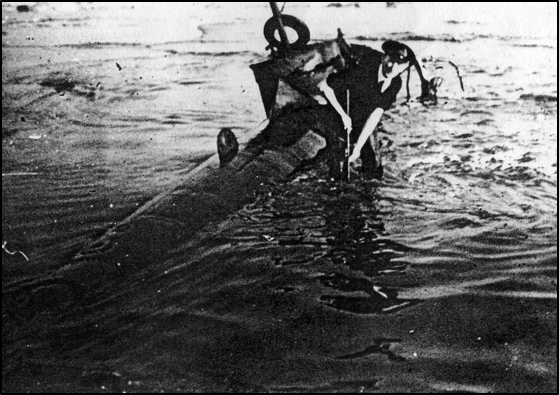
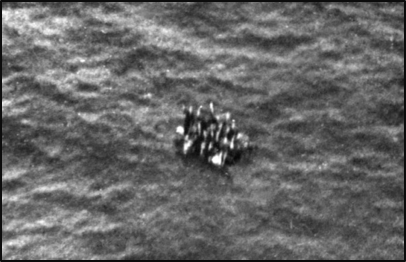
The course alteration had taken the convoy unwittingly towards Sealion and Pampanito. At 0522 Sealion fired three torpedoes at a tanker and then three towards a second ship, hitting both. Two from the second salvo hit Rakuyo Maru. These two weapons mercifully struck the bow and number one hold, which was full of rubber, and the engine room. The hundreds of men down in Number Two hold were shaken but safe. Harry, standing on the hatch of Number Three hold, was propelled across the deck into a winch, receiving a nasty cut on his leg and shin. As the ship lurched to a halt, the bow dipped and a wave of water cascaded over him.
He had to hold on for his life. Rakuyo Maru drifted out of control listing to port but staying afloat because of her cargo of rubber.
Abandon ship
The Japanese abandoned ship in a very orderly manner, using bayonets to prevent the POWs from getting into the lifeboats. Bombardier Tommy Moxham, whose brother Harry was also onboard, jumped into a small blue rowboat containing the ship’s captain. He reportedly threw the captain overboard and held him under drowning him, before returning to the ship with the boat. Tommy would survive the sinking. Sadly, his brother Harry would perish four days later. Their older brother Bill, who had joined up with Harry, was in Borneo where he would be one of only six survivors of the Sandakan death march. With the crew and guards gone, the ship began to drift towards a burning tanker. Just after dawn AB Arthur Bancroft of Perth recalled that the officers gave the order to toss overboard anything that could float and then in a very orderly manner the men began to slip into the water. Harry was about to abandon ship when he remembered that he had left behind his treasured photos of Hilda and William which he felt had brought him luck. He retrieved the photos, stopped in the galley for a final drink of water and then joined his mates in the sea. He also recounted that there were initially Japanese survivors on the rafts side by side with POWs.
Eventually the convoy escorts returned and they picked up all the Japanese survivors, refusing steadfastly to take any of the POWs and even running down some groups in the water. When the escorts left, around 300-400 men were able to squeeze into the seven lifeboats abandoned by the Japanese, leaving over 700 men in the water.
Harry stated that numerous men simply gave up and died within the hour. He was on a group of rafts which were tied up together. The men paddled frantically to prevent them from drifting towards the burning tanker.
As little could be done to assist the men in the water, the lifeboats sailed off in two groups, initially heading for Formosa (Taiwan). The larger of the groups included Brigadier Varley and over 200 men, whilst the second and smaller group was under the effective command of Petty Officer Vic Duncan of Perth and contained the only Australian officer to survive, Doctor Rowley Richards. Duncan later reported that at various times they were in sight of the Varley group, but on 14 September they heard heavy machine gun fire from the direction where the group had last been seen. Soon after, Japanese warships were sighted. The men from the Varley group were never seen again and it is assumed that the Japanese murdered them. For some inexplicable reason, a Japanese warship spared the Duncan group. Sergeant Arthur Wright, of the 2/18th Battalion, later believed that it was because that when challenged as to who they were, they answered “Australians, rather than “British” or “American”. A total of 87 Australians, along with British survivors were picked up by the Japanese corvette which had a sympathetic captain and crew. After another month travelling north in a converted whaling ship, they eventually reached Japan.
Rafts
The men who were left behind clung onto anything that floated. Covered in oil some had to lash themselves onto their rafts just so they did not slip off. By the morning of the 13th their numbers had diminished greatly, and those living were surrounded by grotesque corpses bobbing on the sea’s surface. That evening Lance Corporal George Fogo, hanging onto a hatch cover, floated alongside Harry’s raft. George was delirious and had taken off his life jacket. Harry tried in vain to get him to put his jacket back on, but he passed away as Harry was helping him. He also witnessed the death of Joe Barron, a member of the 2/4th Casualty Clearance Station, one of the brave medics who had kept so many men alive on the railway.
By the morning of the third day conditions had become critical. Gunner Ernest Fieldhouse’s raft had only four of its original 24 occupants left. Harry realised he was becoming delirious and engaged young Pat Smith from the 2/19th Battalion in conversation, effectively geeing each other up. The tactic worked and both men survived the ordeal.
The fate of the men in the water was so grim that many of the survivor’s de-briefing statements in the National Archives are closed files until 2043, to protect the families of the exact circumstances of their deaths. Some men committed suicide, while others lost their minds and simply died.
Rescued
On the 15th, Pampanito closed into what they thought was a group of Japanese survivors on rafts and prepared to shoot their enemies. Fortunately, a very vocal Australian realised what was about to happen and expressed his opinion to the American crew. They immediately swung into action and within an hour the submarine had recovered 47 survivors. By nightfall they had an extra 73 bodies on a submarine which normally only carried 65 men. They included Harry Weigand, back onboard a submarine after an absence of fourteen years!
Pampanito’s commanding officer broke radio silence and called Sealion to assist in the recovery, which picked up 54 more men. Unfortunately, both submarines immediately set sail for Saipan in the Northern Mariana Islands, without thinking to provide provisions and water to the hundreds of men still in the water.
On the fourth and fifth day Queenfish and Barb arrived, by which time only 32 men were still alive. In total, the four US submarines would recover 159 survivors, of whom seven would die enroute to Saipan. They were all that remained from the 700-plus men who had not found a place in a lifeboat. Over the next few days 152 men were landed ashore to the US Army hospital in Saipan, 92 Australians and 60 British.
Of the 22 men from the 2/12th Field Company who had boarded Rakuyo Maru in Singapore, only four remained. Harry and Sapper Bill McKittrick were rescued by the Americans, and Sapper Ray Burridge and Lance Corporal Wally Dorman who were in the Duncan group and taken to Japan. Wally would die of pneumonia in Sakata in May 1945.
“Treated like Royalty”
The news that the men had been rescued raced around the world as they were the first POWs recovered from the Japanese. As soon as the men were fit enough, they were interrogated by US, British and Australian intelligence officers.
The Americans were extremely interested in the four Perth survivors and what they knew about Perth and USS Houston’s last battle and how many of Houston’s crew had survived. Initially the interrogators were sceptical about what had occurred on the Burma Railway and the numbers of men who had died during its construction. But as more and more men told the same story the truth began to set in.
Meanwhile Harry and his mates were being “treated like royalty.” He quipped that “it seemed funny to sleep in a nice clean bed with nice clean sheets and pillowslips. With no bugs or lice.”
On 18 October, a little over five weeks from when they were sunk, 86 Australians led by the senior survivor WO Bill Smith of the 2nd/10th Field Regiment walked down the gangway of USS Monadnock in Brisbane. Six men were still in hospital overseas, but the majority were finally home.
On their arrival the Army survivors were taken immediately to ‘Stuartholme,’ a girl’s school converted to a military hospital at Toowong in Brisbane. Here they received ongoing medical treatment and more interrogation. The four Navy survivors were taken to HMAS Moreton, briefly interrogated, issued new kit, paid, then sent straight on leave. In Arthur Bancroft’s case they even arranged air travel to Perth, and he was home before the Army men left ‘Stuartholme.’
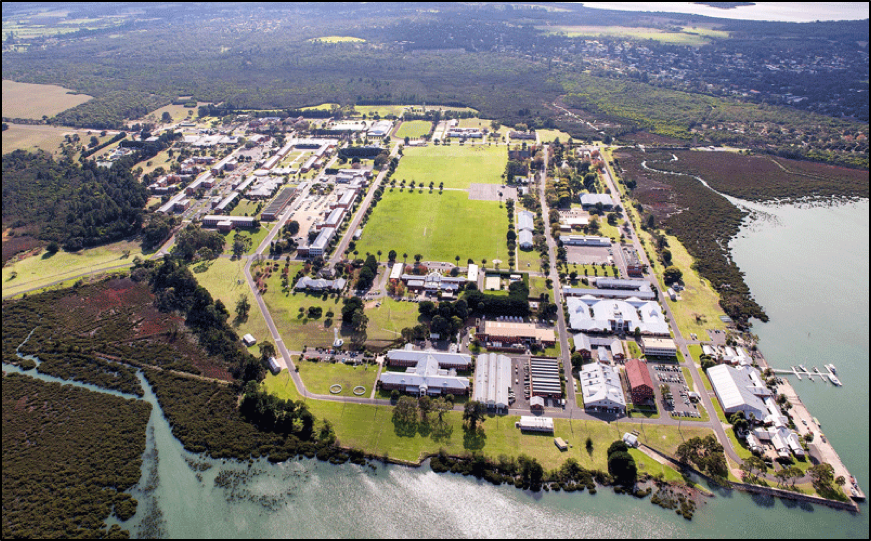
Two views of ‘Stuartholme,’ the Brisbane girl’s school converted to the US Army’s 42nd General Military hospital.
Army Intelligence wanted the men retained in Brisbane to undergo further interrogation, mainly to determine the last known whereabouts of other men in their units. This plan was overturned by the Acting Prime Minister, Frank Forde, who decreed that as soon as the men were fit enough, they were to proceed on three month’s leave.
On the evening of 28 October Harry boarded the overnight train to Sydney from Brisbane. The next day he was reunited with Hilda and eleven-year-old William who had not seen his father for over four-years.
He remained on leave until 10 February 1945 at which time interrogations about his experiences recommenced. This included making formal statements about the deaths of George Fogo and Joe Barron. His health was still suspect, and in late February he began medical rehabilitation at the Army’s 103rd Convalescent Depot at Ingleburn in Sydney. Whilst there Harry co-signed, with ten other survivors, a letter to the Daily Telegraph newspaper, attesting to the cruelness of their Korean guards.
The Government had offered all the recovered POWs a free discharge if they desired, and all but a handful accepted it. For most, including Harry, they were granted a ‘Medical Discharge’ and on 2 July 1945 he returned to civilian life.
Later years
Post-war Harry worked as a plumber and the family resided in Croydon in Sydney. William followed his father into the RAN in 1952; however, he was dismissed from the service the same year after absconding and spending a period in the military prison. In the mid-1960s Harry developed a heart condition and he sought assistance from DVA.
The Army provided little support to his claim to have it recognised as service related. Harry and Hilda retired and moved to Woy Woy on the NSW Central coast in the late 1960s, where Harry would pass away at his home on 4 September 1972, aged 67-years. He is buried in the Point Clare Cemetery at Gosford NSW, just 30 metres from Leading Seaman Dalmorton Rudd DSM, a ringleader of the battlecruiser HMAS Australia’s 1919 mutiny.
Harry Weigand had lived a hard life. He arrived in the world as the illegitimate son of a blacksmith’s apprentice. He served on the lower deck of the RAN for six-years, worked as a seaman, mechanic and miner, and for three-years was a slave of the Japanese Army. On his return home he continued to work in a manual occupations. His career as a submariner, albeit brief, went full circle from HMAS Oxley in 1928 to when he was saved by Pampanito in 1944.
Bibliography:
Bancroft, Arthur, and Harman, John, 2010, Arthur’s War, Penguin.
Blair, John, and Blair, Clay, 1979, Return from the River Kwai, MacDonalds General Books.
Power, Francis William Grene, 1991, Kurrah, RJ & SP Austin.
Richards, Rowley, 2005, A Doctor’s War, Harper Collins.
Wall, Don, 1991, Heroes at Sea, Griffin Press.
NAA – various files.



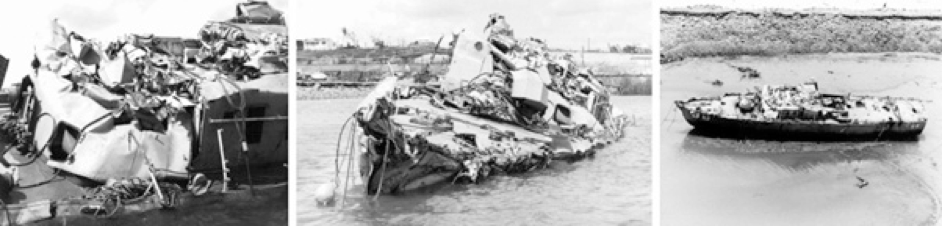
Above: Gone, but not forgotten. These three images were sourced from the Britain at War Facebook page.

Author Tony Vine.
