- Author
- Editorial Staff
- Subjects
- History - general
- Tags
-
- RAN Ships
- None noted.
- Publication
- December 2024 edition of the Naval Historical Review (all rights reserved)
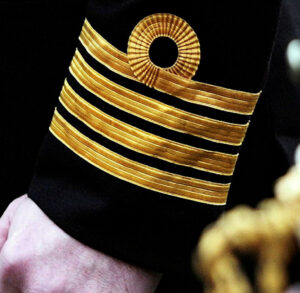
A recent article found on the UK Forces Net asks the question: Is the braid used on Royal Navy officers’ uniforms really made of precious metal? This article tells us that the highly decorative gold embroidery that adorns Royal Navy uniforms was first introduced in April 1748 in response to a petition from Royal Naval officers for a distinctive form of dress for their profession.
The ‘curl’ on the upper row of gold lace came later to Royal Navy uniforms on 11 April 1856 – 167 years ago. The curl is a loop of real gold braid that appears above an officer’s rank insignia on their epaulettes and on the cuffs of their sleeves. According to Royal Museums Greenwich, the curl on the upper row of cuff lace was introduced for executive officers’ uniforms, to distinguish them from officers of the civil branch. But from 1918 onwards, the gold curl was worn by all branches.
Is the gold real?
West Yorkshire company Wyedean Weaving Co Ltd, which supplies the Navy’s tailors with ‘Gold Gilt Wire Naval Lace’, makes the lace using real gold, which is electroplated onto a fine copper core, providing sufficient strength for it to be woven.
Originally formed in Coventry, the company has been trading since 1852, and says it’s possible its forebears were involved in the development of the original lace. The factory was destroyed in November 1940 during the Blitz and all records were lost.
A 25-metre reel costs around £750 and the company supplies the Royal Navy and other naval forces with around 3000 metres per year, with each 25 metre batch taking around 10 days to make. The supplier of military insignia also makes Royal Navy service dress epaulettes, using a much cheaper synthetic gold, and has produced nearly 7000 pairs in the past two years.
Wyedean Weaving Co Ltd is based at Bridgehouse Mill in Haworth, West Yorkshire, and in 2024 celebrated its 60-year anniversary of being based in Haworth and in Wright family ownership.
The founding member of the company, David Wright, served in the Royal Navy’s Fleet Air Arm as a fighter pilot during the Second World War, serving first in the Battle of Atlantic on Catapult Aircraft Merchant (CAM) ships and later in the Mediterranean on HMS Formidable during the North Africa, Sicily and Italy campaigns.
Development of Naval Uniforms in Australia
On 1 March 1901 the Australian States transferred their naval forces to the newly established Federal Government creating the Commonwealth Naval Forces (CNF). There was no immediate change to the individual uniforms based on those of the Royal Navy which had been worn by the individual states. It was not until 1904 that new uniform regulations were promulgated with these instructions again providing minor modifications but with the advent of the Royal Australian Navy in 1911 buttons and cap tallies were of a different design.
With both world wars more practical types of action working dress and anti-flash clothing were developed, and in the 1960s Australian involvement in Vietnam saw the influence of American styles being adopted and again in the Gulf War of 1990 further more practical working style uniforms came into being.
The need to provide home based essential defence materials for the newly federated Australian Commonwealth defence forces was quickly acknowledged with the founding in 1907 of the Lithgow Small Arms Factory. This was followed by the Government Clothing Factory established in Melbourne in 1912. Together with a number of other defence industries, including naval dockyards, in 1989, these became part of an Australian Government-owned organisation named Australian Defence Industries. Progressive privatisation followed quickly, most being acquired by the French Group Thales.
The Government Clothing Factory became Australian Defence Apparel (ADA) in 1995, with rationalisation reducing labour and the importation of some materials. ADA is now based in Bendigo and Melbourne. The Workwear Group in Melbourne uses fabric manufactured by Bruck Textiles of Wangaratta. There are two other Melbourne based suppliers of clothing materials with J & J Cash providing sailor cap tallies and Spear & Flame providing shoulder boards.
The Wyedean Company suffered bomb damage early in WWII resulting in the loss of many of its records so they are unable to say if they produced products for Australian forces. However, they have discovered an order book which contains details of goods provided to Australia from January 1942 to November 1961.
The first order is for 225 yards of 1½ inch brown cotton webbing for the New South Wales Government. By 1943 pure silk medal ribbons are first mentioned with the supply of 50 feet for Conspicuous Gallantry Medals. Larger orders were coming through in 1948 with the supply of numerous medal ribbons, starting with 162 yards for MBEs to 90 yards for DSOs. In these times of course these were all Imperial medals as it was not until 1975 that Australian medals were issued.

It is perhaps noteworthy that the last supply of ribbons in 1961 was addressed to the Superintendent, Royal Edward Victualling Yard, Pyrmont, New South Wales. Wyedean records do not mention supply of gold lace but say they may have supplied this through a third party and a past member of staff was aware of local supply with Maltese connections which were competitors to them.
Kit Muster
In 2011 John Perryman published the first volume of Kit Muster, his epic work on Australian naval uniforms, and Volume 2 followed in 2021. These tell in detail of the progressive development of naval uniforms but do not dwell overmuch on the supply and production of materials. Nevertheless, we discover (Vol 1 p 90) that the early responsibility for overseeing the standard of uniforms was vested in the Navy’s Director of Victualling (DoV) in Melbourne. When a new item of uniform, badge or accoutrement was approved, sealed patterns were produced and issued to the appropriate manufacturer. Rigid quality control was enforced by the DoV and any item of kit not up to standard was rejected. Once completed, supplies of uniforms were forwarded to the Royal Edward Victualling Yard (REVY) at Pyrmont in Sydney, for quality assurance, storage and distribution.
He goes on to demonstrate how the specification issued to the Melbourne firm of J & J Cash for the production of cap ribbons was an example of how strictly the production of uniforms was managed. Cap tallies were made locally with the metal in the thread comprising gold 2.5%, silver 88.0% and alloy 9.5%.
January 1924 saw the introduction of ready-made uniforms for all ratings in the Sydney area when a fitting room was established in the depot ship HMAS Penguin (ex-HMAS Encounter). Penguin was stocked with a wide range of ready-made suits and items of kit and also provided the services of a qualified civilian tailor.
Post-War Developments
Post-war developments saw a surge in the manufacture of goods within Australia. In the 1960s it is believed that gold lace used in naval uniforms was being produced locally by small manufacturers who had migrated from Malta. They had learned the trade in that island when it was a major Royal Naval base. However, trade protection tariffs which helped support local industries started to be reduced and then withdrawn from the 1970s. Accordingly, many smallindigenous industries became uncompetitive and were replaced by imported goods. Could this have happened to the local manufacture of gold lace?
Australian Honours and Awards
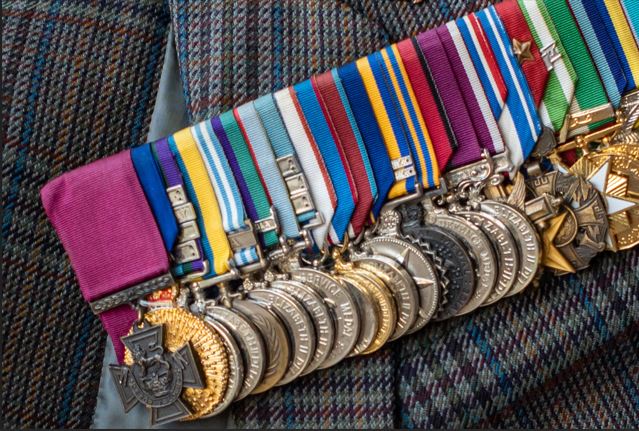
On 14 February 1975 the Imperial system of Honours and Awards was replaced by the Australian system covering the Order of Australia, Meritorious Awards, Military Awards and Australian Bravery Decorations. Medals for the above are struck by the Royal Australian Mint based in Canberra. Enquiries made of the Mint regarding Medal Ribbons indicate that these are of overseas manufacture.
Current Procedures
The Deputy Director, Navy Uniforms Navy Logistics & Infrastructure Branch/Navy Capability has kindly made the following information available.
Lace items are specified in DEF(AUST)8931 Lace, Ornamental. The Specification states:
Composition of gold and silver metal elements. The composition for gold and silver metal elements shall be made up of the following minimum proportions and white metal.
- Gold – 2% gold, 1% silver
- Silver – 50% silver
Note: White metal shall be 95% ± 1% copper, 5% ± 1% nickel.
Gold Lace. The gold laces for items 1–3 and 11-32 shall have a gold wire weft, and a cotton warp of a similar colour.
Composite Yarns. Where a combination of metal and textile yarns is required the metal is to be twisted uniformly over the textile core.
The number of turns shall be such that complete coverage of the core is obtained without grinning through of the textile base. The textile yarns shall be a colour to match the metal component.
Lace items are purchased from local suppliers Solomon Brothers and P. Blashki and Sons. Currently the manufacturer of the lace is Ets Carlhian of Lyon in France. Carlhian is a well-respected company established in 1870 which supplies customers throughout the world.
Advice on medal ribbons was received separately from Defence Honours and Awards (H&A) Policy Division which says: Defence medal ribbons are manufactured by Toye, Kenning and Spence of the United Kingdom. This Birmingham based company with a Royal warrant has been in existence since 1685.
Currently the ribbons from Toye, Kenning and Spence are 70% nylon warp and 30% cotton weft. Warp is the long yarn that runs vertically up and down the roll of fabric, this governs the vertical pattern repeat regardless of fabric width. Weft is the yarn that passes horizontally across the fabric roll, generally is it shorter and governs the horizontal pattern repeat regardless of fabric width.
Summary
In summary, on ceremonial naval uniforms we still wear highly decorated embroidered gold lace first introduced in 1748 well before Captain Cook and the First Fleet found our shores. Gold lace is presently produced in France and medal ribbons in England while the medals themselves are cast locally in Canberra.
References
ANP 4426-1203 Uniform Instructions for the Royal Australian Navy, Commonwealth of Australia, Canberra, 2019.
UK Forces Net, Going for Gold, 12 April 2024.
Perryman, John, Kit Muster Vols 1 & 2, Sea Power Centre, Canberra, 2011 & 2021.