- Author
- Gillett, Ross
- Subjects
- Naval Aviation, Ship histories and stories, WWI operations, Aviation
- Tags
-
- RAN Ships
- HMAS Brisbane I
- Publication
- March 2025 edition of the Naval Historical Review (all rights reserved)
On 6 May 1917 the Royal Australian Navy (RAN) began its long association with naval aviation. In these early days, the seaplane was the aircraft of choice to be embarked, a very modest start – a borrowed Blackburn Baby, for operations aboard the light cruiser HMAS Brisbane. Its task would be a fruitless search for the German raider SMS Wolf – but this first step was of enormous significance. Fleet Air Arm pilot Cris George recounts the tale of that very first mission.
The beginning of Australian embarked naval aviation is usually associated with the flying-off experiments of Sopwith Pups from HMA Ships Sydney and Australia in December 1917. But six months earlier, on 6 May 1917, HMAS Brisbane achieved the distinction of being the first Australian warship to embark and operate a powered aircraft at sea.
The aircraft was a Blackburn Baby seaplane loaned to Brisbane by the Royal Navy seaplane tender HMS Raven II. Brisbane flew the single seater in May 1917 during the search for Wolf in the Indian Ocean.
It is also likely that Brisbane conducted a second embarkation of an aircraft late May and early June when the cruiser searched the Bay of Bengal, but the records to confirm this have not been located.
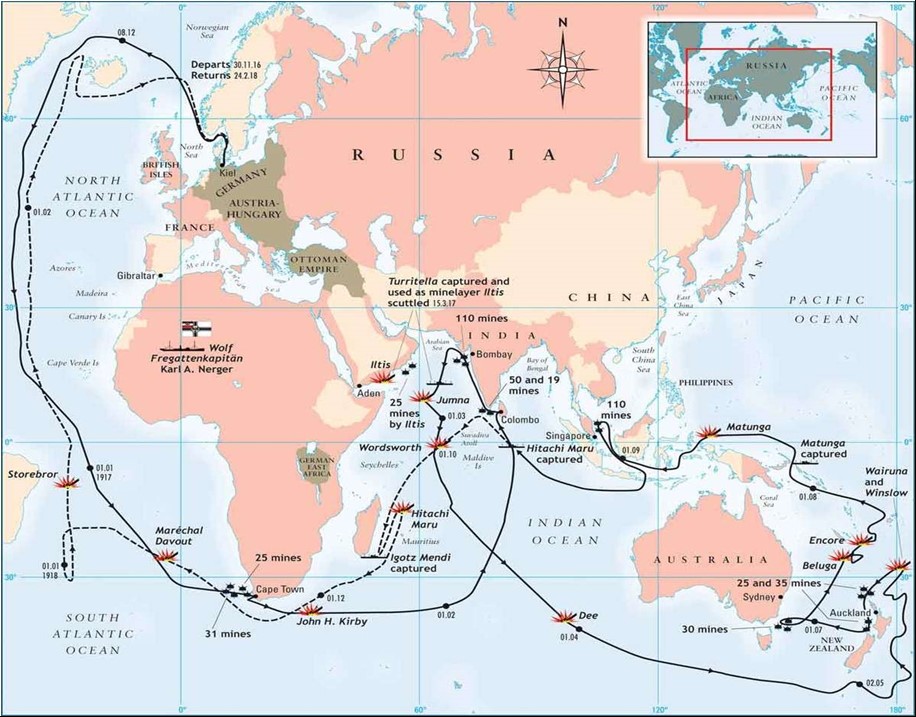
At the request of the British Admiralty, Brisbane left Port Jackson in Sydney on her first deployment in December 1916, bound for the Mediterranean. After two months at Malta the cruiser was despatched to the Indian Ocean to search for an unknown enemy sea raider, later determined to be the German Wolf , which operated her own seaplane, a two-seat Friedrichshafen FF33e named Wolfchen (Wolf Cub or Little Wolf). The raider had departed her home port of Kiel on 30 November 1916 with the mission to raid shipping and lay minefields in the Atlantic, Indian and Pacific Oceans.
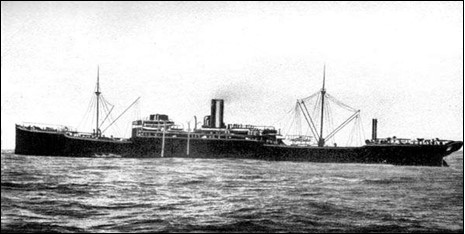
Wolf, although by appearance a merchantman, was heavily armed with six 5.9-inch, three 2-inch and some smaller calibre guns, plus four torpedo tubes. She also carried more than 450 mines. By end of May 1917 Wolf had sunk four ships by direct action and her mines had accounted for another five. When Wolf eventually berthed back at Kiel on 24 February 1918, she had sunk 14 ships directly and 13 with her mines. She also carried more than 450 prisoners, captured from her victims.
The Wolf Cub
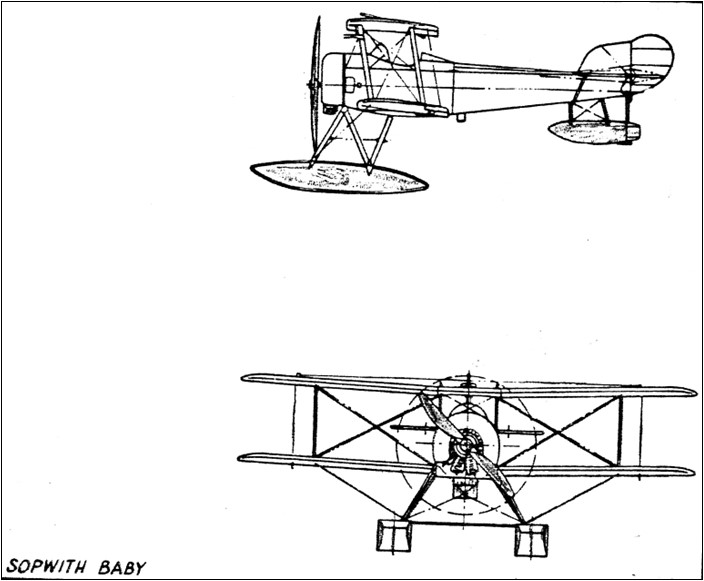
Wolf’s embarked seaplane was a Friedrichshafen FF33e, of which 180 were constructed during the Great War. The aircraft was largely responsible for the location of its parent ship’s victims. It is recorded as having captured two vessels in its own right. At 54ft 6in (16.6m) the FF 333e had over twice the wingspan of the Baby and was 10ft 6in (3.2m) longer. The loaded weight of Wolfchen was 1550kg and twice that of the Baby’s 779kg.
The physical size of the aircraft would have made the FF33e much more unwieldy than the Baby to lower and raise over the ship’s side, and the aircraft also presented a greater stowage challenge. The Wolf’s FF 33e had its wings removed after every flight partially because of their size and to protect them from blast damage by gun fire.
The FF 33e was powered by a Benz inline liquid-cooled engine of 150hp. The Baby had a 110hp Clerget engine. The FF33e is unlikely to have been a startling performer in terms of manoeuvrability or rate of climb but its endurance was five to six-hours and more than twice than claimed for the Baby, a positive attribute for its reconnaissance role.
Probably the greatest advantages enjoyed by the FF 33e were that it had a crew of two and was equipped with a wireless. The second crew member would have been of enormous advantage releasing from and hooking the aircraft onto the whip of the ship’s crane but also conducting navigation and communication both with Wolf by radio and intended victims.
The standard method of communication with victims was to drop a note written in English onto the target ship demanding surrender and directing a heading toward Wolf be immediately followed. Resistance caused the aircraft to drop a bomb just ahead of the ship. This procedure appears to have been successful in capturing all the ships apprehended by Wolfchen.
The Sopwith Baby is not known to have ever been required to perform such a role and even though it was armed with a Lewis gun and bomb racks it is unlikely the aircraft would have found it practical to do so. But the Baby was a general purpose aircraft, and for its time a handy ‘maid of all work” aircraft. It was not optimised for any particular role, but used for most. A total of 386 Babies were built.
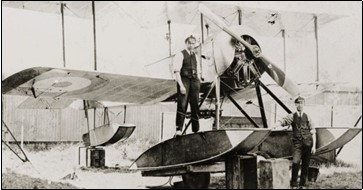
The FF 33e Wolfchen was reportedly airborne over Wolf when the ship entered Kiel at the end of its 15-month deployment. Considering the ship had not enjoyed any support from ashore during that time, the evident serviceability of the FF 33e is a considerable testament to the aircraft’s design and to the competence of the embarked maintenance crew.
By March 1917 Wolf was beginning to generate a great deal of consternation with the Allied governments. The Official History of the Great War: Naval Operations, Vol IV by Henry Newbolt, states that there was no definite intelligence on the Wolf until early March. And he records that in March of 1917 there were approximately 24 British, Australian, French and Japanese naval vessels deployed throughout the Indian Ocean on patrol and escort duties in response to the threat of the raider.
By the end of April, the light cruisers HMS Gloucester and Brisbane had arrived at Colombo from the Adriatic and and Malta respectively, and the seaplane tender Raven II, with the French cruiser Pothuau, had been directed from the Red Sea to Colombo. The significant Japanese contribution has largely been forgotten. Newbolt acknowledged in the official history that the Imperial Japanese Navy did more than was asked of them and had at one point provided up to ten cruisers and destroyers in the Indian Ocean and Western Pacific in response to the threat of the German raider. Brisbane’sembarkation of an aircraft was but one consequence of Wolf’s foray into the southern oceans.
Raven II
With Short Type 184 seaplanes, and one Blackburn Baby seaplane embarked, Raven II was under the control of the outstanding and indomitable FAA pioneer Commander RN, later Air Commodore, Charles Rumney Samson, CMG, DSO & Bar, AFC, RAF. Commander Samson and Flight Commander Clemson who was a pilot aboard Raven II had worked and flown together before, in the Dardanelles.
Raven II arrived at Colombo in early April 1917 in company with Pothuau after searching the Laccadive Islands during their transit from the Red Sea. While the ships were coaling, arrangements were made for Raven II and Potuau to search the Maldive and Chagos Islands with the Short seaplanes.
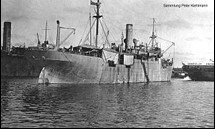
Additionally, the Baby was to be transferred to Brisbane with the intention that the Australian ship should search further reaches of the Indian Ocean. This aircraft, which carried the Royal Naval Air Service serial number N1014 (referred to as “Sopwith 2014” in Raven II’s Log), was one of the first batch license-built by Blackburn. After the aircraft’s embarkation with four maintainers on 6 May 1917 it was stowed aft on the upper deck of Brisbane on a platform designed by the ship’s CO, Captain Claude Cumberledge Royal Navy.
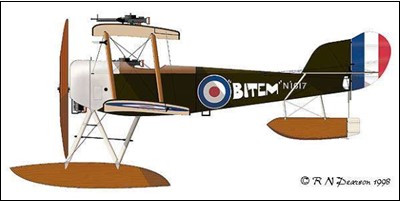
For flight operations, the Baby was craned overboard from this stowage and would take off from the sea and, after landing, would then be hoisted inboard.
Brisbane’s search did not find Wolf, because the raider by this time was well to the south of Australia, sailing eastward. The embarked Baby operated successfully from its new parent ship during the embarkation between 6 to 15 May 1917, reportedly making two flights daily, each of an hour’s duration in the early morning and late afternoon. The dates and duration of the embarkation are assumed from the entries in Raven II’s log recording when the aircraft, pilot and maintainers were transferred to and from Brisbane. The pilot was Flight Commander A.W. Clemson RNAS who impressed CO Brisbane with his most competent conduct of his duties.
In late May 1917 Raven II was recalled to the Red Sea to participate in the ongoing operational tasking in the Middle East. According to her log Brisbane sailed with Raven II. Before departing, Sopwith 2014 had, on 17 May 1917, been disembarked from Raven II with eight maintainers to the depot at Colombo. The Baby continued to conduct searches to seaward from ashore.
On 22 May 1917 Raven II also recorded Brisbane’s departure to Bombay. The ship is likely to have again embarked the Baby with CMDR Clemson as it passed Ceylon (now Sri Lanka) on passage to the Bay of Bengal.
Postscript
On 1 or 2 June 1917 the Admiralty advised that escorts were no longer required in the Indian Ocean. Brisbane returned to Colombo, disembarking its aircraft upon arrival and later sailing from the depot for Australian waters on 14 June.
Brisbane was not the first allied warship to embark and operate an aircraft. Many RN cruisers were appropriately equipped to conduct such operations and had done so.
The cruisers Doris and Minerva, amongst others, had operated aircraft at Gallipoli in 1915. And there had been many similar embarkations after that. By May 1917, the Royal Navy had approximately eight to ten seaplane tenders in service. It is difficult to be sure of the precise number because some of these ships were Royal Fleet Auxiliaries and therefore do not always appear in the RN’s records of activity. The RN could field a substantial number of aircraft from these ships and cruisers at sea.
The seaplane’s mode of operation was cumbersome however, and limited by ship’s motion in any significant sea. Additionally, the weight and aerodynamic drag of floats imposed a considerable penalty upon aircraft performance, and ships’ captains did not enjoy the vulnerability of being stopped dead in the water while the lowering and hoisting an aircraft.
So, the next stage of the development of naval aviation was rapidly progressed. This involved the fitment of launch platforms mounted upon gun turrets and the introduction of aircraft with substantially better performance than the Baby, particularly the Sopwith Pup and Camel.
Australian ships played a leading role in this important development. Although launching was much easier from these platforms, the recovery of these ‘once only’ aircraft (introduced primarily to counter the threat from Zeppelins) remained an unsolved problem – unless the parent ship was within diversion range of land. The development of the conventional flush-decked aircraft carrier was the answer and was also well underway by late 1917.
References.
– Official History of the Great War: Naval Operations Vol. IV by H. Newbolt.
– In All Respect Ready: Australia’s Navy in World War One by CMDR D. Stevens RAN.
– War in the Air Vol. VI by H.A. Jones.
– The Sky their Battlefield by T. Henshaw.
– First of the Line by Group Captain K. Isaacs AFC, ARAeS, RAAF (Retd).
– Australian Naval Aviation Part 1 by Group Captain K. Isaacs AFC, ARAeS, RAAF (Retd).
– The Wolf by Richard Guilliatt and Peter Hohnen.
– The Acquisition of HMA Ships Albatross, Sydney and Melbourne by A. Wright.
– Sopwith Baby (Windsock Data File) by J.M. Bruce.
– Flying Stations by Australian Naval Aviation Museum: A Story of Australian Naval Aviation.
– World Wide Web Sites Various.
– British Naval Aircraft since 1912 by O. Thetford.
– Military Aircraft of Australia by S. Wilson.
– Seagulls, Cruisers and Catapults. Australian Naval Aviation 1913-1944 by R. Jones.
– Catapult Aircraft: Seaplanes that flew from ships without Flight Decks by L. Marriot.
– Flypast: A Record of Aviation in Australia by N. Parnell and T. Boughton.
– Fights and Flights by ACDRE C.R. Samson CMG, DSO, AFC,