- Author
- A.N. Other
- Subjects
- Ship histories and stories, WWII operations, History - WW2
- Tags
-
- RAN Ships
- HMAS Falie
- Publication
- September 2025 edition of the Naval Historical Review (all rights reserved)
by Lyn O’Grady
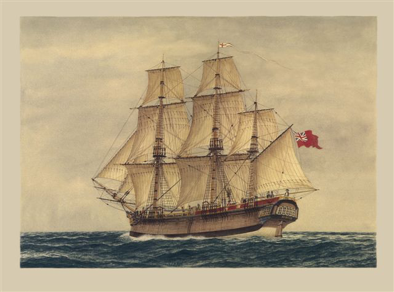
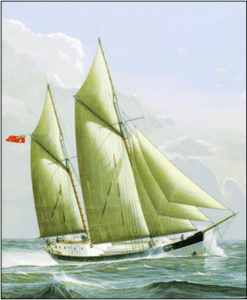
Having been requisitioned by the Royal Australian Navy to act as an examination vessel at the entrance to Sydney Harbour from 1940, HMAS Falie began a new role in 1942. She would become a stores carrier in the northern region, including Borneo and the near Pacific, for the duration of the Pacific War. Duties would include carrying naval supplies, equipment and at times, transferring troops under the veil of darkness.
Falie was fitted with two 20-mm Oerlikon anti-aircraft guns (fore and aft), and two Vickers machine guns. The main mast was removed, keeping the mizzen and derrick for loading. Also installed was an AWA tele-radio, a Type 3B model, which permitted two-way communication, and two sets of Carley floats mounted on each beam. The ship’s fuel capacity for her Petters two-stroke solid injection main engine was 2,400-gallons, sufficient for 600-hours or 4,200-nautical miles. She also carried a pair of seven-cubic-foot refrigerators, a tank capacity for 2,700-gallons of fresh water, three-tons of bagged coal on deck for the galley, and provisions sufficient for 90-days.
Falie departed Sydney on 17 July 1943, her destination, Milne Bay via Townsville.
After three round voyages from Milne Bay to Port Moresby and back, Falie sailed back to Townsville on her way south. Falie’s engine broke down south of the Brook Islands and drifted into Rockingham Bay, where the corvette HMAS Pirie found the vessel and took her under tow on 7 September 1943. After repairs at Pearl Bay, Falie left for Sydney but broke down once again off Smoky Cape, before receiving a tow to Newcastle and onto Sydney by the auxiliary minesweeper HMAS Samuel Benbow.
Falie was employed as a pilot ship in Sydney for a ten-day period – but the Naval Officer Commanding Sydney, determined that Falieshould return north. Accordingly, she was loaded with naval stores for the Port Directorate at Finschhafen, on the New Guinea coast. After making her way north, Falie again operated from Milne Bay, shifting many tons of naval cargo and numerous personnel between the islands in the region.
Still in command was Lieutenant Commander Charles Victor Wood RANR(S), with Sub-Lieutenants A.R. Templeton and E.C. Daniel RANR and about 20 merchant service men. By the end of 1944, Madang became Falie’s homeport, undertaking trips to Hollandia where General MacArthur had set up his headquarters. The crew and engineers had to draw on their expertise in keeping the ship’s engine and rudder in working order, and a few times, her funnel and exhaust muffler caught on fire. During 1945 the engine became increasingly worn, and in July Falie received assistance from a USN destroyer repair base for ongoing engine repairs. The men aboard Falie saw bombs dropping and Japanese planes in the distance but never had to fire their own guns.
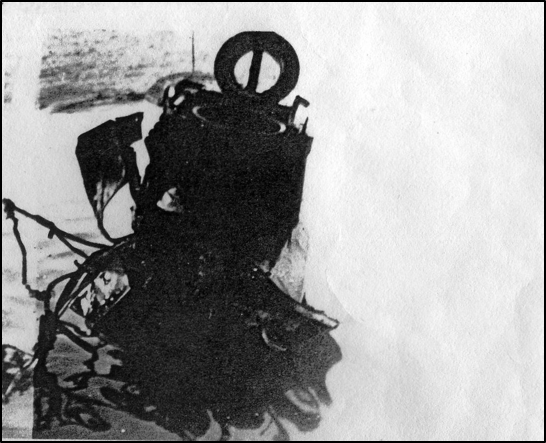
On 4 August 1945 Tancred began towing Falie from Finschafen, bound for Sydney for a refit. However, a fire in Tancred’s engine room at 0430 on 8 August, caused the crew to abandon ship. Falie took their lifeboat in tow while her motor skiff went to pick up men in lifebelts or on various rafts. After burning for five-hours, the officers returned to investigate. The fire was extinguished and all the crew returned. When it seemed to be drifting towards rocks,Falie took Tancred in tow to an anchorage off Kitaba Point. Tancred was eventually towed away by the salvage tug Cambrian Salvor.
Falie proceeded to Milne Bay to await another tow, and was still there on 15 August, when Japan announced it would surrender. On 28 August 1945, Caledonian Salvor took Falie and Tancred both in tow, bringing them via Cairns to Sydney, with Falie berthing at Garden Island on 15 September.
It wasn’t until October 1946, that Falie was returned to her owners at Port Adelaide, having been converted back to the mercantile trade. Because of the shortage of coastal transport during the war, farmers had shifted to utilising rail and road, ending a century of the coastal grain trade. For 15-years Falie’s cargo included explosives for mining and Falie then became a sail training and charter ship for the next 20-years. However, in 2006 it was found that her steel hull plates were thinning and she was placed out of survey. Since 2009 a committed team of retirees has undertaken maintenance jobs and held open days. Further warnings of thinning hull plates were again ignored in 2013 and when Falie was slipped again in 2021 it was found to have many pinhole leaks and couldn’t return to the water.
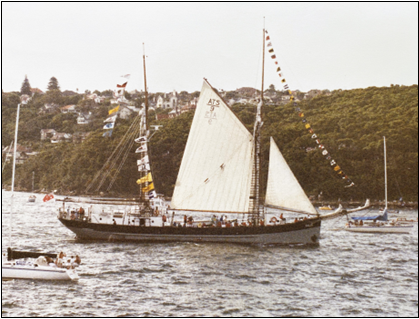
Falie still remains out of sight on a slipway with an uncertain future. Maintenance volunteers continue their work chipping and painting decks and varnishing timber trim while others are preparing activities relating to maritime history for students.
The future
Historic Ketch Falie Inc was formed to access grants and to organise open days. A new website with online education resources, and an oral history programme have also been launched. The few contacts we have received from those who served on HMAS Faliehave come from NSW, as we seek stories and photos to add to the archives. More information is available at https://historicketchFalie.org.au , or email us at historicketchFalie@hotmail.com.
Information for this article was sourced from FALIE, Portrait of a Coastal Trader by Gordon Pickhaver and Bob Sexton, 1986.
The author: Lyn O’Grady has been involved with the Falie project for the last eight-years as historian, curator, archivist, oral historian, and currently Secretary of Historic Ketch Falie Inc.