- Author
- Gillett, Ross
- Subjects
- Ship histories and stories
- Tags
-
- RAN Ships
- HMAS Kanimbla II, HMAS Manoora II
- Publication
- September 2025 edition of the Naval Historical Review (all rights reserved)
Origin: In Australian service HMA Ships Kanimbla and Manoora were employed as LPAs (amphibious transports). Both were originally constructed for the United States Navy (USN) as members of the Newport class tank landing ships (LSTs). Kanimbla had commissioned on 23 January 1971 as the USS Saginaw (LST 1188) and Manoora on 16 October 1971 as the USS Fairfax County(LST 1193).
Overall, 20 of the Newport class were built for the USN from 1969 to 1972. During the years 1994 to 2002, eleven of the class were transferred to seven other navies including Brazil-1, Chile-2, Malaysia-1, Mexico-2, Morocco-1, Spain-2 and Taiwan-2. Another three sunk were sunk as targets and four retained as reserve assets until 2008, when three ships were earmarked for Peru.
The Malaysian ship, ex-USS Spartanburg County was retired in 2010 after a major onboard fire on 8 October 2009. Of the two Chilean units, ex-USS La Moure, was damaged after running aground on 12 September 2000 and was sunk as a target on 10 July 2001. The second Chilean ship was retired in 2010.
Purchase: The decision to acquire two of the class for the RAN was made on 15 December 1993. Kanimbla was planned to be transferred upon her decommissioning from the USN on 28 June 1994, but the transfer was delayed by the U.S. Senate. Then, on 24 August, her transfer was achieved, the 24-year-old ship commissioning in Newport on 29 August. Kanimbla subsequently arrived at Fleet Base East in Sydney on 18 November 1994.
Manoora departed the American east coast port, sailing on 15 August 1994 and arriving at Fleet Base East on 19 September. Manned by a mixed RAN and USN crew, she was decommissioned and transferred on 27 September. The ship was formally commissioned into the RAN on 25 November 1994, but was laid up in July 1995.

THSS: Original RAN plans had called for the type classification THSS (Training and Helicopter Support Ship), but after the start of conversion work to both vessels, the former LSTs were re-classified as amphibious transports (LPAs). The two ships were originally intended to replace the 1981 vintage Tobruk and the stricken training ship, cum troop transport Jervis Bay, but the former was retained to form a trio of capable amphibious ships for the Australian Fleet.
Design Notes: As originally designed for the USN, the two ships could each transport up to 2,000-tons of cargo on their 1,765-square metres of deck space. The aft stern door allowed for the loading and unloading of vehicles, with the tank deck fitted with a 75-ton-capacity turntable at both ends.
Combat Systems: The ships’ original two twin three-inch guns (mounted amidships) were deleted during 1993 and replaced by a single U.S. Mk 15 Phalanx CIWS (close-in-weapon-system) atop the bridge. The latter was removed in Australia and placed into the RAN’s weapon pool. In subsequent years both LPAs re-mounted the Phalanx above the bridge, with two stabilised Raphael Typhoon 25-mm automated, lightweight, stabilised naval gun systems for additional close-in defence. The Typhoons were mounted amidships, on either beam. Two smaller 12.7-mm Mini-Typhoon guns were also mounted on the starboard and port sponsons.
Electronics: Fitted with surface search radar, Kelvin Hughes 1007, I-band.
Upgrades: A contract to convert the LSTs to LPAs was awarded to Forgacs Shipbuilding at Newcastle, NSW in December 1995. Both ships were to be modified by:
– the fitting of a hangar to take up to three Sea King or four Black Hawk helicopters,
– the incorporation of a third helicopter landing spot forward of the bridge,
– an increased aviation fuel capacity, and
– the removal of the original bow landing ramp and bow horns.
| Name | Builders | Hull No | Laid down | Launched | Comm’ d | Fate |
| Kanimbla | National Steel & SB, USA | L51 | 24 May 1969 | 7 Feb 1970 | 23 Jan 1971 (USN)
29 Aug 1994 (RAN) |
Paid off
25 Nov 2011 |
| Manoora | National Steel & SB, USA | L52 | 28 Mar 1970 | 19 Dec 1970 | 16 Oct 1971 (USN)
25 Nov 1994 (RAN) |
Paid off
27 May 2011 |
Manoora was laid up in Sydney during July 1995 to await her conversion with Forgacs. Work began on 23 May 1996 for completion in 1998 but this was delayed until mid-1999.
Kanimbla’s conversion to an LPA commenced on 28 June 1996, for completion in August 1998, but was not completed until late-1999.
The stern gate to the tank deck was retained, with the ships able to load tanks, as well as Bushmaster protected mobility vehicles, artillery pieces and Australian Light Armoured Vehicles (ASLAV-25) wheeled vehicles. The Bushmasters could be configured as troop, command, Assault Pioneer, mortar, direct fire weapon and ambulance variants. ASLAVs were configured as formation reconnaissance, infantry fighting vehicles, armoured ambulances or recovery vehicles.
To shift the embarked vehicles, two LCM-8s (Landing Craft Mechanised Mk 8) could be carried on the forward deck, unless the third helicopter landing spot was required.
The flight deck aft was also CH-47 Chinook capable. Helicopter operations were based around the three landing spots, one forward for use after the landing craft had been offloaded and two aft, from the lengthened and widened flight deck. The hangar, built between the original funnels, required the original starboard landing craft davit to be deleted.
Other changes included:
– the removal of the beaching capability,
– replacement of the USN radars and boat,
– fitting of a very large and powerful crane to embark the two LCM-8s,
– a new training bridge,
– an increased ship water making facility (up to 150-tonnes of water per day), and
– power improvements via a 4th diesel generator.
Additional improvements: Aviation fuel capacity was also increased from 70-tonnes to 250-tonnes, ensuring greater operational endurance for the embarked helicopters. This was achieved via the conversion of two of the original three vehicle fuel tanks to provide separate aviation fuel.
In 2001, work was undertaken to install communications and command support systems to support a deployable Joint Task Force Headquarters.
Both ships boasted a Joint Operations Room and an enhanced medical and surgical fit to provide an improved
clinical capacity when a Primary Care Reception Facility was embarked. During 2004 Manoora also underwent an extensive refit to allow the ship to transport new M1A1 Abrams tanks.
The Joint Task Force Headquarters capability aboard each LPA was further upgraded in 2008, when a set of four state-of-the-art Command Central Communications and Intelligence suites was added to each ship.
Army loads: Each LPA could support an Army company size force, but without all of the enablers they required. Each ship possessed 229-lane metres for vehicles. Offloading the equipment onto the embarked pair of LCM-8s was conducted through the stern door, but limited to sea state 2. In the best conditions, the military load could be disembarked in one cycle of darkness, reducing the threat to the ship and the other forces.
Machinery: The six Alco diesels powered two shafts to produce 16,500 bhp. Controllable pitch propellors were fitted. As completed, one bow thruster enabled faster berthing.
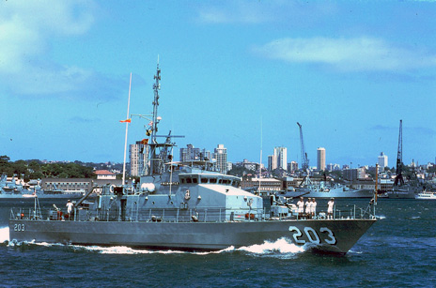
Crew: Accommodation, medical facilities and galleys were greatly modified for both crew and embarked forces as part of the conversions. Both ships were homeported at Fleet Base East in Sydney.
Refits: Initially, Kanimbla and Manoora were expected to pay off prior to the commissioning of the two new Canberra class LHDs (Landing Helicopter Dock). However, on 21 September 2010, a fire aboard Kanimbla caused the ship to lose power off Sydney Heads. The situation was brought under control with no injury or loss of life, although the LPA did briefly drift towards North Head at the entrance to the harbour. The ship’s final activity at sea would take place later the same month when an Army Tiger attack helicopter landed onboard for the first time, conducting flight and deck-handling trials.
As a result of the September 2010 incident Navy decided that its two LPAs would be kept alongside in Sydney for advice of an independent board to evaluate the seaworthiness and safety of the ships. Shortly after, the then Chief of Navy, Vice Admiral Russ Crane, advised in November 2010 that the old ships would continue in service, with one to decommission in late 2012 and her sister ship in late 2014.
Surveys: The ‘survey’ of the LPAs spanned over three months, until, on 1 February 2011, it was announced that Manoora would be decommissioned on 27 May, the LPA needing emergency remediation for significant hull corrosion, as well as the replacement of both of the ship’s gear boxes. Estimated to cost more than $20 million and take until April 2012 to complete, Navy determined that such a refit so late in her career was not value for money.
Kanimbla’s refit was planned to span from late-2010 to mid-2012. She would then remain in commission until the close of 2014 to provide a large amphibious ship to undertake both military and humanitarian tasks.
The ship was docked for repairs from March 2011, and by mid-year Defence had assessed the future of a refitted Kanimbla, including a detailed appraisal of the capability provided by the long-serving ship, an assessment of her materiel state and a cost and risk assessment.
It was decided that the most cost-effective and lowest risk option was to decommission the old LPA at the Fleet Base East in Sydney on 25 November 2011. Kanimbla was
undocked in August and moored alongside the oil wharf at Garden Island, with the already decommissioned Manoora.
Departure:
The September 2013 edition of Naval Historical Review described their departure from Garden Island and Sydney:
After some time alongside Garden Island, on Monday, 15 October 2012 the two retired amphibious ships, Kanimbla and Manoora, were towed to White Bay, on the western side of Sydney Harbour to await their final disposal. They were first offered to the Queensland State Government as wreck dives but owing to the high cost of preparing the ships for scuttling, and the adverse environmental lobbying against the similar wreck dive fate of the former frigate, HMAS Adelaide, the proposal did not proceed.
Defence subsequently announced both vessels were to be broken up with an estimated scrap value of $2.5m each. Tendering for disposal began in June 2012 with a contract awarded to the American company, Southern Recycling, in May 2013.
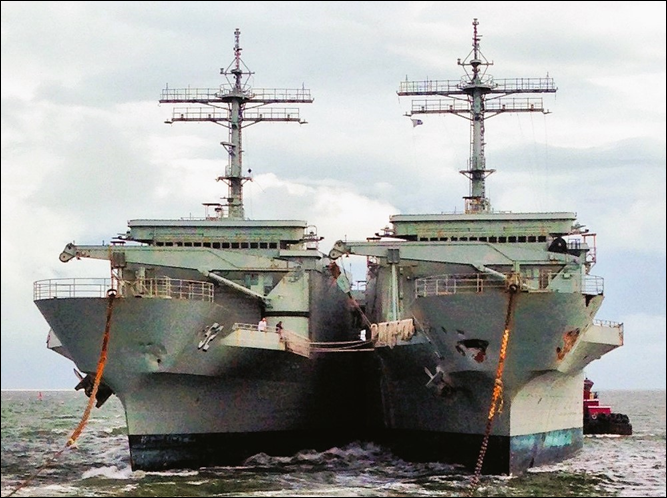
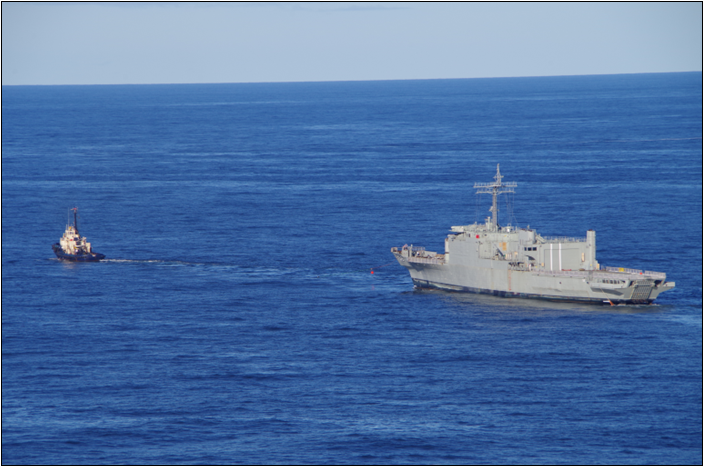
On a calm but cloudy Monday, 1 July 2013 these grand old ladies of the seas, now both well over 40-years old, were towed from the harbour one at time by the Svitzer tugs Giru and Woona.
There was no salute or fanfare, their passing hardly noticed. They were taken to a position six-nm off Sydney Heads where a rendezvous was made with the Taiwanese owned deep sea salvage tug Salvage Ace.
The two former warships were secured in tandem to Salvage Ace for the 60-day tow, at six-knots, across the Pacific Ocean to Panama. The ships were handed over to American tugs for the final leg of their voyage to the breakers yard in Texas, where they arrived on 3 October 2013.
Kanimbla class data:
Type: Amphibious Transports
Designation: Landing Platforms Amphibious (LPAs)
Country of origin: USA
Complement: 213
Military lift: 450 troops, 229 lane-metres for ADF vehicles, two Army LCM-8 landing craft
Displacement: 4,975 (standard), 8,450 (full load)
Dimensions: 168.2 × 21.2 × 5.3 metres
Armament: Two 25-mm Typhoon, two 12.7-mm Mini-Typhoon, one 20-mm Vulcan Phalanx M Mk5 CIWS. Fitted for but not with RBS 70 missile launchers
Helicopters: Three Sea King or four Black Hawk (Army) or one CH-47D Chinook (Army)
Countermeasures: Two SRBOC Mk 36 chaff and IR launchers
Fuel: Diesel, plus 250-tonnes of aviation fuel
Speed: 20-knots (economical), 22-knots (max)
Range: 3,500-nm @ 15-knots