
- Author
- A.N. Other
- Subjects
- Ship histories and stories
- Tags
-
- RAN Ships
- None noted.
- Publication
- March 2025 edition of the Naval Historical Review (all rights reserved)
Plans to repatriate the former Royal Navy Type 21 frigate HMS Ambuscade to the United Kingdom from Pakistan are continuing to move forward. The vessel, which was sold to Pakistan in 1993 to become PNS Tariq, is currently in Karachi Naval Dockyard having decommissioned on 5 August 2023.
Ralph Edwards reports.
Following discussions led by Glaswegian businessman David O’Neill, the vessel has recently been generously donated by the Pakistan Navy to a charity, to enable the ship to be transferred to a location on the River Clyde where she will become amuseum ship. There the frigate would showcase the importance of shipbuilding on the Clyde and its links to the Royal Navy. The ship would also highlight the connection between the Royal and Pakistan navies and become a focus point for the local Pakistani community.
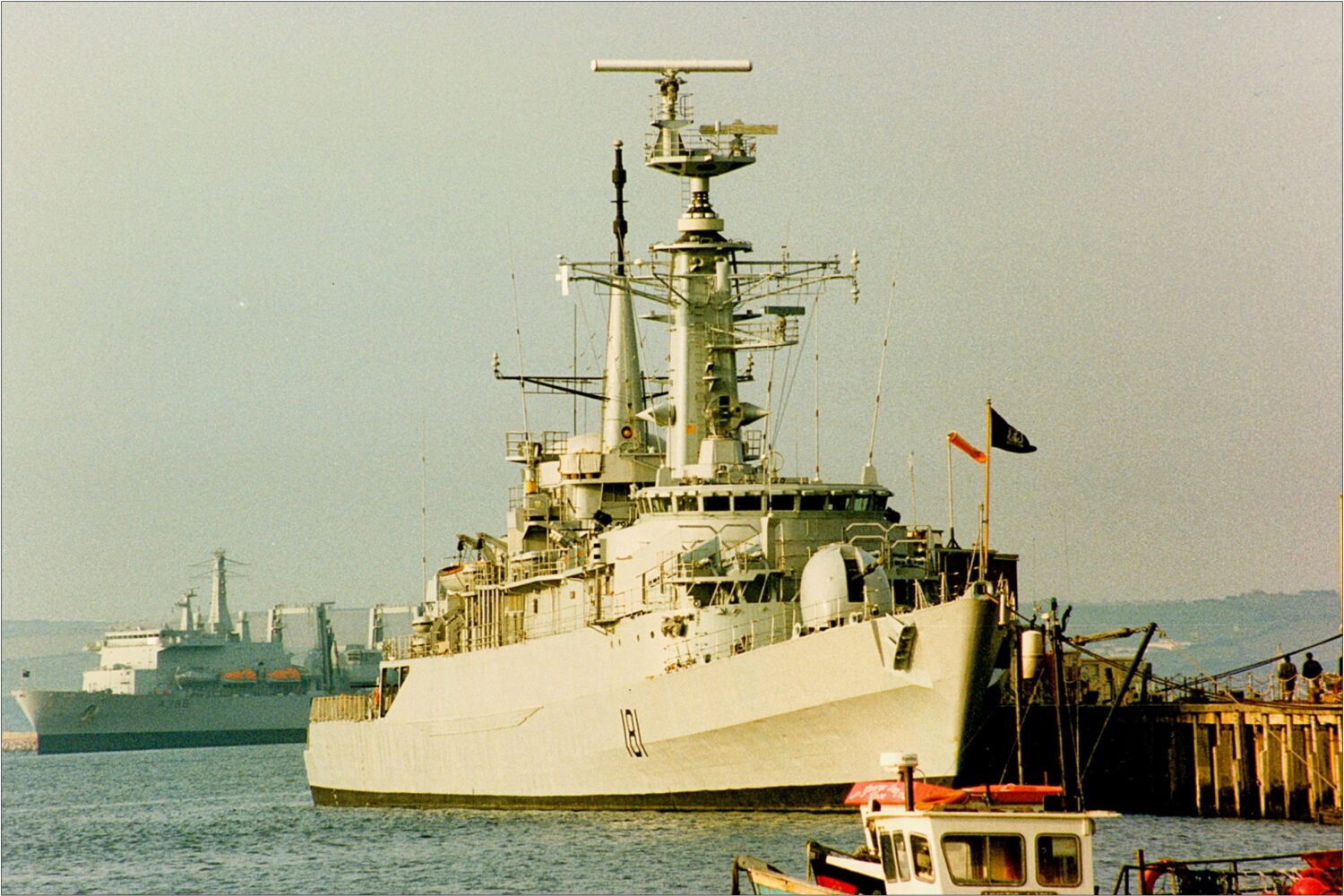
Preservation
The scheme was originally overseen by the Falls of Clyde International charity, but will now be managed by a new charity, the Clyde Naval Heritage. The Falls of Clyde International charity had originally been set up by Mr O’Neill to preserve the last surviving iron-hulled, four-masted full-rigged ship, a Scottish-built tall ship named Falls of Clyde. However, legal complications meant that the bid has been unsuccessful so far and a new charity was set up to differentiate between the two schemes.
The frigate will be moved from Karachi Naval Base to a commercial location where preparations for the ship to be conveyed to Scotland can be made. A team from the UK is to oversee the operation. The transfer of the vessel will certainly be challenging. The plan is to transfer her via a heavy-lift vessel. The original plan to take her via the shortest route, the Red Sea, and the Suez Canal, poses significant risk as the heavy-lift vessel is US-Registered and could be considered a prime target for the Houthis. The alternative route via the Cape of Good Hope is significantly longer, costlier and at a greater risk of adverse weather.
Glasgow City Council has been supportive, but no decision has been made yet regarding her final berth. Several final locations have been considered including the Riverside Museum in Glasgow, Custom house Quay and Beacon Arts Centre in Greenock and Govan Graving Docks.
Looking back
A contract was awarded on 27 February 1968 to Vosper Thornycroft to design a patrol frigate in collaboration with Yarrow Ltd. The first three units were laid down by Vosper Thornycroft at their Woolston, Southampton yard with the remaining five built by Yarrows (now part of BAE Systems) in Glasgow.
Ambuscade was the first unit to be built by Yarrows and was the third unit to be commissioned, on 5 June 1975, and ahead of Vosper Thornycroft’s third unit. She was the first warship to be designed from the outset for the Royal Navy to incorporate gas turbine propulsion. Ambuscade was homeported in Devonport, Plymouth. After completion of sea trials, she joined Standing Naval Force Atlantic in 1977. The following year, she deployed for five months to the Western Atlantic and the Pacific. In 1979 she returned to UK waters before serving as the West Indies Guardship. The year 1980 saw her first refit. In 1982 she was taking part in the Armilla patrol (the Royal Navy’s permanent presence in the Persian Gulf) when she was recalled due to the outbreak of the Falklands war.
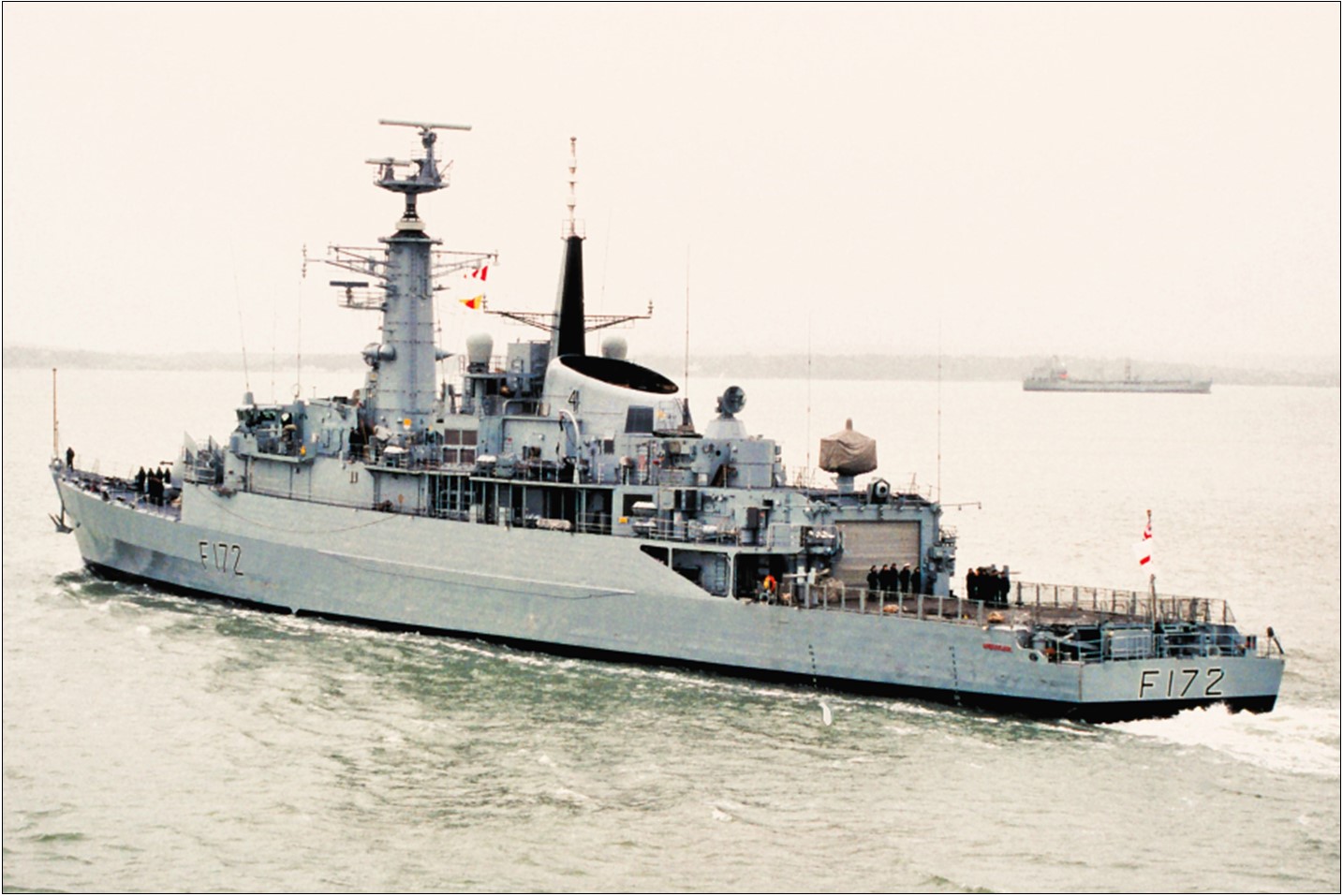
Falklands
In the South Atlantic, she was deployed initially as an electronic warfare picket. Later, she participated in several bombardments of Argentine positions. However, on 25 May, she was targeted by two Argentine Dassault-Breguet Super Etendard strike aircraft. Two Exocet missiles were fired at her.
Ambuscade successfully deflected the missiles by firing chaff decoys but the Exocets then locked onto the SS Atlantic Conveyor. The vessel, which was carrying vital helicopters for the task force (six Westland Wessex helicopters, three Boeing Chinook helicopters and a single Westland Lynx), was destroyed by fire caused by unburnt missile fuel from the Exocet missiles and sank three days later when under tow.
Ambuscade’s last action in the Falklands War was on the night of 13 June, when she fired over 200 4.5-inch shells in support of the Parachute Regiment’s assault of Wireless Ridge, a vital hill that had to be taken to gain Port Stanley, five miles distant. The assault was successful, resulting in the surrender of the Argentine forces in the Falkland Islands the following day.
In 1983 Ambuscade returned to the Indian Ocean. On 27 April, whilst conducting tactical manoeuvres with British and American warships, she was in a collision with the Leahy class guided missile cruiser USS Dale. Her bow impacted Dale’s port side, resulting in both vessels suffering damage that required dry-dock for repairs. Ambuscade went to Bombay (now Mumbai) for a new bow to be constructed and fitted, a task that would take six weeks. Later, from 1984 to 1986, she received an extensive refit. Severe cracking of her hull was repaired by the addition of steel plates down each side of the ship. On completion, she returned to the South Atlantic as Falkland Island Guardship.
Pakistan
Except for 1989, when she remained in UK and European waters, she would alternate this role with that of West Indies Guardship until decommissioned at Devonport on 28 July 1993. She was at once recommissioned into the Pakistan Navy as PNS Tariq. This was part of a deal between the Britain and Pakistan to sell all six of surviving Type 21 frigates. Her Exocet and Sea Cat missiles and launchers were removed before transfer, although her Lynx helicopter did transfer.
Ambuscade was the first Type 21 frigate to transfer to Pakistan. On arrival in Karachi, the ship was refitted by KSEW Ltd, including the fitting of a Phalanx close-in-weapon-system and the installation of the Chinese LY-60 surface to air missile system to replace the Sea Cats. The frigate went on to provide a further 30-years of service and was the last Type 21 to decommission. Her service included international anti-piracy patrols off Somalia and escorting merchant vessels. One of her most notable contributions was the rescue of 377 tourists from the Maldives following the 2004 Boxing Day Tsunami.
Survivors
All five of her sister vessels that were transferred to Pakistan have now been scrapped or sunk as targets. Ambuscade is almost the last existing warship that participated in the Falklands War for the Royal Navy. The only others are the soon to be scrapped Type 82 destroyer HMS Bristol, the Brazilian BNS Rademaker (ex-HMS Battleaxe, Type 22 frigate) and the nuclear-powered Churchill class submarine HMS Courageous, which is now a museum ship in Plymouth.