By Commander David Jordan CSC RAN (Retd)
Background and need
During the late 1950s and well into the 1960s, the Royal Air Force (RAF) still had flying boats in service. Towing flying boats and servicing their moorings needed support craft. Some type of craft was also needed to support the ever-increasing requirement to recover air-dropped stores, such as torpedoes and sonobuoys, from trials and practice ranges.
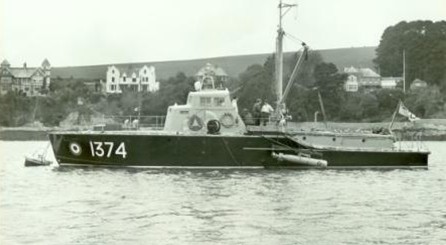
As air-to-surface weapons developed there was also a need for surface target towing. Of note, there were specific RAF air sea rescue craft but for support roles, pinnaces were used. Interestingly from a naval perspective, the term ‘pinnace’ was used to describe these small, light boats. While not embarked in a ship as a pinnace might traditionally have been, use of the word reflected their attachment to a RAF Airfield, Station or Unit.
The Pinnaces did not offer a true very high-speed or blue water target towing capability. But they were located near RAF Airfields in the United Kingdom (UK) and overseas, making them a practical and convenient asset for this role.

Australia’s own Anti-Submarine Warfare (ASW) research, development and trials were gaining pace by the mid-1970s with the Barra sonobuoy and Mulloka sonar most notable activities. Ikara had entered service but was still being updated. While the RAN was a key stakeholder, these efforts were led by the (now) Defence Science and Technology Group (DSTG) and selected industry partners. Most of the research and development effort was done in Adelaide. But much of the trials activity took place off Jervis Bay and a marine craft was needed there for support. The Royal Australian Navy’s (RAN’s) 40’ work boats could not support the trials offshore and the RAN’s Torpedo Recovery Vessels (TRVs) were already heavily tasked.
Conveniently, at that time the RAF was looking to divest their 63’ Pinnaces, which were performing exactly the same tasks the Australian Department of Defence (DoD) needed to support at Jervis Bay. Ex-RAF1383 was disposed of and sold to civilian buyers on 1st July 1975 at Portsmouth. But after only limited civilian service supporting the RAF and UK MoD, she was acquired by Australia and prepared for shipping.

In 1977 HMAS Melbourne (II) under command of Commodore (later Rear Admiral) R.C. Swan AO RAN, attended the Silver Jubilee Review in the UK. In July 1977 ex-RAF 1383 was loaded onto Melbourne in Portsmouth Harbour for transporting to Australia. Melbourne arrived in Sydney in early October 1977 and ex-RAF 1383 was offloaded at Garden Island.

63’ Pinnace Design
17 new build 63’ General Purpose Pinnace Mk1s were ordered by the Royal Air Force (RAF) in 1955 via UK MoD Contract DO/6/MC/899/CB21 (a). Built between 1955 and 1962, they served until 1997. The 17 Mk.1 versions (RAF 1371-1374 and RAF 1378-1390) were followed by two Mk.2 versions (RAF 1391 and RAF 1392). All but one survived their RAF service.

The hulls of the 63’ General Purpose Pinnaces were of double diagonal mahogany planking with a full-height superstructure, or wheelhouse cabin, made of riveted aluminium. They had a cut down freeboard towards the aft section with a long but low cabin covering a cargo hold space occupying the after part of the Pinnace. The low-lying cabin top aft provided a working deck, which was serviced by a hydraulic Hyland winch with a lifting capacity of 33 cwt.

Considered by their crews to be good sea boats, the engines had Blocktube controls coupled with Mathway gearboxes, endowing them with great handling characteristics. But their hard chine meant they were ‘tricky’ (chine walk) in a following sea and lay beam on when hove to.
The 63’ Pinnaces were fitted with various early generation direction finders, radars and radios. They had four V-berths forward with a head, a galley and a ‘Skippers’ two-berth cabin with its own head. The wheelhouse had a tri-fold door arrangement at the rear, enclosing the space.
Kunghah Maris
RAF 1383 was built in 1959 by Groves and Gutteridge on the Isle of Wight as yard no.585. When offloaded in Sydney, ex-RAF 1383 was taken in-hand for some overdue maintenance. Opportunity was also taken to do modifications to make her better suited to the specific tasks at Jervis Bay and in the East Australian Exercise Area (EAXA).
First though, the hull was sheathed in a protective layer of fiberglass to address leaking, a common approach in the marine industry and reasonably effective. But over time rotting wood or other defects that might weaken the structure, may not ever be detected.
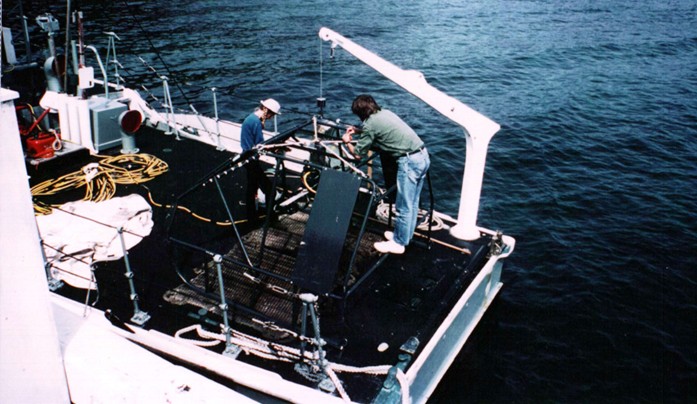
There were a number of modifications made, most prominent being removal of the aft cabin top, resulting in a flush deck aft at the original deck level. The boom of the crane was removed along with the winch. A new radar was fitted at the mast head. The superstructure was extended further aft and weather sensors were mounted on a new yard arrangement towards the top of the mast. More robust naval guard rails were fitted. A crane was fitted at the starboard quarter although, it appears this was not shipped when target towing.
Ex-RAF 1383 was renamed Kunghah Maris. The name is thought to have been created from a fusion of two words from older world languages. Kunghah an Australian aboriginal word broadly meaning to ‘collect or gather’ and Maris, a Latin-derived name broadly meaning ‘of the sea’. A very appropriate and well considered name for her role.

At this point it is appropriate to briefly reflect on an early Australian connection. RAF Pinnaces based at Bridlington, including RAF 1383, were often maintained in a yard at Whitby, the site where Captain Cook’s HMS Endeavour was built.
Kunghah Maris arrived at Creswell in late 1977 being partially crewed by RAN personnel until 1984 when a purely civilian contract crew assumed full responsibility. She was usually berthed alongside the SAR Wharf at Creswell. The white PVC tubes mounted either side at the base of the mast were for storing sonobuoys and other air-dropped stores, reflecting her primary role, particularly during latter years.

By the early 1990s the pace of the sonobuoy tasking had slowed. This meant Kunghah Maris was potentially available for other tasking and her crew, led by Master Scott Corson, were ever willing and able to support whatever was thrown at them. The civilian crewing arrangement was working well. In the early 1990s Kunghah Maris was hired by the CSIRO for environmental surveys of Jervis Bay when there was a possibility that the Fleet Base would be moved there.
The sinking
Kunghah Maris did many target tows in the EAXA. These surface gunnery shoots were conducted during daylight and were usually held about 15 nm to the east of Jervis Bay in the EAXA. Kunghah Maris would depart her berth at the Creswell SAR Wharf during the early morning, manoeuvre to pick up the RAN Mk1 target in the boat harbour and then, with tow secured at short stay, begin the one-hour passage to sea. Once in the exercise areas the tow would start to be streamed to long stay.

Kunghah Maris would head east at 8 knots with the target fully streamed to 1,200 yards. The towing bridle was typically an 8-strand polypropylene line of 75 mm diameter and needed two people to attend. Firing units would start to the north of the target at about 15 nm. The firing ships would approach at speed exercising tactics, techniques and procedures as they closed the target. Radio communications by VHF would be maintained throughout. Permission to engage the target and advice as to each burst of fire by the medium calibre guns was always passed on the radio. The towing vessel would observe each fall-of-shot and provide a report on completion of the firing. Kunghah Maris would then recover the tow to short stay and proceed back into Jervis Bay.
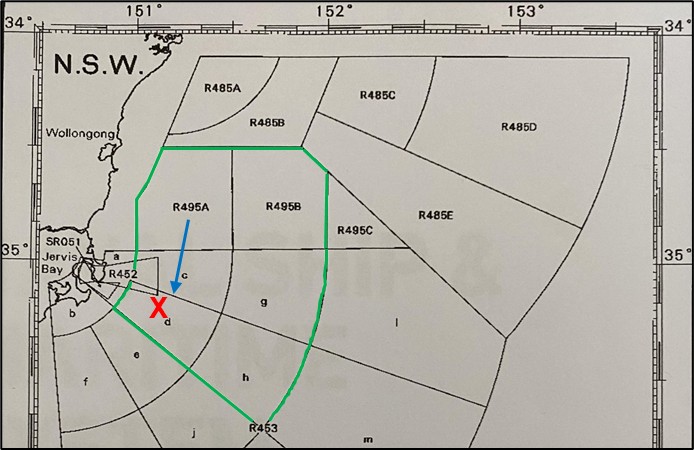
The allocated exercise areas in the EAXA for the surface firing exercise with Kunghah Maris on Friday 10 December 1993 are shown by the green boundaries in Picture 10 below. It was the final serial of a Principal Warfare Officer’s Sea Assessment Week. HMAS Hobart (II) under the command of Captain (later Rear Admiral) W.A.G. Dovers CSC RAN, was the Officer Conducting the Serial (OCS). The Serial went as planned and Hobart, along with her consort, was at the bottom of the run. Having expended rounds, Hobart was preparing to head north and return to Sydney. Kunghah Maris had slowed and was preparing to send the results of the firing to Hobart.
Scott Corson, the Master of Kunghah Marris, summed up the situation just after the firing run:
“Conditions were fair with a moderate swell. It was about 7.00 o’clock when one of the crew decided to go below to make a cup of coffee, only to find several inches of water sloshing around the galley. We quickly checked other compartments only to discover that flooding had spread throughout the vessel as there were no watertight bulkheads between compartments. Despite immediately starting the pumps, we could not cope with the inflow of sea water and Kungah Maris began to settle in the water”.
At the same time in Hobart the Author, embarked for the week as PWO Directing Staff, went to the Bridge to hear the firing report. Kunghah Maris came on to the radio but it was a request for assistance as they were taking on water. Lieutenant Commander (later Commander) Stephen Duffy RAN was Hobart’s Gunnery Officer but it was in his capacity as the Ship’s Diving Officer and Ship’s Demolitions Officer that he led the team to assist Kunghah Maris.
“We proceeded to Kunghah Maris in two boats. I had two other divers with me in one boat. The other boat had some stokers on board. We carried various flood kit, including a fairly big P250 pump”.
Back on board Kunghah Maris, Master Scott Corson said:
“From the time we started the [boat’s] pumps to the stage we realised the position was hopeless it was no more than 15 minutes. It was an unnerving experience for the crew to be standing there with life vests on, with water washing over the deck and the prospects of a swim”.
Lieutenant Commander Duffy outlined the situation as his team reached Kunghah Maris:
“My first observation was that the tow was still connected! We secured a pimple buoy to the end and cast it lose. The priority was people. We accounted for everyone and then worked with the crew to get the P250 going, secure classified materials and see if we could find the source of the leak. A stoker went forward but could not find anything. We took an axe to cabling on the radar and other electronics so we could salvage some equipment. At the same time we got the P250 going and it slowed the flooding but we weren’t winning. It was time to go. We were just about all in the boats when the Master moved quickly – almost swam – back into the wheelhouse with a spanner and unfastened the wheel and brought it with him”.
At 0945 on Friday 10 December 1993, Kunghah Maris slid beneath the waves into 1,400 metres of water some 16 nm to the east of Jervis Bay.
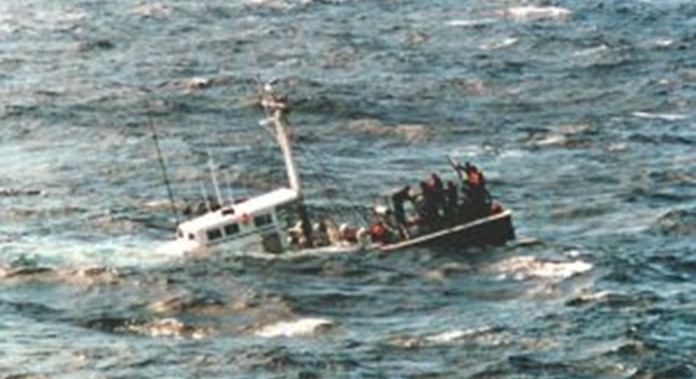
With everyone safe the focus became the target as it had drifted from the scene. Lieutenant Commander Duffy took his boat towards the target and almost immediately came across the pimple buoy. Having secured the buoy inboard, the long slow energy-sapping work of hauling in the tow line began. With 1,200 yards of line in the water it was tough work but it quickly became a real estate problem more than anything else.
“The RHIB was filling up with the tow line and soon we couldn’t see the deck and had to start piling some of it on the seats. The boat coxswain was now kneeling on part of the tow line and having to bend down to reach the wheel and throttle. We informed Hobart they would need to come to us as we couldn’t come back to them”.
The tow was passed to Hobart who secured the target at short stay and began passage into Jervis Bay. Some post incident reflection invited thoughts of perhaps one of the 5-inch shells causing damage but no one could remember seeing anything and all the rounds fired were accounted for by Kungah Maris’ crew. Had there been collision with a submerged object such as a container or marine life? But no one ‘felt’ anything of note. Indeed, there was no opportunity to discover the root cause of the sinking. Although, a Naval Board of Enquiry stated that “ … the prime suspect had to be a collapse of part of the wooden hull covered by the fibreglass sheathing, preventing proper inspection of the hull’s condition”.
The six crew (two civilian and four sailors) of Kunghah Maris were transferred ashore at Creswell. The Target and tow were also secured at Creswell before Hobart began a fast passage back to Sydney. Hobart berthed at Garden Island, Sydney at 1940 that evening, allowing the Gunnery Officer just enough time to make it to the Opera with his wife as part of their 10-year wedding anniversary celebrations.
All who were connected with Kunghah Maris have fond memories of a much-loved local lady of Jervis Bay. A varied 34-year career that turned out to be much longer than was probably intended for a Pinnace.

Sources, Resources and Acknowledgements
Much of the information for this work has unashamedly been sourced from the public domain. In that context, I wish to acknowledge the contributions of Scott Corson, Tom Strasser, the Fleet Air Arm Association of Australia (article by Kim Dunstan), the RAN Sea Power Centre – Australia, the Naval Historical Society of Australia, the RAF Museum and RAF Boats (UK). I also wish to thank Commander Stephen Duffy RAN (Rtd) for his spirited recollection of the events of Friday 10 December 1993. The Reports of Proceedings for Melbourne and Hobart were invaluable in clarifying some of the information in the public domain.
Acknowledgement of Imagery:
| Pic 1 | National Historic Ships (UK) | Pic 8 (both) | Tom Strasser |
| Pic 2 | RAF Boats (UK) | Pic 9 | Scott Corson Collection |
| Pic 3 | RAF Boats (UK) | Pic 10 | RAN SPC-A |
| Pic 4 | Tom Strasser | Pic 11 | Author |
| Pic 5 | RAF Boats (UK) | Pic 12 | FAAA (Kim Dunstan) |
| Pic 6 | RAF Boats (UK) | Pic 13 | RAN Heritage Collection |
| Pic 7 | Scott Corson Collection |
Perhaps this opportunity has been about value-adding to the story of Kunghah Maris. After all, I was there on the day so feel duty bound to tell. Any errors or omissions are my own.
About the Author: David Jordan spent his childhood in Papua New Guinea and the Pacific before joining the RANC in 1983. After the usual training as a Seaman Officer, he qualified as an Officer of the Watch and subsequently as a warfare officer specialising in Gunnery. He commanded the patrol boat HMAS Bendigo and the frigate HMAS Warramunga. He also served as Voyage Captain in STS Young Endeavour. He left the Permanent Naval Force in 2007 and transferred to the Reserves. David is currently a consultant in Defence industry advising small and medium enterprises.