- Author
- A.N. Other
- Subjects
- History - pre-Federation
- Tags
-
- RAN Ships
- None noted.
- Publication
- December 2024 edition of the Naval Historical Review (all rights reserved)
By Walter Burroughs
After the gold rushes of the 1850s the Australian colonies had prospered and the population had dramatically increased, with a corresponding building boom. New streetscapes appeared in major centres with significant public buildings. We now needed to make others aware of the presence of this New World which had progressed from distant convict outposts to prosperous colonies of a mighty empire.
The Crystal Palace
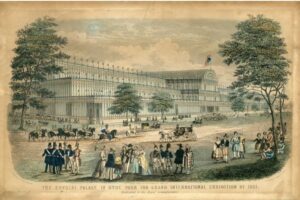
The specific notion of displaying industrial development linked to the arts, manufacture and commerce can be traced back to earlier times, but in particular the British Royal Society of Arts under the patronage of Queen Victoria’s consort Prince Albert sponsored a Great Exhibition for the works of industry of all nations, culminating in the building of the Crystal Palace. The Crystal Palace, constructed at London’s Hyde Park in 1851, began an international exhibition movement of fifty similar huge lightweight structures which could be built quickly using prefabricated materials of galvanised cast-iron, glass and laminated timber. The Crystal Palace was a large cathedral like building with a long hall, with aisles on either side and a central dome. With so much glass used in its walls and ceilings it did not require internal lights. After the London International Exhibition, the building was taken down and rebuilt in the outer suburb of Sydenham where it was used to house many more major events, but over time with lack of maintenance, decline set in. A small accidental fire in November 1936 eventually engulfed the building which was totally destroyed. The name is perpetuated by a famous football club from this region.
New South Wales sent a selection of products which were displayed at the 1851 London International Exhibition including samples of native timbers, wool, wine and surprisingly a local invention the ‘Boomerang Propeller’ patented in 1853 by Sir Thomas Mitchell, the Surveyor-General of NSW. Its boomerang design reduced water resistance resulting in increased speed and less fuel consumption than obtained from conventional propellers. Also included in the display was a model of the dry docks at Cockatoo Island.
The Garden Palace
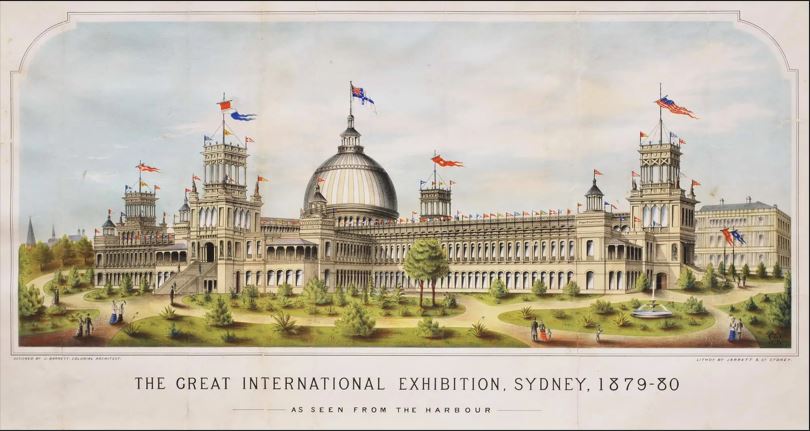
The Australian experience was based on the Crystal Palace design but with less glass. Using the newly available electric light, work on the Sydney Garden Palace, built at the Domain, was carried out around the clock involving 3000 workmen. The hugely impressive domed Garden Palace, three times the size of the extant Queen Victoria Building, was built in just eight months, at a cost of £191,000 or $400M at today’s (2024) prices.
This palace was to accommodate the Sydney International Exhibition of 1879 which attracted local exhibits and others from around the world. It was a great success. being visited by over one million visitors, a phenomenal figure for those days.
With countries from around the world invited to provide exhibits, most of course came from Great Britain as the centre of the Empire but another significant contributor was the Republic of France. French support was assisted by contacts known to Jules Francois de Sales Joubert. The son of a naval officer, Joubert first came to our shores as a passenger in a French frigate and remained, starting a successful merchant business. Accordingly, the French naval transport Le Rhinarrived in Sydney on 4 August 1870 with works of art and materials which advertised the great French nation. Le Rhinwas under the command of Capitaine Adolphe Francois Mathieu who was also titled the Commissioner-General of France for the Sydney International Exhibition.
Hot on the heels of Sydney’s success, Melbourne had its own International Exhibition with the Royal Exhibition Building rising in Carlton Gardens in time to host the Melbourne International Exhibition 1880 – 1881 and then the Centennial International Exhibition in 1888, and the formal opening of the first Parliament of Australia in 1901. For the next 26 years the building housed the Victorian State Parliament whilst their parliament house was loaned to the Federal Parliament until facilities were available in Canberra.
The Melbourne Royal Exhibition Building remains to this day but not so Sydney’s Garden Palace which was burnt to the ground in the early hours of 22 September1882, only three years after opening. The fire was devastating, and although the local fire brigades were assisted by seamen from ships in the harbour, it was beyond containment. Not only was the building lost but all of its contents were destroyed, containing public records relating to the 1881 census and including significant specimens and artefacts gathered as the foundation collection to a national museum. So ferocious was the fire that the windows in the terraces along Macquarie Street cracked with the heat and debris was blown away as far afield as Elizabeth Bay. And the centrepiece under the dome, a bronze statue of the Queen/Empress, melted. The building does not appear to have been insured which was quite common in those times.
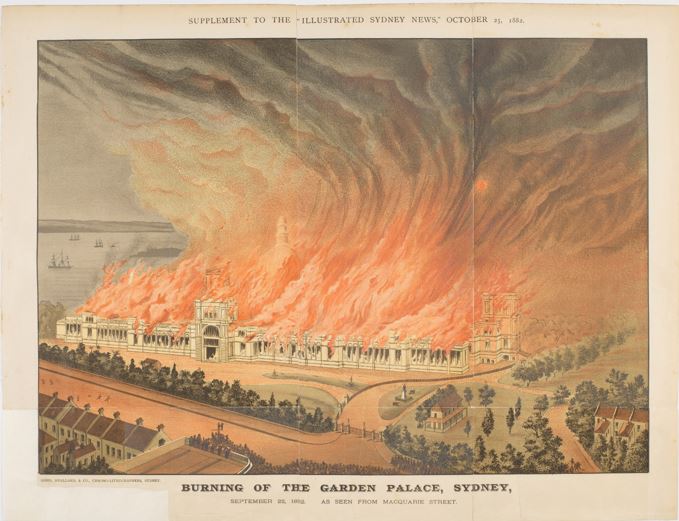
No one knows how the fire started on that fateful September morning, and despite an official enquiry no explanation was ever delivered. One theory blamed the wealthy residents of Macquarie Street, disgruntled at losing their harbour views. Another was that it was burnt to destroy records stored in the basement of the building that contained embarrassing details about the convict heritage of many distinguished families. The coroner did not make a conclusive finding on the cause of the fire, however the fact that work was being conducted under the floor of the basement in the day before the fire started, suggests a possibility that the fire was related to this work.
French Ship Le Rhin
Le Rhin was a composite sail and steam naval transport built at Rochefort in northern France, launched on 31 August 1855 and fitted out in November of that year.
She was 71.9 m in length, with a 12.9 m beam, a draught of 8 m, displaced 2916 tonnes, and was armed with two 14-cm cannons. To assist her sailing, she received auxiliary power from a 230 h.p. propeller driven engine built by Creusot. When in Australia her complement was 190 officers and men.
She first made several voyages from Toulon to support the war in Crimea and the subsequent war with Italy. In December 1859 she sailed for China, not returning to France until September 1862. Again in Toulon for refit, new boilers were installed and in August 1863 she sailed for the South Seas and thence to the west coast of Mexico during another war. During the night of 3 February 1864 at Mazatlan she was struck by violent winds and driven on rocks. To make good repairs she was towed to San Francisco by the frigate Victoire.
Over the next few years she made several voyages from France to South America until she arrived in Brest in April 1869 and was again refitted with new machinery and boilers and her sail plan modified. From January 1872 to October 1876 the ship was engaged in a number of voyages taking convicts from France to New Caledonia.
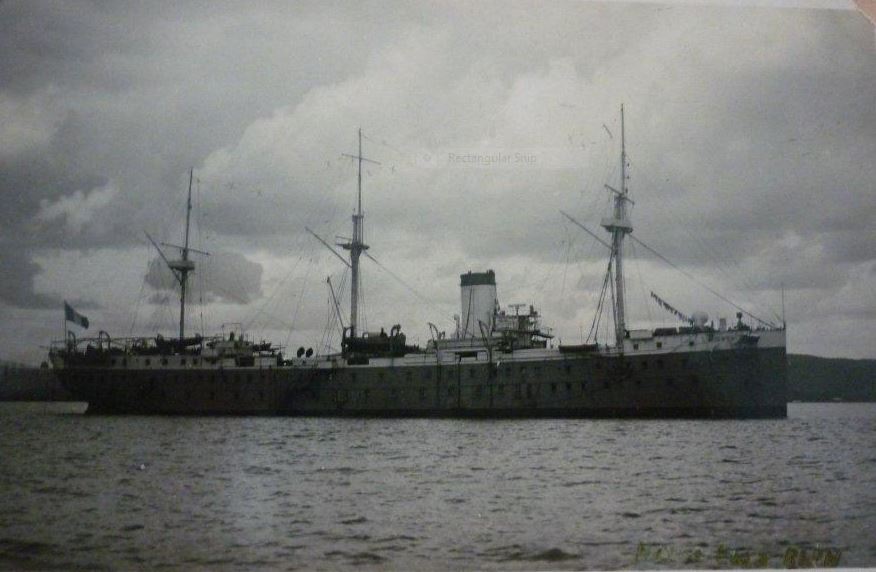
Following a period of layup and further refit Le Rhin sailed from Toulon carrying products for the Sydney International Exhibition arriving Sydney on 4 August 1879. She spent ten months moored in Port Jackson and it was not until 7 June that she sailed for Melbourne arriving in that city on 17 June 1880, this time she was carrying about 500 tons of products for the Melbourne International Exhibition. These were in addition to a large quantity of products that had been brought to Melbourne in the French steamer Finislore.
Her visit was memorable for a Grand Ball held in the ship on 15 October 1879 to which the who’s who of society was invited and was considered one of the liveliest occasions held in the colony. This was followed a few days later by a ‘Sailors Dinner’ on 20 October, to which representatives of the ships of the Australian Squadron were invited. And a somewhat premature Farewell Ball was held on 30 January 1880.
On Monday 7 June 1880 on her departure from Port Jackson Le Rhin fired a 21-gun salute which was returned by the Dawes Point battery. HM Ships Wolverine and Emerald also exchanged salutes with the Frenchman and the crews heartily cheered each other. She was accompanied to the Heads by the steamer Princess amply filled with well-wishers, which had been especially chartered for the occasion.
The stay at the southern city was of a much less duration with Le Rhin departing Melbourne on 13 July taking with her a consignment of South Australian wines for consideration by French wine merchants. The departure was not without incident as we have a copy of a letter from her commander when leaving our shores which appears in the Tasmanian House of Assembly regarding ‘Lighthouse Services’.
On board Le Rhin 14 July 1880, 2.30 pm
My Dear Beechet,
We are near the lighthouse on Deal Island, one of the Kent Group. A boat having made signals we stopped, and the keeper of the lighthouse came on board.
For a fortnight the men of the lighthouse had been waiting for rations, and they were on the point of starvation. We gave them what we thought would be most useful – wine, brandy, salt beef, biscuits, flour and haricot beans; to which supplies the officers, including your friend, added fresh vegetables, coffee and sugar.
The unfortunate Keeper has a wife and several children, so I sent them a lot of nice cakes, which my cook Chevel is exceedingly clever in making.
I thought I had left Australia for ever, but it was not to be, and I take advantage of this opportunity to ask you again to tell my friends that never, never will I forget them, and that my heart is still in Australia.
Au revoir, my dear Beechet, with the liveliest remembrance of your good fellowship.
- Mathieu.
(It is assumed that this letter addressed to a friend in Hobart was passed to another steamer)
Le Rhin returned via Cape Horn to Toulon where she was laid up in March 1881. The elderly lady was not finished yet and was fitted out again and departed Toulon carrying passengers between Madagascar and Réunion. The ship was condemned on 5 June 1886 and first used as a collier and later as a depot ship for torpedo boats of the 1st Ocean Flotilla at Lezardrieux (north west coast) until 1910 when she was sold out of service. All told a remarkable service life of 55 years.
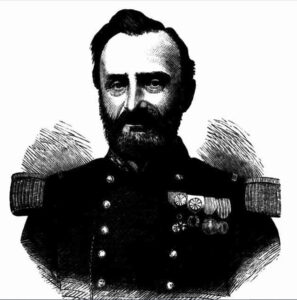
Capitaine de Vaisseau Adolphe Francois Mathieu
Adolphe Francois Mathieu was born in Paris on 6 April 1827. From the earliest age he showed an aptitude for mathematics and when barely 15 years old carried off the prize at the general concourse of all Paris schools with his work being published in the Scientific Review. Besides his liking of mathematics, the young scholar enjoyed geographical studies and in particular the works of the celebrated explorer Dumont d’Urville which caused him to leave college in favour of the naval school. He was appointed as midshipman on 16 August 1844, Ensign on 1 October 1848, Lieutenant 3 February 1855, Commander 7 March 1868 and Captain 29 January 1879.
From 1844 to 1848 he served in the sloops Coetlogon and Marceau in Tahiti and the Marquesas where there were a number of disturbances with the Bishop hemmed in by cannibal tribes. Mathieu was one of the first to come to the rescue of the venerable missionary. After a short return home, he was once more in the Pacific, serving in Durance, Cocyle, Thistle and in command of the corvette Thetis. In 1852 Admiral Bonard selected Mathieu as his chief of staff, being involved in the difficult task of managing the settlements of Tahiti and her dependencies.
From the Pacific Mathieu was removed to French Guyana where he served in Armide, Vedette and Marceau. Again he was made chief of staff, but his efforts were frustrated when fever compelled him to return home. After recovery he sailed for the West Indies in Cleopatra, with Admiral de Guesdou, one of the most distinguished French seamen of the day.
On leaving the Caribbean the now Commander Mathieu took an active part in the Italian campaign, during which he was made Knight of the Legion of Honour, as well as decorated by the Italian Government. During this campaign he showed particular superiority as an engineer, suggesting improvements to his own vessel as well as the other steamships of the squadron. For this he received special commendation and was appointed to command the steam frigate Coet Logeu. This vessel made rapid passage from France to New Caledonia where during the next four years he rendered services to that settlement. During this period Mathieu became acquainted with the social and progressive institutions of Australia, for which he declared unqualified admiration.
Next, Commander Mathieu was invited to join the staff of Admiral Guillain, Governor of New Caledonia, first as aide-de-camp, then staff commander, and subsequently colonial secretary. Here he attempted to introduce ideas he had witnessed in Australia to some of the more liberal institutions. In 1866 Commander Mathieu visited Melbourne and the Victorian gold-fields. On his return Mathieu proceed to the northern part of colony where civil unrest threatened the safety of the inhabitants but this was successfully resolved. At this period Mathieu thought seriously of changing his naval career for one in colonial administration. But the timing was not opportune as the term in office of his mentor, Admiral Guillain, was about to expire, and perhaps the opinions of Commander Mathieu were too liberal to suit the French colony at this stage of its development.
Upon his return to France he was posted to the Jeanne d’Arc serving in the Mediterranean where he received recognition with advancement to an officer of the Legion of Honour. From here he was posted in command of the training school ship Cornelie and later to Entreprenant on a voyage of inspection to Senegal, the West Indies and Guyana.
He was a disciple of Whitehead and had devoted time to the study of torpedoes, and although after such a lengthy period of active service and 50 years of age he might have expected some restful pursuits, he patiently sat out all the lectures at Beyardville, the school of submarine warfare. He soon mastered this art and his reports on the topic attracted much attention so that he was honoured to be appointed a member of the Commission of Torpedoes which was reporting on coastal defences, and was promoted to the rank of captain.
When considering senior appointments for the Sydney International Exhibition the reports from the ex-Colonial Secretary of New Caledonia were not forgotten, nor was the nickname given to him by his naval colleagues, being known as the ‘Australian’. Accordingly, Capitaine Mathieu was appointed to command the transport Le Rhin, and given the further title of Commissary-General.
In his private life Mathieu would have had considerable association with the Australian community then prevalent in New Caledonia, as the then 43-year-old Commander Mathieu married the 17-year-old Agnes Elizabeth McCulloch in Noumea on 9 April 1870. Her father Andrew McCulloch was a grazier, shipowner and politician in New South Wales. The marriage produced one daughter but tragically Agnes died. The captain later remarried, with his second wife coming from the Caribbean French colony of Guadaloupe, and they had a son. Both mother and son remained in France whilst he was in Australia.
He was appointed Officer of the Legion of Honour and held the Colonial Medal with clasps Nouvelle-Calédonie, Algérie, and Iles de la Société. Capitaine Mathieu died in Brest on 7 September 1912.
Summary
Like many great disasters involving political intrigue blame and responsibility are features of disguise which go undiscovered. This story serves to demonstrate the fragility of the memory of great historic events. Few Sydneysiders can now recall hearing of the Garden Palace, the Sydney International Exhibition, or the great fire that engulfed this cathedral like structure. As for a French naval ship that remained moored in Sydney Harbour for ten months, and rescued a lighthouse keeper – what was her name!
The Sydney International Exhibition did however achieve its noble aim in promoting the products and industry of New South Wales and in turn becoming more aware of the latest products and industrial innovations of America and Europe. As an entertainment it was seen by over half the population of the colony who thought it a grand building and occasioned a great outing on a scale not previously seen. Resulting from the Exhibition trade increased and the world became more aware of these New World colonies and it helped decreased their isolation.
References
Jogerst, Gilles, French Naval Biographies, available online, 2024.
La Perouse Museum & Headland Trust newsletter 14 July 2022, Randwick City Council.
Tasmanian House of Assembly record dated 17 August 1880 – Ocean Lighthouse Service.
Trove – various newspaper of those times.
Webb, Joan, Eccleston Du Faur – Man of Vision, Deerubbin Press, Sydney, 2004.
Young, Linda. Let Them See How Like England We Can Be – An account of the Sydney International Exhibition 1879, Thesis for MA degree, University of Sydney, June 1983.