- Author
- A.N. Other
- Subjects
- History - general, Ship histories and stories, Royal Navy
- Tags
-
- RAN Ships
- None noted.
- Publication
- December 2024 edition of the Naval Historical Review (all rights reserved)
By Ray Atkinson
In the latter part of those long-gone times when Britain and its colonies ruled the waves, prospective ships’ officers were trained at a number of pre-sea training schools. In the UK, one of those training establishments was HMS Worcester. Over the years there were three separate training vessels, Worcester I, Worcester II and Worcester III; all of them claimed London’s Thames as home.
Worcester I arrived at her moorings in the Blackwall reach of the river Thames on Thursday 29 May 1862. She moved to Erith on 8 September 1863 and to Southend in June 1869. From there she was moved to permanent moorings off Greenhithe, Kent in December 1871; all future Worcester training vessels would also be moored off Greenhithe. Worcester I had been funded by a group of London based shipowners, underwriters and merchants who felt the need for pre-sea training for potential officers in both the Royal and Merchant Navies.
The first Worcester was a 1473 ton, 50 gun (32-pounder medium guns) wooden frigate built at the Deptford Naval yard in 1843. The objective was to train young officer cadets and midshipmen for the Merchant Navy, Royal Navy and Royal Naval Reserve. Her first 18 cadets joined in August 1862 and a further four followed quickly. Found to be too small, Worcester I was replaced by an old two deck ship–of-the-line; Worcester I was handed back to the Admiralty in 1876 and was succeeded by Worcester II, the former Frederick William.
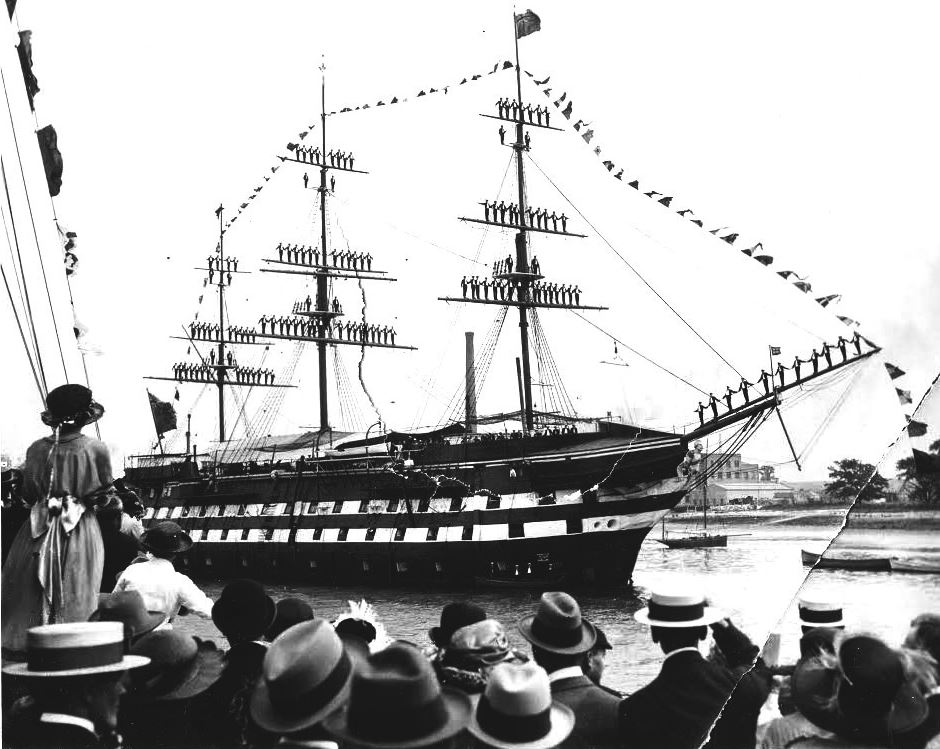
In 1833, the keel was laid for the Royal Sovereign, which eventually became Worcester II; she was initially designed as a 4725 ton battleship and converted to steam while still on the stocks at Portsmouth. Laid-down as a three-decker and mounting 110 guns, she took 27 years to build. She was subsequently renamed Royal Frederick and then Frederick William as a compliment to the King of Prussia.
By 1859, her design had been altered and her armament increased to 116 guns. Later that year armaments were reduced, decks scaled back to two, and engines, boilers and a propeller installed. She was launched with 86 guns and 500 HP engines; she was immediately added to the Reserve Fleet because her technology was outdated and new iron-clad vessels were nearing completion. She saw sea service briefly between 1866 and 1868 as a coastguard vessel and, after gun removal, served as HMS Worcester for some 70 valuable years. Worcester II usually catered for between 150 and 155 cadets. With the onset of war in 1939, Worcester cadets were moved ashore to Footscray Place near Sidcup, and the ship was handed back to the Admiralty.
After the war the Admiralty had sold Worcester II and the grand old lady was to be broken up. But on 30 August 1948 while lying at her moorings in the Thames she unexpectedly turned over and sank into the mud; the three shipkeepers aboard escaped. It was not until May 1953 that she was raised and finally broken up.
Worcester III had been purpose-built in 1905 as a school ship for the London County Council (as it was then called). She was initially designed for up to 750 boys, and was first used for some 600 ratings. During the Second World-War (1939-45) she had served under the White Ensign as a minesweeper depot ship and was moored at Scapa Flow; a safe, largely land-locked anchorage in the Orkney Islands off Northern Scotland. Following demobilisation she was repositioned to the Thames in mid-1945 and prepared for her first post-war intake of young men for officer training. From January 1946 she quite comfortably accommodated some 200 cadets. Upon joining the ship cadets automatically became members of the Royal Navy Reserve (RNR).
The famous clipper Cutty Sark was acquired by the Worcester in 1938, and moored close to her throughout the Second World War and beyond. During the war, Cutty Sark was used for seamanship classes; in 1954 she was moved the short distance from Greenhithe to Greenwich, where she forms a significant part of the National Maritime Museum. When I attended Worcester (1958-1959) we slept in hammocks made from the sails of the Cutty Sark.
Cutty Sark was a tea clipper, one of the world’s most famous ships. She was built in Dumbarton, Scotland in 1869, specifically for the tea trade from China; nevertheless London was her home port. Tea had been enjoyed in Asia forcenturies, but it did not reach Britain until the 1650s. Initially hailed for its medicinal qualities, its use quickly spread to the general population, aided somewhat by an extensive smuggling network. The tax on tea was slashed which ended the smuggling, and by the early 19th century, working families were consuming the beverage at least twice daily (many British people still do!). Tea importation was a huge business which spurred the ‘Great Tea Clipper Races’ and intense competition to arrive first from China to London in the season and gain the best prices for your cargo. On her maiden voyage in May 1870, the ship made it to London from Shanghai in some three and a half months.
With steamers taking over the tea trade and utilising the newly opened Suez Canal, Cutty Sark was repositioned into the Australian wool trade in 1883 and in 1886 the ship achieved a record for the passage from Sydney to London of just 73 days. After being used as a cadet training vessel in the port of Falmouth, Cutty Sark was gifted to Worcester where she continued her career as a training vessel as an adjunct to the Worcester.
There have been many notable Worcester graduates over the years. The famous Admiral Tojo of Japan was a Worcester Cadet in 1873, graduating second in his class the following year. He was renowned as commander in chief for the victory over the Russian fleet in 1905, a battle which ended the Russo-Japanese war and which shattered for all time Russia’s hope of mastery of the sea.
Tojo was promoted to Admiral of the Fleet of the Imperial Japanese Navy and, when he attended the coronation of George V in 1911, he donated his 1905 battle ensign to Worcester.
Following the Great War, now usually referred to as World War I, there were many ex-Worcester cadets granted gallantry awards and honours; this included two Victoria Crosses, an Albert Medal, some 51 Distinguished Service Orders, 52 Distinguished Service Crosses, nine Distinguished Flying Crosses, 46 Military Crosses, three Airforce Crosses, five Distinguished Service Medals, one Distinguished Conduct Medal and one Military Medal. There were also 87 persons mentioned in despatches and 87 foreign awards, some of which were multiple awards to a single person.
Five of the Old Worcesters (OWs) were knighted, including three Admirals and two Air Chief Marshals. In addition to the above, the First World War saw some 87 honours bestowed to OWs when their actions were away from the immediate battlefield or face to face action with the enemy (Tony Maskell OW).
With respect to World War II, Tony Maskell also records that of the 1907 Cadets that left Worcester between 1920 and 1945, 537 of them joined the Royal Navy in its various shades (RN, RNR, RNVR, RCN, RIN, RAN, RNZN, and the Royal Marines); of these 38 were killed in action.
On land, 128 ex-cadets joined the army, with two KIA. The Air Force attracted 145 ex-cadets; 10 died in action, while 20% of cadets remained at sea with the Merchant Service. Of these, 144 men perished either at sea or in bombing raids on harbours, both in the UK and overseas.
The Thames Nautical Training College HMS Worcester closed at the end of summer term in 1968, but continued to be used by some shipping lines until training was moved ashore in 1974, finally departing her moorings on Saturday, 8 July 1978 bound for razor blades in Belgium.
My thanks to the following OWs: G.K.C. Smith, Tony Maskell, Martin Tregoning and many others.
Ray Atkinson, CFP, MBA, Master Mariner F.G. (OW 58-59) now resides in Melbourne, Australia.